

The 2026 CPD Mandate: Integrating AI Competence into South African Legal Training
Discover how to prepare your South African law firm for mandatory 2026 AI compliance standards.
The landscape of legal practice in South Africa is undergoing its most significant regulatory shift in decades. As the Legal Practice Council (LPC) moves closer to embedding formal technological standards into professional development, attorneys must prepare for mandatory compliance.
According to recent sector surveys, 68% of legal practitioners in South Africa lack formal training in AI ethics and prompt engineering, despite looming regulatory deadlines. With the introduction of the Draft National AI Policy, the era of treating artificial intelligence as an optional, novelty tool is officially over.
South African law firms must now proactively align their operational habits with emerging legal tech south africa frameworks. Failing to adapt does not just mean falling behind technologically—it means risking disciplinary action under updated Continuing Professional Development (CPD) guidelines.
Table of Contents
- The Regulatory Shift: The 2026 CPD Compliance Landscape
- The Non-Delegable Duty: Human-in-the-Loop Verification
- Building a Compliant Law Firm AI Governance Framework
- POPIA and Cross-Border Data Transfer Challenges
- Practical AI Training Modules for Modern Firms
- Take the Next Step
- Frequently Asked Questions
- Recommended
Quick Summary
| Key Takeaway | Practical Explanation for Law Firms |
|---|---|
| CPD Integration | The LPC is actively aligning technological competence with mandatory CPD structures. |
| Non-Delegable Duty | Attorneys remain personally liable for any deep-seated errors or fabrications in AI outputs. |
| POPIA Restrictions | Free AI models violate South African privacy laws regarding cross-border data transfer. |
| Enterprise Governance | Firms must institute formal, written policies blacklisting consumer-grade AI tools. |
| Active CPD Auditing | Proactive practical training is the only safeguard against future professional indemnity claims. |
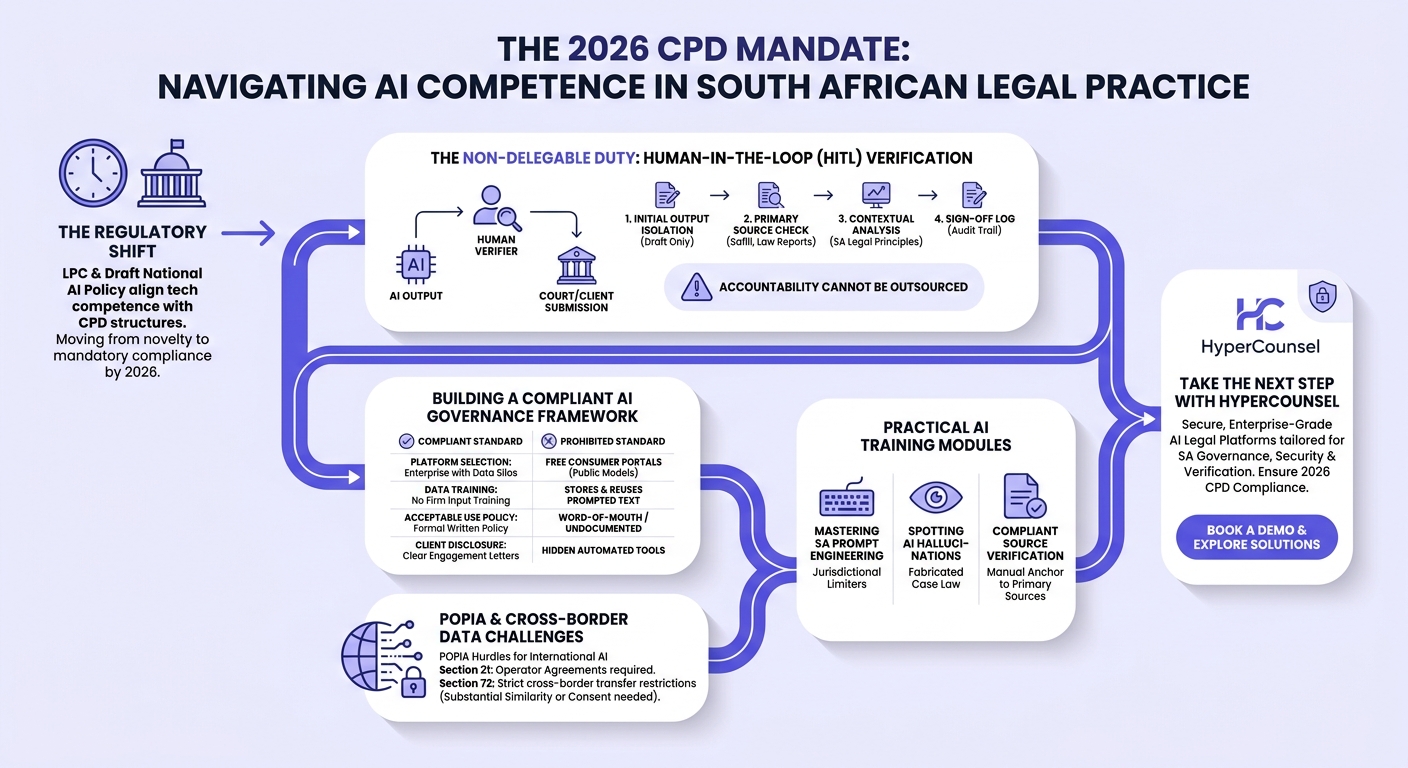
The Regulatory Shift: The 2026 CPD Compliance Landscape
The LPC is signaling a major overhaul in how technological competency is assessed. Under evolving structures, including Regulation 6(10) frameworks historically focused on Information and Communications Technology (ICT) and cyber law, legal practitioners will soon be required to demonstrate ongoing competence in foundational AI applications.
This shift is heavily informed by broader state initiatives. The Draft South Africa National Artificial Intelligence (AI) Policy focuses on a risk-based, rights-focused governance framework. As this policy progresses toward full Cabinet approval, regulatory bodies like the LPC are updating their guidelines to ensure legal professionals do not deploy automated systems blindly.
The Non-Delegable Duty: Human-in-the-Loop Verification
One of the most critical ethical directives coming from the LPC and legal scholars is that professional accountability cannot be outsourced to software. This principle is reinforced by international precedents, such as the Ayinde v Haringey principles, which discourage blind reliance on unverified digital research.

South African practitioners have a strict, non-delegable duty to verify all AI-generated outputs before they are submitted to a court or delivered to a client. To stay compliant with ethical standards, firms must utilize structured human-in-the-loop (HITL) verification protocols.
Recommended
Building a Compliant Law Firm AI Governance Framework
To mitigate the risk of ethics violations, law firms must establish a robust internal AI governance framework. Utilizing free, web-based models introduces massive liability. Firms must replace consumer-grade applications with enterprise-grade legal tech systems that guarantee data containment.
| Governance Element | Compliant Standard | Prohibited Standard |
|---|---|---|
| Platform Selection | Enterprise-grade systems with absolute data privacy silos. | Free consumer portals (e.g., public, unpaid ChatGPT). |
| Data Training | Models that do not use firm inputs to train global algorithms. | Platforms that store and reuse prompted text. |
| Acceptable Use Policy | Formal, signed written policy detailing approved use cases. | Word-of-mouth guidelines or undocumented usage. |
| Client Disclosure | Clear engagement letters outlining safe AI usage for research. | Hidden usage of automated generation tools. |
POPIA and Cross-Border Data Transfer Challenges
The Protection of Personal Information Act (POPIA) presents significant hurdles for South African law firms adopting international AI platforms. Because many of the world's leading LLMs (Large Language Models) process operations on servers located in North America or Europe, absolute compliance is critical.
- Section 21 Operator Agreements: Under POPIA, AI vendors act as "operators" processing personal information on behalf of the firm (the responsible party). Firms must secure written, signed Section 21 agreements ensuring the vendor protects patient, client, and proprietary data.
- Section 72 Restrictions: POPIA strictly regulates cross-border transfers of personal information. If an AI platform processes data outside South Africa, the destination country must have data privacy laws offering a level of protection substantially similar to POPIA, or the client must explicitly consent to the transfer.
Practical AI Training Modules for Modern Firms
To meet the impending 2026 CPD targets, forward-thinking South African law firms are organizing systemic internal training modules. Rather than treating AI training as a one-off IT seminar, firms should integrate it directly into their professional development calendars.
- Mastering South African Prompt Engineering: Training lawyers to input precise parameters, jurisdictional limiters (e.g., "apply South African common law"), and specific role prompts to minimize algorithmic drift.
- Spotting AI Hallucinations: Practical workshops designed to train junior associates to identify fabricated case law, incorrect citations, and logical gaps within automated drafts.
- Compliant Source Verification: Establishing firm-wide habits where every document is manually anchored to verified primary-source documents.
Take the Next Step
Preparing your firm for the incoming 2026 CPD standards does not have to be an administrative or financial burden. By integrating specialized legal tech south africa solutions early, your firm can convert compliance requirements into a competitive business advantage.
HyperCounsel provides state-of-the-art AI legal platforms tailored specifically to strict governance, security, and verification requirements. Secure transparent, fixed-price access to advanced enterprise tools and ensure your practitioners remain fully compliant under the latest LPC guidance.
To discover how we can help your legal practice stay ahead of the curve, Book a Demo or explore our tailored solutions today.
Frequently Asked Questions
This article provides general information and is not legal advice.
What is the 2026 CPD deadline for AI competence in South African legal practice?
The Legal Practice Council is progressively aligning CPD requirements and Regulation 6(10) training guides to require South African attorneys to demonstrate ongoing tech competency, with formal training integrations anticipated by 2026.
Do South African lawyers need to verify AI-generated court submissions before filing?
Yes. South African practitioners hold a non-delegable ethical duty to verify all AI outputs. Presenting fabricated citations or unchecked claims to a court constitutes a major professional breach.
Can law firms use free AI tools like ChatGPT for legal research under new CPD rules?
No. Free consumer-grade AI platforms typically store prompt data to train public models, violating POPIA privacy guidelines and failing the strict security thresholds required for compliant legal practice.
How does POPIA affect cross-border data transfers when using international AI models?
Under Section 72 of POPIA, transfers of personal data across borders are prohibited unless the recipient is subject to similar data protection laws, or the client explicitly consents. Enterprise-grade contracts with appropriate transfer clauses are essential.