

AI Contract Review for Tech Law Firms in Nigeria: Modernizing Due Diligence and Deal Practice
Learn how Nigerian tech law firms use AI contract review to accelerate diligence and closing cycles.
Deal velocity across West Africa is accelerating rapidly, placing intense pressure on commercial practices to deliver faster contract turnarounds without compromising precision. Transaction monitoring reports indicate that over 70% of transactional bottlenecks in early-stage financing and cross-border mergers and acquisitions stem from manual document review and diligence backlogs.
For leading tech law firms in nigeria, adopting artificial intelligence for contract review has transformed from an experimental advantage into a core operational standard. Progressive corporate clients no longer tolerate multi-week review periods for standard transactional documents when closing rounds or executing commercial partnerships.
By augmenting seasoned legal oversight with specialized AI workflows, corporate teams can shorten diligence cycles, ensure strict compliance with domestic privacy regulations, and scale client delivery. Modern platforms like HyperCounsel allow legal practitioners to maintain high-precision risk spotting while offering competitive, predictable fee structures.
Table of Contents
- The Shift to AI-Assisted Review in Nigerian Deal Practice
- Core Diligence Use Cases for Commercial Transactions
- Navigating NDPC Compliance and Data Privacy Standards
- Step-by-Step Implementation for Transactional Teams
- Common Pitfalls and Best Practices in Deal Automation
- Scale Your Deal Practice with HyperCounsel
- Frequently Asked Questions
- Recommended
Quick Summary
| Takeaway | Explanation |
|---|---|
| Accelerated Turnaround | AI review reduces initial contract diligence time by up to 60%, speeding up closing cycles. |
| Augmented Precision | First-pass issue spotting identifies non-standard indemnities, change of control, and liability caps. |
| Data Protection Compliance | Diligence workflows must strictly follow the Nigeria Data Protection Act and NDPC regulatory guidance. |
| Playbook Standardization | Automated clause comparison ensures consistent risk tolerance across multi-lawyer transaction teams. |
| Lawyer-in-the-Loop | AI augments diligence without replacing Nigerian legal counsel's judgment on enforceability and local practice. |
The Shift to AI-Assisted Review in Nigerian Deal Practice
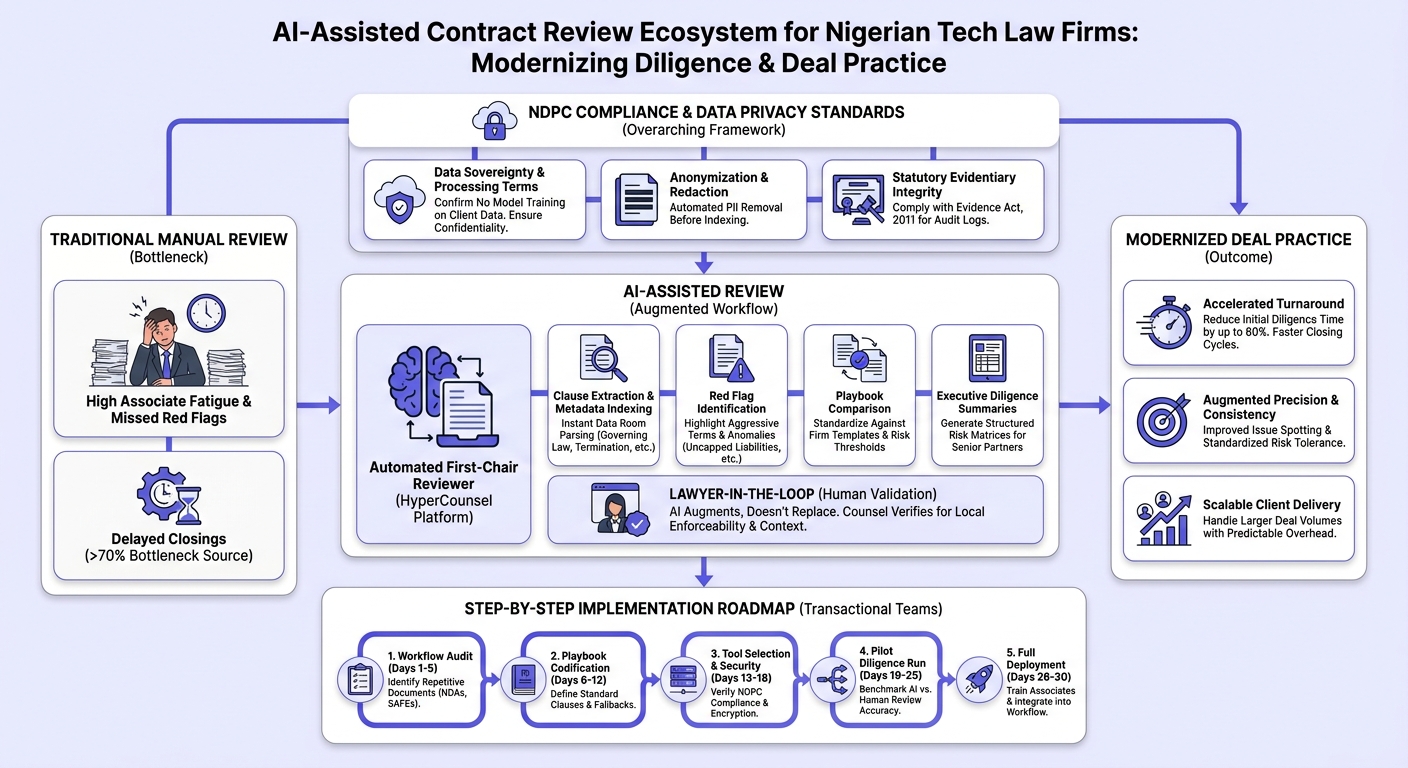
Commercial law firms in Lagos, Abuja, and regional commercial hubs handle increasingly complex financing rounds, cross-border joint ventures, and technology vendor contracts. Traditional manual review requires associates to spend dozens of billable hours parsing through hundreds of pages of ancillary agreements, disclosure schedules, and standard corporate documentation.
This manual approach introduces two critical vulnerabilities: associate fatigue leading to missed red flags, and delayed deal closings that frustrate founders and investors. Modern tech-focused law practices are redefining this workflow by adopting AI-assisted document review.
Rather than replacing legal expertise, artificial intelligence acts as an automated first-chair reviewer. It parses entire data rooms, extracts key terms, flags anomalous clauses, and highlights deviations from firm-approved standard terms within minutes. This shift allows senior lawyers to focus their time on strategic negotiation, deal structuring, and local enforceability analysis under Nigerian law.
Core Diligence Use Cases for Commercial Transactions
Integrating AI into transactional workflows enables legal teams to handle larger deal volumes with predictable overhead. Law firms deploy automated contract intelligence across several key transactional phases:

- Clause Extraction and Metadata Indexing: Instantly extract governing law clauses, dispute resolution forums, termination triggers, and assignment restrictions across hundreds of commercial agreements.
- Red Flag Identification: Highlight aggressive indemnification provisions, uncapped liabilities, non-standard restrictive covenants, or vague intellectual property assignment language.
- Playbook Comparison: Compare incoming vendor contracts or target company agreements against firm-standard templates and predefined institutional risk thresholds.
- Executive Diligence Summaries: Generate structured risk matrices and summaries for senior partners and clients, reducing the time required to prepare formal due diligence reports.
Navigating NDPC Compliance and Data Privacy Standards
Adopting technology tools in corporate practice requires rigorous alignment with Nigerian data protection and professional ethics standards. The statutory framework established under the Nigeria Data Protection Act (NDPA) and regulated by the Nigeria Data Protection Commission (NDPC) mandates strict security measures for personal and commercial data processing.
When using cloud-based AI tools for contract analysis, law firms must ensure that counterparty information, founder identities, and proprietary business secrets remain protected:
- Data Sovereignty and Processing Terms: Confirm whether data sent to the AI engine is used for model training. Enterprise legal tools must guarantee that client data remains strictly confidential and isolated.
- Anonymization and Redaction: Apply automated redaction to personally identifiable information (PII) before documents are indexed or summarized.
- Statutory Evidentiary Integrity: Ensure that electronic records and audit logs comply with the admissibility requirements under the Evidence Act, 2011 for electronic documents and digital trails.
Step-by-Step Implementation for Transactional Teams
Transitioning a corporate deal practice to an AI-augmented workflow requires a structured rollout to maintain quality control and data security.
| Stage | Action Items | Estimated Timeline |
|---|---|---|
| 1. Workflow Audit | Identify repetitive contract types (NDAs, SAFEs, vendor agreements, loan notes). | Days 1–5 |
| 2. Playbook Codification | Define standard clauses, acceptable risk ranges, and mandatory fallbacks. | Days 6–12 |
| 3. Tool Selection & Security | Verify enterprise encryption, zero-data-retention training policies, and NDPC compliance. | Days 13–18 |
| 4. Pilot Diligence Run | Run parallel human and AI reviews on a closed transaction to benchmark accuracy. | Days 19–25 |
| 5. Full Deployment | Train associates on prompt precision, issue verification, and summary exports. | Days 26–30 |
- Audit Common Transactional Documents: Pinpoint the high-volume agreements your firm reviews regularly, such as non-disclosure agreements, simple agreements for future equity (SAFEs), and employment contracts.
- Standardize Institutional Playbooks: Draft clear guidance on acceptable fallback provisions for key terms, including limitation of liability, governing law (e.g., Lagos State or English law), and dispute resolution mechanisms.
- Establish Human-in-the-Loop Validation: Require associates to verify every flagged clause and citation against the primary document before delivering advice to clients.
- Deploy Dedicated Legal Technology: Choose purpose-built legal platforms that integrate directly into existing document management systems rather than consumer-grade AI tools.
Common Pitfalls and Best Practices in Deal Automation
While AI contract review delivers substantial efficiency gains, missteps during implementation can compromise client outcomes and firm reputation.
- Using Consumer AI for Confidential Client Files: Free, public AI chatbots often store inputs for retraining, creating severe confidentiality breaches and regulatory non-compliance under NDPC rules.
- Overlooking Local Statutory Nuances: Generic AI models may not recognize mandatory provisions required under the Companies and Allied Matters Act (CAMA 2020) or local content regulations in specialized sectors like energy or fintech.
- Failing to Verify Citations: Automated summaries must always link back to specific page and clause numbers in source documents so reviewing lawyers can verify context instantly.
- Neglecting Change Management: Ensure associates understand that AI is designed to eliminate tedious mechanical review, empowering them to deliver higher-level legal analysis.
Scale Your Deal Practice with HyperCounsel
Modernizing contract diligence enables tech-focused law practices to deliver faster turnarounds, protect realization rates, and scale their client base with confidence. By adopting enterprise-grade legal AI workflows, your team can standardize risk spotting across every deal without adding administrative drag.
If your firm is ready to eliminate diligence bottlenecks, improve issue spotting, and deliver seamless client experiences, explore how HyperCounsel transforms modern transactional practice. Book a Demo to see automated contract review in action, or use our ROI Calculator to project your firm's annual time and cost savings.
Take the Next Step
Ready to protect your business with expert legal support? Explore how HyperCounsel can help:
Frequently Asked Questions
How does AI contract review fit into Nigerian deal practice?
AI contract review serves as an automated first-pass diligence assistant. It reads data room files, extracts standardized clauses, flags deviations from client playbooks, and compiles risk summaries, allowing lawyers to complete due diligence faster and with greater consistency.
What are the main risks lawyers should watch when using AI for contract review in Nigeria?
The primary risks include using unsecured tools that compromise client confidentiality, failing to catch Nigeria-specific statutory requirements under CAMA 2020, and relying on AI outputs without independent verification by qualified counsel.
How does data protection affect AI-assisted due diligence in Nigeria?
Under the Nigeria Data Protection Act, legal practitioners must ensure that client and counterparty personal data processed by AI tools is handled securely. Firms must verify data processing agreements, check cross-border transfer protections, and confirm that client data is not used to train public models.
Can AI replace lawyer review in a Nigerian transaction team?
No. AI is an augmentation tool that accelerates data extraction and red-flag identification. Final risk allocation, contextual negotiation, statutory interpretation, and enforceability opinions require the professional judgment of qualified Nigerian legal practitioners.