

AI Procurement for UK Law Firms: Meeting SRA AI Guidance and UK GDPR Requirements
Learn how UK law firms can safely procure AI while complying with SRA guidance and UK GDPR rules.
Law firms across the United Kingdom face growing pressure to streamline document review, legal research, and administrative tasks using modern technology. However, deploying generative tools requires strict alignment with professional obligations. Applying actionable sra ai guidance throughout your procurement process ensures your practice safely leverages software without compromising regulatory compliance.
According to market research, 79% of legal departments report increasing their year-on-year investments in legal technology, with budgets expanding significantly among firms adopting automated tools. Despite these rapid efficiency gains, the Solicitors Regulation Authority (SRA) makes it clear that solicitors remain fully accountable for all work delivered to clients, regardless of whether it was drafted by a fee earner or generated by an algorithm.
To navigate vendor evaluation without creating regulatory exposure, law practices must implement structured due diligence workflows. By aligning software procurement with SRA expectations and statutory UK GDPR data processor obligations, firm leaders can modernize their practices while protecting client privilege and operational integrity.
Table of Contents
- Quick Summary
- Understanding SRA AI Guidance and Regulatory Expectations
- UK GDPR Processor Due Diligence Framework
- Public vs Private AI Models: Confidentiality and Data Storage
- Essential Contractual Clauses for Legal AI Vendors
- AI Procurement Red Flags and Due Diligence Checklist
- Internal Governance: Roles, Approvals, and Documentation
- Streamline Your AI Vendor Due Diligence
- Frequently Asked Questions
- Recommended
Quick Summary
| Takeaway | Explanation |
|---|---|
| Regulatory Accountability | The SRA holds law firms and fee earners fully liable for the accuracy and confidentiality of AI-assisted legal work. |
| Mandatory Human Oversight | Fee earners must independently verify, supervise, and cross-check all AI-generated citations, analysis, and draft clauses. |
| Processor Due Diligence | Under UK GDPR Article 28, firms must perform pre-contract security and data governance checks on all software vendors. |
| Zero Model Training | Law firm vendor contracts must strictly prohibit client data from being used to train third-party foundation models. |
| Documented Governance | Regulators expect an auditable register of approved tools, risk assessments, and defined internal approval workflows. |
Understanding SRA AI Guidance and Regulatory Expectations
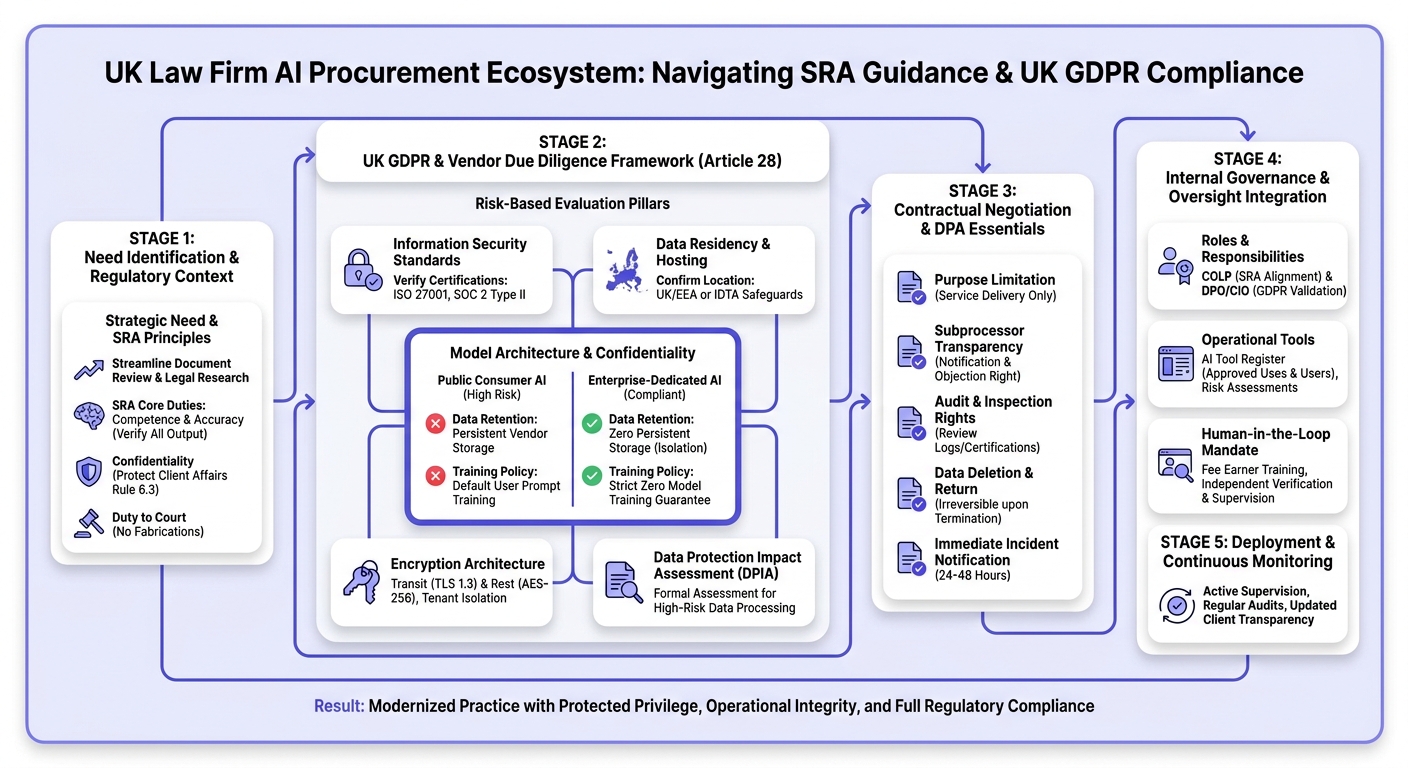
The Solicitors Regulation Authority sets clear expectations regarding the adoption of automated technology in regulated firms. As detailed in the SRA Warning Notice on AI Misuse, software tools do not replace the fundamental professional duty to act with competence, maintain confidentiality, and properly supervise legal services.
When procuring technology, firms must evaluate how a tool impacts core regulatory principles:
- Competence and Accuracy: Generative models are susceptible to hallucinations, creating fabricated case citations or statutory references. Fee earners must exercise active supervision and independent verification before any output reaches a client or court.
- Client Confidentiality: Solicitors have an absolute duty to protect client affairs under SRA Code of Conduct Rule 6.3. Passing unredacted client information through public or unverified AI platforms represents a direct breach of this duty.
- Duty to the Court: Submitting AI-generated court filings without verifying authorities violates professional conduct standards and risks severe regulatory sanctions.
- Transparency: Firms must remain transparent with clients about how automated tools are integrated into their matters, updating client care letters and engagement terms where necessary.
Practices implementing HyperCounsel benefit from built-in governance safeguards designed to align daily workflows directly with UK regulatory expectations.
UK GDPR Processor Due Diligence Framework
Under Article 28 of the UK GDPR, a law firm acts as a data controller, while the legal tech provider operates as a data processor. As noted in the ICO Guidance on Processor Due Diligence, controllers must only appoint processors that guarantee appropriate technical and organizational measures.

Before signing any software contract, firms must conduct a structured, risk-based evaluation covering 4 core pillars:
- Information Security Standards: Require verified certifications such as ISO/IEC 27001 or SOC 2 Type II compliance to validate system resilience.
- Data Residency and Hosting: Confirm whether client data remains within the UK or EEA, or if adequate transfer safeguards (such as the UK International Data Transfer Agreement) are established.
- Encryption Architecture: Ensure client data is encrypted both in transit (TLS 1.3) and at rest (AES-256), with strict tenant isolation protocols.
- Data Protection Impact Assessments (DPIA): Conduct a formal DPIA whenever introducing novel AI tools that process high volumes of sensitive or special-category data.
Public vs Private AI Models: Confidentiality and Data Storage
A primary distinction in software vetting is whether a tool runs on public consumer infrastructure or dedicated enterprise architecture. Law firms must understand these differences before granting access to firm documentation.
| Architecture Type | Client Data Retention | Model Training Policy | Regulatory Suitability for UK Law Firms |
|---|---|---|---|
| Public Consumer AI | Retained on vendor servers for review | User prompts train public models by default | High Risk: Violates SRA confidentiality and UK GDPR rules |
| Commercial API Integration | Temporary caching (often 30 days) | Opt-out available; training disabled by policy | Medium Risk: Requires strict contract terms and DPA addenda |
| Enterprise-Dedicated AI | Zero persistent storage; client tenant isolation | Strict contractual guarantee: zero model training | Compliant: Meets enterprise security and regulatory baselines |
When evaluating systems, legal operations teams must verify that vendor settings prevent prompts, uploaded briefs, and client communications from being ingested into broader public training sets.
Essential Contractual Clauses for Legal AI Vendors
Standard consumer terms of service are insufficient for law firm compliance. Any vendor agreement handling confidential legal files must incorporate robust Data Processing Addenda (DPAs) with specific legal protections:
- Purpose Limitation: Explicit language stating the vendor processes client information solely to provide the contracted service and for no ancillary purposes.
- Subprocessor Transparency: Advance written notification of any new subprocessor additions, with a unilateral right for the firm to object or terminate.
- Audit and Inspection Rights: Contractual authorization for the firm (or an independent auditor) to review compliance logs and security certifications.
- Data Deletion and Return: Clear procedures requiring the irreversible deletion of all law firm data upon contract termination or on-demand.
- Immediate Incident Notification: A mandatory requirement to notify the firm of any potential security or data breach within 24 to 48 hours.
AI Procurement Red Flags and Due Diligence Checklist
Evaluating software claims requires a critical eye. When screening vendors, watch for these common red flags:
- Vague Model Origins: Vendors unable to identify which underlying foundation models power their legal features.
- Ambiguous Training Clauses: "We may use anonymized metadata to enhance system performance" often serves as a loophole for data mining.
- Lack of Independent Security Audits: Relying solely on self-assessment questionnaires rather than verified third-party audit reports.
- Opaque Subprocessor Chains: Unclear third-party API dependencies that route data across unauthorized foreign jurisdictions.
5-Step Due Diligence Checklist
- Step 1: Technical Scoping: Determine whether the tool interacts with personal data, confidential matter files, or public information.
- Step 2: Architecture Verification: Confirm dedicated tenant hosting, zero-training commitments, and UK/EEA server hosting locations.
- Step 3: Security Validation: Review SOC 2 Type II reports, penetration test summaries, and encryption protocols.
- Step 4: Contract Negotiation: Secure custom DPA terms covering breach notifications, audit rights, and complete data deletion.
- Step 5: Governance Approval: Submit the DPIA and risk assessment to the COLP, CIO, or Data Protection Officer for formal sign-off.
Internal Governance: Roles, Approvals, and Documentation
Establishing clear internal oversight prevents shadow IT and ensures consistent compliance across practice areas. Regulators look favorably on firms that maintain disciplined internal controls:
- Compliance Officer for Legal Practice (COLP): Oversees alignment with SRA Standards and Regulations, ensuring tools do not compromise professional conduct.
- Data Protection Officer (DPO) / CIO: Validates UK GDPR compliance, evaluates system architecture, and monitors ongoing data security.
- AI Tool Register: Maintain a centralized register documenting every approved application, its permitted use cases, approved user groups, and renewal dates.
- Fee Earner Training: Deliver mandatory training on prompt safety, verification of citations, and the non-delegable nature of legal supervision.
Streamline Your AI Vendor Due Diligence
Navigating regulatory requirements and vendor due diligence does not have to stall your firm's modernization initiatives. By standardizing your procurement framework, you can deploy powerful legal automation with complete confidence in your compliance posture.
Discover how HyperCounsel equips UK legal practices with secure, enterprise-grade tools built specifically around professional standards and regulatory transparency. Book a Demo with our compliance specialists or Explore HyperCounsel Pricing to find the right deployment for your practice.
Take the Next Step
Ready to protect your business with expert legal support? Explore how HyperCounsel can help:
Frequently Asked Questions
What should a law firm check before buying an AI tool under UK GDPR?
Firms must verify the vendor's technical security measures (such as ISO 27001 or SOC 2 certification), data hosting locations, subprocessor lists, and data retention policies. A formal Data Protection Impact Assessment (DPIA) should be completed alongside an Article 28-compliant Data Processing Addendum.
Does the SRA require firms to have a formal AI policy or register?
While the SRA does not mandate a rigid template, firms are required under SRA supervision rules to maintain effective systems and controls. Maintaining an AI register, a firm-wide usage policy, and documented risk assessments is the standard way to prove regulatory compliance.
How should solicitors supervise AI-assisted legal work and third-party outputs?
Solicitors must treat AI outputs like work produced by an unadmitted junior paralegal. Every case citation, legal assertion, and drafted clause must be verified independently by a qualified lawyer before being shared with clients, counterparties, or courts.
What contract terms should be included when a vendor will process client data?
Agreements must include clear purpose limitations, strict prohibitions against using client data to train public models, rapid breach notification timelines (24–48 hours), enforceable audit rights, and clear terms for data return and irreversible deletion.