

SRA AI Guidance: How UK Law Firms Build Compliant AI Inventories and Controls
Learn how UK law firms build SRA-compliant AI inventories, usage logs, and governance controls.
Artificial intelligence has rapidly shifted from an experimental side project to an everyday workflow accelerator across the UK legal sector. Recent industry research reveals that 89% of legal professionals now use AI tools in some capacity, while only 27% of firms have embedded AI widely across the organisation. This disconnect creates a dangerous governance gap commonly known as shadow AI, where fee earners and support staff test unvetted platforms without formal oversight.
Navigating regulatory obligations requires more than an informal internal memo. Solicitors and law firm leaders must align everyday technology practices with official SRA AI guidance from the Solicitors Regulation Authority. Regulators expect firms to maintain active supervision, protect client confidentiality, and enforce robust systems and controls across all automated legal workflows.
Implementing firm-wide operational controls does not mean prohibiting innovation. By adopting practical governance systems—such as centralised software inventories, immutable usage logs, and structured training registers—practices powered by HyperCounsel can safely capture productivity gains while staying strictly compliant with regulatory standards.
Table of Contents
- SRA AI Guidance and Core Regulatory Expectations
- The Hidden Risks of Shadow AI in Legal Practice
- Building an SRA-Compliant AI Inventory
- Designing Audit-Ready AI Usage Logs
- Establishing Mandatory AI Training Registers
- Step-by-Step AI Governance Implementation Plan
- Common AI Compliance Mistakes Law Firms Make
- Operationalise Your SRA AI Compliance
- Frequently Asked Questions
- Recommended
Quick Summary
| Takeaway | Explanation |
|---|---|
| Regulatory Responsibility | The SRA holds solicitors directly accountable for all work product and client data security, regardless of whether AI tools generated or assisted the work. |
| Shadow AI Exposure | Unmonitored use of consumer generative AI creates critical liabilities under UK GDPR, client confidentiality rules, and professional indemnity insurance terms. |
| Software Inventories | Firms must maintain a living register of every approved tool, documenting vendor data retention policies, risk ratings, and assigned business owners. |
| Verification & Logging | Documenting human oversight and input validation provides an essential audit trail if output accuracy or data protection is challenged. |
| Staff Competence | SRA Standards and Regulations require firms to maintain verifiable training records demonstrating that staff understand prompt risks, hallucination tendencies, and ethical duties. |
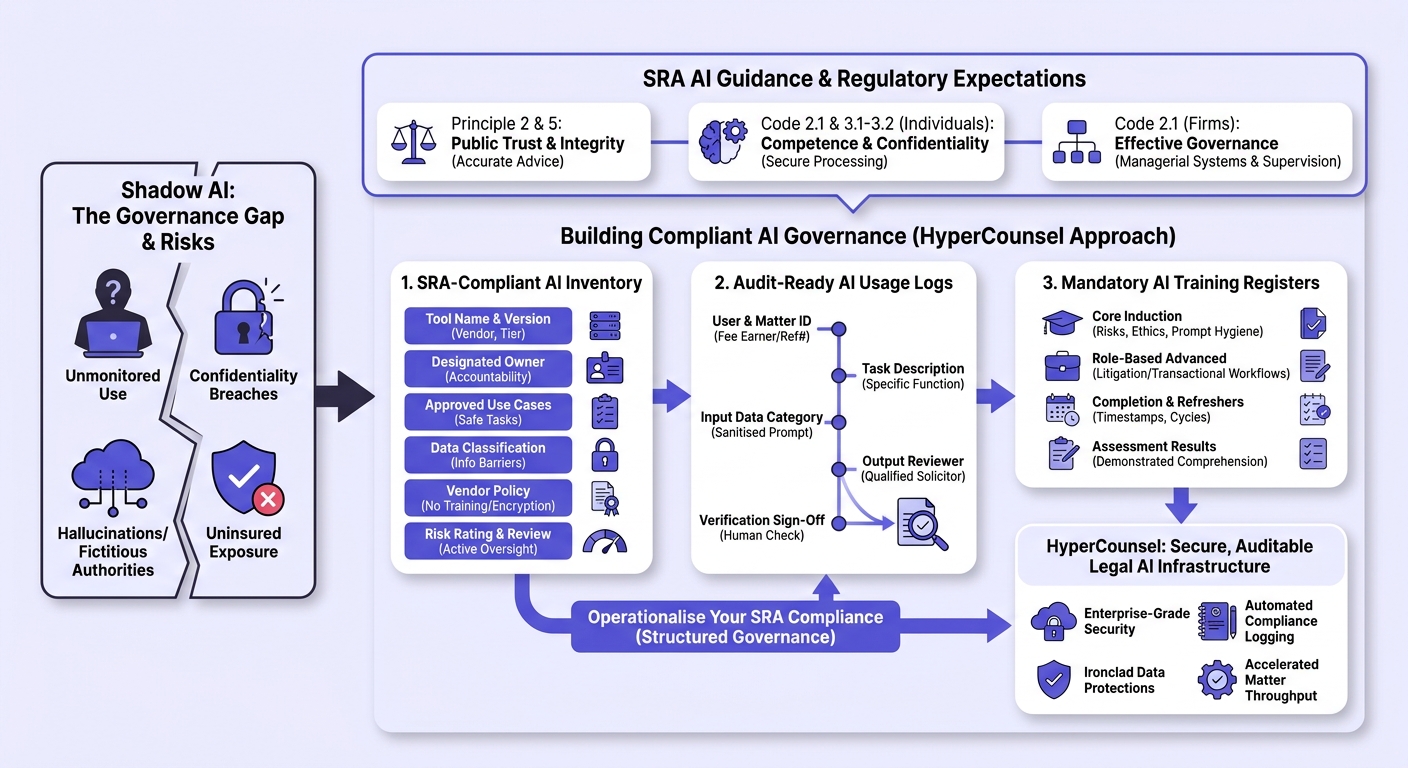
SRA AI Guidance and Core Regulatory Expectations
The Solicitors Regulation Authority does not prohibit law firms from adopting artificial intelligence. However, regulatory warning notices emphasise that technological tools do not dilute professional obligations. Under the SRA Code of Conduct, law firm managers and individual solicitors retain non-delegable duties to protect client confidentiality, provide a competent standard of service, and maintain effective governance systems.
Key regulatory principles governing AI deployment include:
- SRA Principle 2 and Principle 5: Upholding public trust and acting with integrity by ensuring automated tools do not generate misleading legal submissions or inaccurate advice.
- Paragraph 2.1 of the Code for Individuals: Maintaining professional competence by understanding the operational limits, biases, and error rates of any deployed system.
- Paragraph 3.1 and 3.2 of the Code for Individual Solicitors: Keeping client affairs confidential and ensuring third-party technology vendors do not process data insecurely or use client matters for model retraining.
- Paragraph 2.1 of the Code for Firms: Implementing clear managerial systems and supervisory frameworks that identify, monitor, and mitigate operational risks.
Compliance officers for legal practice (COLPs) and compliance officers for finance and administration (COFAs) must prove that supervision remains active at every stage of matter delivery.
The Hidden Risks of Shadow AI in Legal Practice
Shadow AI occurs when fee earners, paralegals, or administrative staff paste confidential client details, sensitive negotiation notes, or draft contracts into unapproved commercial AI platforms. While staff usually seek faster turnaround times, unmanaged tool adoption exposes law firms to severe operational risks.

Confidentiality and Data Breaches
Consumer AI applications frequently store user prompts to train baseline foundation models. Entering identifying client information into these tools constitutes an unauthorised disclosure under UK GDPR and violates Paragraph 6.3 of the SRA Code of Conduct.
Hallucinations and Fictitious Authorities
Generative models can generate plausible but entirely fabricated citations, statutory cross-references, or case precedents. Citing hallucinated authorities in court documents or client correspondence undermines professional credibility and invites formal disciplinary sanctions from the SRA and the judiciary.
Uninsured Commercial Exposure
Professional indemnity insurance (PII) policies often require firms to disclose technological risks and adhere to recognised quality standards. Operating without defined risk assessments or usage logs can complicate claims coverage following an AI-assisted malpractice incident.
Building an SRA-Compliant AI Inventory
A central requirement of modern legal risk management is maintaining a comprehensive AI inventory. This living register documents every software system deployed across the firm that incorporates machine learning, natural language processing, or automated generation features.
| Inventory Component | Purpose | Detail Required |
|---|---|---|
| Tool Name & Version | Identifies the exact application and deployment environment. | Software vendor, deployment tier (enterprise vs consumer), and hosting location. |
| Designated Owner | Establishes internal accountability. | Partner, COLP, or practice group head responsible for supervising usage. |
| Approved Use Cases | Restricts scope to safe tasks. | Permitted functions (e.g., initial research, draft summarisation) and explicitly banned tasks. |
| Data Classification Level | Enforces information barriers. | Clarifies whether confidential client data, anonymised text, or only public data may be processed. |
| Vendor Model Policies | Confirms confidentiality protections. | Verification that the vendor does not use firm data for model training and provides end-to-end encryption. |
| Risk Rating & Review Date | Ensures active operational oversight. | Risk tier (Low, Medium, High) and mandatory quarterly or semi-annual review deadlines. |
Firms should conduct periodic internal audits to discover unlisted tools and update their inventories as vendors roll out new generative features into standard office software suites.
Designing Audit-Ready AI Usage Logs
To satisfy SRA expectations regarding supervision and accountability, firms must be able to demonstrate when, why, and how automated tools contributed to client deliverables. A structured AI usage log provides the necessary paper trail to protect the firm during regulatory inquiries or client billing audits.
An effective usage log records five core data points:
- User and Matter Identifier: The fee earner handling the file and the corresponding internal matter reference number.
- Task Description: A concise record of the task performed, such as reviewing commercial lease clauses, drafting initial discovery indices, or structuring chronology outlines.
- Input Data Category: Confirmation that input prompts were sanitised or restricted to approved data tiers in line with internal policy.
- Output Reviewer: Identification of the qualified solicitor who independently reviewed, verified, and approved the resulting output.
- Verification Sign-Off: Explicit confirmation that citations, calculations, and statutory interpretations were cross-checked against authoritative legal sources.
Automating these logging workflows minimizes fee-earner administrative friction while ensuring compliance records remain accurate and accessible.
Establishing Mandatory AI Training Registers
Deploying governance policies without structured education leaves firms vulnerable to operational lapses. Regulators expect firms to deliver adequate training tailored to the specific tools fee earners use in their daily practice.
Your firm's AI training register should track:
- Core Induction Modules: Foundational training for all new joiners covering the risks of generative AI, prompt engineering hygiene, data sanitisation, and SRA ethics.
- Role-Based Advanced Modules: Specialised training for litigation teams on citation verification, or transactional teams on contract analysis tool workflows.
- Completion Timestamps and Refresher Schedules: Documented proof of course completion, with scheduled annual or bi-annual refreshers to account for rapid technological updates.
- Assessment Results: Records showing that participants demonstrated comprehension of hallucination risks, confidential data boundaries, and mandatory review protocols.
Maintaining detailed training logs allows the COLP to substantiate ongoing compliance during SRA thematic reviews or Lexcel audits.
Step-by-Step AI Governance Implementation Plan
Transitioning from informal tool adoption to an auditable governance framework can be achieved through five practical steps:
- Step 1: Conduct a Firm-Wide Technology Audit: Survey fee earners and support teams anonymously to uncover all current software usage, third-party browser extensions, and consumer AI accounts.
- Step 2: Formalise an Acceptable Use Policy (AUP): Draft clear, plain-English guidelines defining permitted AI platforms, prohibited prompt contents, and mandatory human review standards.
- Step 3: Deploy Centralised Software Controls: Consolidate tool access through enterprise-grade platforms that provide contractual guarantees against model retraining and maintain robust access logs.
- Step 4: Launch Role-Specific Training: Roll out mandatory educational modules across all practice areas, logging attendance and assessment results in the central register.
- Step 5: Schedule Quarterly Governance Reviews: Task the COLP and practice heads with reviewing audit logs, evaluating newly approved software requests, and refreshing risk ratings.
Common AI Compliance Mistakes Law Firms Make
Even well-intentioned practices frequently fall into avoidable regulatory traps when managing automated technology.
- Assuming Standard Terms Protect Confidentiality: Using free or basic consumer tiers of popular AI tools usually grants vendors broad rights to retain and analyze user inputs.
- Relying on Blanket Bans: Prohibiting AI outright rarely works; it simply pushes usage underground, driving fee earners toward shadow AI on personal devices.
- Treating AI as a Qualified Fee Earner: Relying on machine output without line-by-line verification by a qualified solicitor breaches supervisory duties under SRA regulations.
- Neglecting Client Transparency: Failing to clarify AI usage terms within client engagement letters or client care notices where automated tools materially handle work product.
- Failing to Maintain Centralised Documentation: Leaving governance policies scattered across informal email threads rather than unified in an accessible, audit-ready compliance hub.
Operationalise Your SRA Compliance
Navigating regulatory requirements while modernising your firm's workflows requires robust systems, reliable controls, and defensible audit records. By transitioning from ad-hoc usage to structured governance, your practice can protect client confidentiality, satisfy regulatory audits, and accelerate daily matter throughput with absolute confidence.
Discover how HyperCounsel equips UK law firms with enterprise-grade legal AI infrastructure, automated compliance logging, and ironclad data protections. Review our transparent HyperCounsel Pricing Plans or Book a Live HyperCounsel Demo to see our regulatory-ready legal platform in action.
Take the Next Step
Ready to protect your business with expert legal support? Explore how HyperCounsel can help:
Frequently Asked Questions
What does the SRA expect firms to do about AI use by solicitors and staff?
The SRA expects firms to maintain effective governance structures, supervisory controls, and risk management systems. Solicitors must ensure client confidentiality is strictly maintained, outputs are independently verified for accuracy, and all staff are adequately trained on the ethical and operational risks of AI systems.
Why do law firms need an AI inventory or usage log if AI is already allowed?
While AI is permitted, regulators require proof of active oversight and supervision. An inventory and usage log provides documentary evidence that the firm monitors tool deployment, prevents unauthorised data processing, and conducts systematic human verification on all client work product.
What should be included in an AI training register for a UK law firm?
An AI training register should record employee names, roles, training modules completed, completion dates, assessment outcomes, and scheduled refresher cycles. It should demonstrate that staff understand prompt hygiene, data privacy, and the risk of hallucinated citations.
How does a firm reduce shadow AI risk without banning AI altogether?
Firms reduce shadow AI risk by providing sanctioned, enterprise-grade AI tools with secure data safeguards, paired with clear acceptable use policies and open communication. When fee earners have access to compliant, high-performing tools, the incentive to use unvetted personal software disappears.