

Law Firm AI Policy: Essential Vendor Contract Clauses to Revisit for 2026 Renewals
Align vendor contracts with your law firm AI policy to safeguard confidential client data.
An internal law firm ai policy is only as reliable as the third-party commercial contracts that back it up. While practice leaders and risk committees have moved quickly to draft employee usage rules, internal governance breaks down the moment proprietary work product enters a commercial software pipeline.
Industry benchmarks indicate that over 79% of law firms have integrated generative AI software without updating their standard vendor master service agreements (MSAs) to prohibit training or verify data deletion protocols. This oversight leaves client communications, confidential trade secrets, and non-public litigation assets exposed to vendor telemetry and third-party model ingestion.
Aligning vendor contracts with your operational standards protects your firm from regulatory sanctions, malpractice claims, and confidentiality breaches. By partnering with HyperCounsel, firms can systematically review contract portfolios, identify problematic vendor terms, and negotiate enforceable protections across every technology tier.
Table of Contents
- Executive Summary
- Why AI Governance Fails Without Contractual Enforcement
- Core Ethical Mandates for US Law Firms
- Critical Vendor Clauses to Negotiate Before 2026
- Red-Flag Terms in Standard Vendor Agreements
- Step-by-Step Vendor Procurement Workflow
- Accelerate Your Procurement Review
- Frequently Asked Questions
- Recommended
Executive Summary
| Takeaway | Explanation |
|---|---|
| Contractual Alignment | Internal usage guidelines fail if vendor terms grant software providers broad rights to client data. |
| Model Training Limits | Vendor agreements must explicitly prohibit the use of customer inputs to train base models. |
| Ethical Supervision | State ethics rules and ABA guidance require attorneys to understand and supervise third-party data handlers. |
| Audit and Deletion | Enforceable terms require definitive 30-day data purging and certified compliance verifications. |
| Tiers of Risk | Categorizing software vendors by data access levels prevents procurement bottlenecks while isolating risk. |
Why AI Governance Fails Without Contractual Enforcement
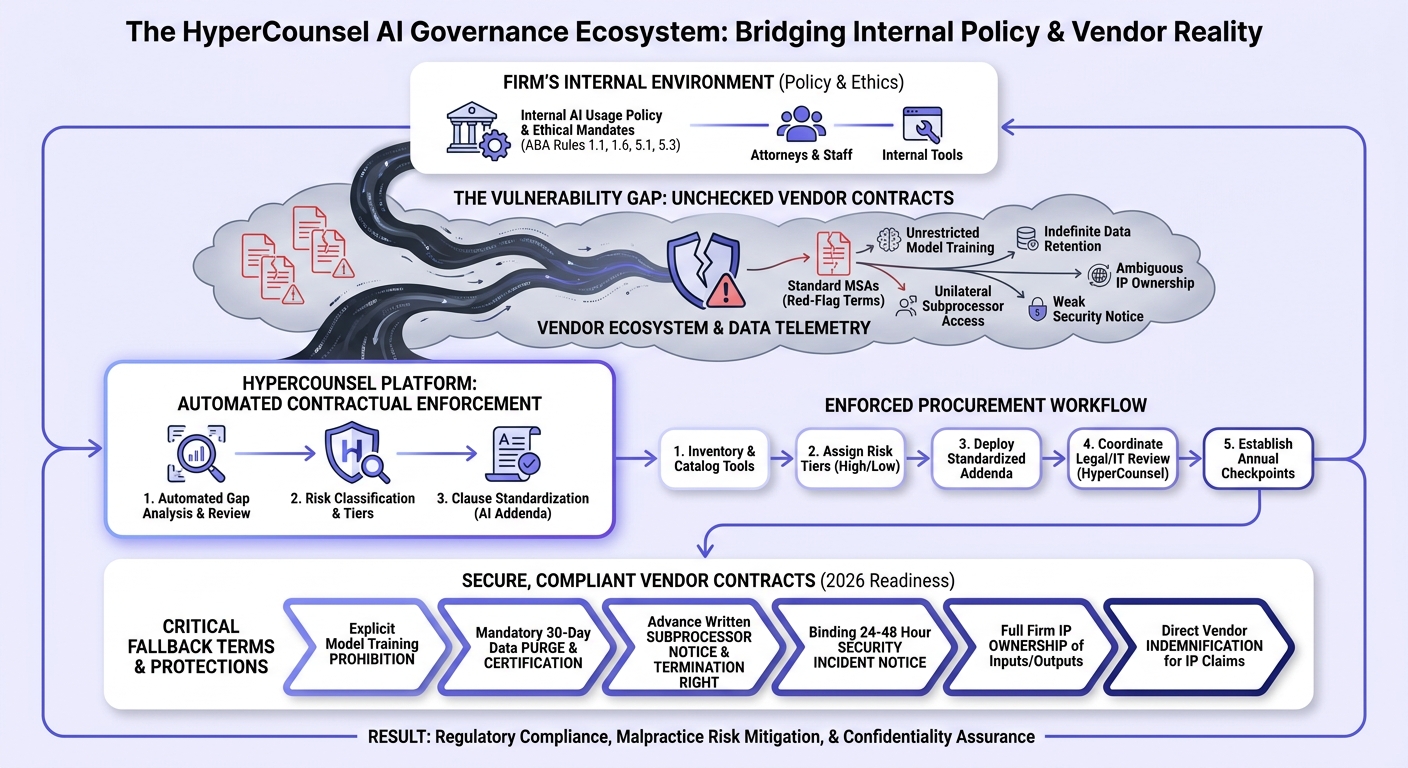
A comprehensive law firm ai policy dictates what personnel can and cannot do with technology tools. However, policy manuals do not bind commercial software providers. If an associate pastes deposition transcripts into an enterprise productivity tool governed by clickwrap terms, the firm remains legally bound by the vendor's data licensing terms.
Commercial agreements determine data ownership, secondary uses, subprocessor access, and breach liability. When software terms grant the provider rights to aggregate user data or train machine learning algorithms, the firm inadvertently waives core confidentiality protections. Contractual language is where firm governance translates into enforceable commercial reality.
Core Ethical Mandates for US Law Firms
Attorneys operating in US jurisdictions face strict ethical obligations when selecting and deploying technology solutions:
- Duty of Competence (Rule 1.1): Lawyers must maintain technological competence, requiring an understanding of the benefits, risks, and data handling methods of selected AI systems.
- Duty of Confidentiality (Rule 1.6): Firms must make reasonable efforts to prevent the unauthorized disclosure of, or unauthorized access to, client information.
- Supervisory Responsibilities (Rules 5.1 and 5.3): Partners and managers must ensure that non-lawyer assistants and external service providers comply with professional conduct standards.
- Reasonable Fees and Candor (Rules 1.5 and 3.3): Automated workflows must reflect accurate billing practices and ensure human verification before submitting generated outputs to courts.
To evaluate technical trustworthiness, firms can reference federal risk architectures such as the NIST AI Risk Management Framework, which establishes clear guidelines for data governance, model monitoring, and third-party oversight.

Critical Vendor Clauses to Negotiate Before 2026
When evaluating software renewals, legal operations and procurement teams must replace generic commercial terms with specialized AI safety addenda.
| Clause Area | Default Vendor Language | Required Firm Fallback Term |
|---|---|---|
| Model Training | Broad license to use customer data for "product improvement" | Express prohibition against using inputs or outputs to train foundation models |
| Data Retention | Indefinite caching for operational telemetry and system monitoring | Mandatory 30-day purge with certified deletion upon contract termination |
| Subprocessors | Unilateral right to add sub-tier data processors without notice | Advance 30-day written notice with the right to terminate without penalty |
| Security Incidents | Notice "as soon as commercially practicable" | Binding notice within 24 to 48 hours of suspected unauthorized data access |
| Work Product IP | Ambiguous ownership or non-exclusive vendor licenses on generations | Full, unencumbered firm ownership of all prompts, metadata, and generated outputs |
| Indemnification | Disclaimed liability for third-party intellectual property claims | Direct vendor defense and indemnity for third-party IP infringement claims |
Red-Flag Terms in Standard Vendor Agreements
Standard software contracts often contain clauses that directly conflict with a firm's legal obligations:
- Broad Feedback and Telemetry Licenses: Language that allows the vendor to retain "feedback, prompts, or usage patterns" to improve underlying machine learning models.
- As-Is Output Warranties: Complete disclaimers of system availability, output accuracy, and data security that leave the firm with zero legal recourse in the event of an outage or leak.
- Unilateral Policy Modifications: Provisions allowing vendors to update their privacy policy or terms of service without affirmative written consent from the law firm.
- Restricted Audit Rights: Clauses denying the firm the ability to review SOC 2 Type II reports, penetration testing results, or subprocessor lists.
Step-by-Step Vendor Procurement Workflow
Firms should implement a predictable, five-step procurement process to review and renew technology licenses efficiently:
- Inventory Firm-Wide Technology: Catalog every commercial tool, plugin, and cloud extension currently utilized across all practice areas.
- Assign Risk Classifications: Group software into tiers based on data access, separating tools that process client confidences from administrative applications.
- Deploy Standardized Addenda: Require all high-risk vendors to execute a dedicated AI Data Protection Addendum (DPA) that overrides default terms.
- Coordinate IT and Legal Review: Utilize specialized platforms like HyperCounsel to run automated gap analyses on incoming redlines and confirm compliance with internal safety standards.
- Establish Annual Checkpoints: Set recurring reviews 60 days before contract renewal deadlines to re-verify vendor subprocessor lists and security certifications.
Accelerate Your Procurement Review
Protecting your firm's reputation and client confidences does not have to create administrative drag or stall procurement cycles. By standardizing required AI contract clauses and using intelligent legal review infrastructure, your firm can deploy cutting-edge tools with total risk certainty.
Find out how HyperCounsel helps firms rapidly review, standardize, and enforce compliant vendor terms. Book a Demo to evaluate your current contract stack, or explore our Predictable Pricing Plans to accelerate your procurement workflows.
Take the Next Step
Ready to protect your business with expert legal support? Explore how HyperCounsel can help:
Frequently Asked Questions
What AI contract clauses should a law firm require from vendors?
A law firm must require explicit prohibitions against using customer data for model training, zero or limited data retention periods, guaranteed ownership of generated outputs, mandatory breach notification within 24 to 48 hours, and comprehensive intellectual property indemnification.
How should a law firm protect client confidentiality when using AI tools?
Firms must ensure that vendor infrastructure includes end-to-end encryption, tenant isolation, and strict role-based access controls. Contracts must prohibit the storage of unencrypted client inputs and mandate compliance with recognized security frameworks like SOC 2 Type II or ISO 27001.
Should a law firm require audit rights, deletion terms, and training data limits from AI vendors?
Yes. Law firms must maintain audit rights to inspect security documentation and verify that client data is purged upon request. Training data opt-outs must be contractually binding rather than managed through user settings that can be reset during software updates.
How do ABA ethics obligations affect law firm AI vendor contracts?
Under ABA Model Rules 1.1, 1.6, and 5.3, attorneys have an affirmative duty to understand technology risks, protect confidential information, and supervise non-lawyer vendors. Contracts serve as documented evidence that the firm has taken reasonable measures to uphold these professional responsibilities.