

Generative AI for Lawyers: Why Your Law Firm Needs a Written Policy in 2026
Discover why your law firm needs a written AI policy to maintain strict ethical compliance.
Generative AI is no longer an experimental novelty in legal practice. The rapid adoption of generative ai for lawyers across legal research, document drafting, and client intake has fundamentally changed how legal professionals deliver work.
According to guidance published by the American Bar Association in ABA Formal Opinion 512, lawyers using generative AI must actively maintain ethical duties across competence, confidentiality, client communication, supervision, candor, and reasonable fees.
Without a structured, firm-wide policy, legal practices risk severe confidentiality breaches, unauthorized data exposure, unverified citations, and inconsistent client disclosures. Implementing clear governance through platforms like HyperCounsel enables law firms to harness efficiency while staying strictly compliant with professional conduct standards.
Table of Contents
- Quick Summary
- Why Generative AI Requires Governance in 2026
- Core Ethical Pillars Under ABA Formal Opinion 512
- The NIST Framework for Managing AI Risk
- Essential Components of a Law Firm AI Policy
- Common Implementation Pitfalls to Avoid
- Step-by-Step Implementation Roadmap
- Protect Your Practice with HyperCounsel
- Frequently Asked Questions
- Recommended
Quick Summary
| Takeaway | Explanation |
|---|---|
| Mandatory Governance | Operating without a formal AI policy exposes law firms to malpractice and disciplinary action. |
| Confidentiality Control | General consumer AI tools often retain user inputs; enterprise-grade security is required for client data. |
| Human-in-the-Loop Review | Lawyers remain strictly responsible for validating every citation, factual claim, and draft output. |
| Transparent Billing | Firms cannot bill standard legal hourly rates for work completed instantaneously by automated tools. |
| Risk Management Standards | Aligning firm practices with established frameworks ensures audit readiness and regulatory compliance. |
Why Generative AI Requires Governance in 2026
The legal sector has moved past early experimentation into standard operational deployment. In 2026, courts, clients, and state bar regulators expect attorneys to understand both the benefits and the liabilities associated with automated drafting and analysis tools.
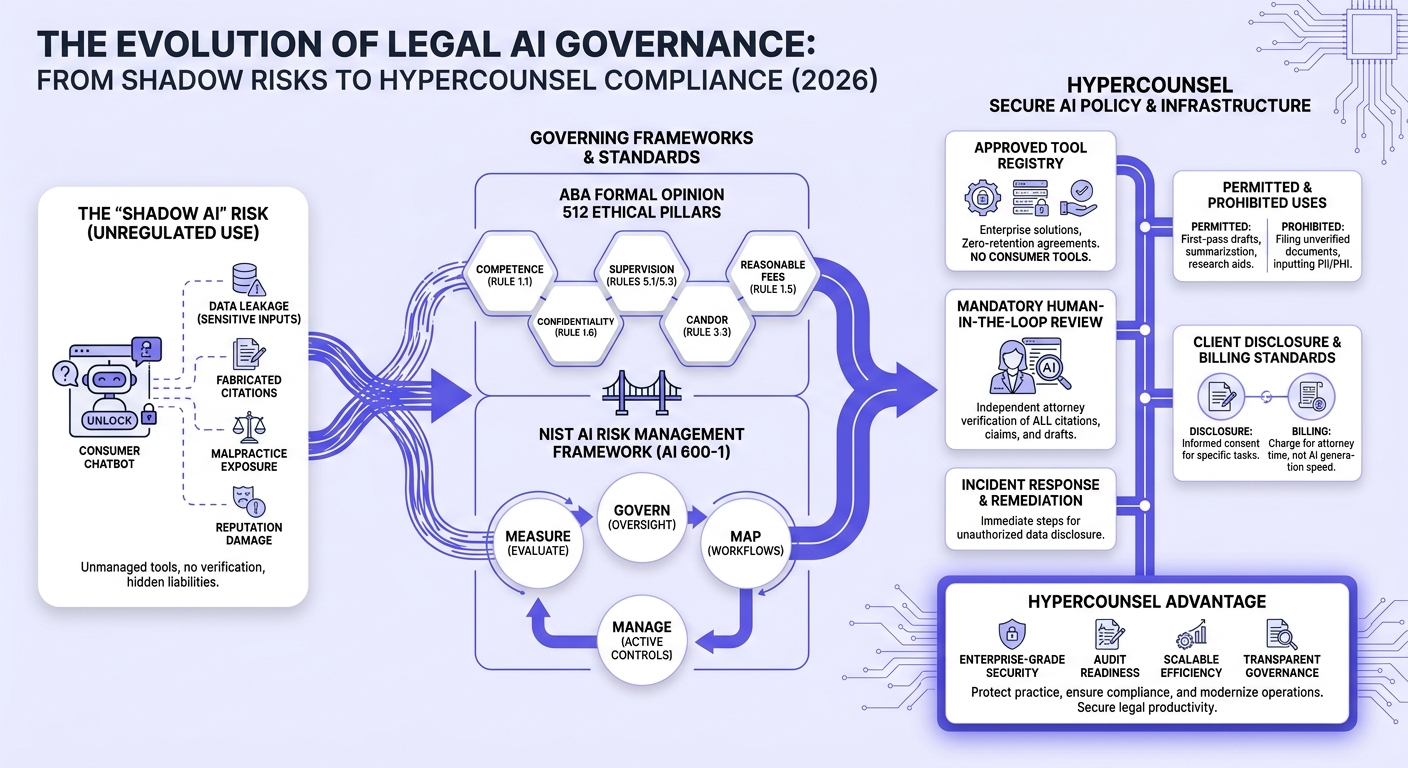
Unregulated "shadow AI" use presents severe exposure. When associates or paralegals paste sensitive briefs, contracts, or discovery documents into consumer-grade chatbots, privileged data may be ingested to train public foundational models. A written policy establishes mandatory guardrails that protect client confidentiality and protect firm reputation.

Core Ethical Pillars Under ABA Formal Opinion 512
State bars and professional conduct boards evaluate technology use under existing rules of professional responsibility. ABA Formal Opinion 512 outlines several distinct ethical obligations every firm must address:
- Duty of Competence (Rule 1.1): Attorneys must maintain an up-to-date understanding of the benefits and operational risks of generative tools, including the tendency for models to fabricate case citations or misinterpret nuance.
- Confidentiality of Information (Rule 1.6): Lawyers must not input non-public client information into third-party tools without informed client consent or verified zero-data-retention agreements.
- Supervisory Responsibilities (Rules 5.1 and 5.3): Partners and managing attorneys must establish clear internal protocols to oversee AI usage by junior lawyers, paralegals, and administrative staff.
- Candor Toward the Tribunal (Rule 3.3): Every citation, authority, and factual argument submitted to a court must be independently verified by a human attorney.
- Reasonable Fees and Expenses (Rule 1.5): Billing practices must accurately reflect time spent; attorneys cannot bill full hourly rates for drafting time eliminated through automation.
The NIST Framework for Managing AI Risk
To build an airtight governance program, firms should look beyond basic ethical checklists and implement structured technical controls. The National Institute of Standards and Technology provides structured guidance through its Generative AI Profile (NIST AI 600-1).
The NIST profile categorizes generative AI risks into manageable operational functions:
- Govern: Establish clear firm-wide oversight, leadership accountability, and documented acceptable-use standards.
- Map: Identify every legal workflow where generative tools are introduced, from initial client intake to court filings.
- Measure: Regularly evaluate AI tool outputs for accuracy, hallucination rates, bias, and compliance with data security benchmarks.
- Manage: Deploy active risk controls, including mandatory human review gates and immediate incident-response plans for unauthorized data disclosure.
Essential Components of a Law Firm AI Policy
A comprehensive law firm policy bridges ethical theory and day-to-day legal workflows. Rather than issuing a vague memo, firms should distribute a standalone policy document that outlines clear operational requirements.
| Policy Section | Operational Requirement |
|---|---|
| Approved Tool Registry | List specific enterprise solutions authorized for firm use; prohibit unapproved consumer tools. |
| Permitted & Prohibited Uses | Define acceptable tasks (e.g., first-pass document summarization) versus barred tasks (e.g., filing unverified briefs). |
| Client Confidentiality & Data Handling | Mandate anonymization protocols and require enterprise agreements that prevent vendor model training. |
| Mandatory Verification Protocols | Require human attorneys to cross-check all statutory references and legal citations against primary law. |
| Client Disclosure Standards | Specify when client consent is required before utilizing AI tools on specific client matters. |
| Billing & Fee Transparency | Provide explicit guidelines on charging for AI tool expenses versus attorney drafting hours. |
Common Implementation Pitfalls to Avoid
When drafting and rolling out a firm AI policy, leadership teams often encounter predictable stumbling blocks:
- Banning AI Outright: Total bans almost always fail, driving staff toward unmonitored shadow AI use on personal devices.
- Assuming Vendor Security: Not all legal tech platforms provide zero-retention enterprise privacy; firms must independently audit data terms.
- Inconsistent Partner Supervision: If senior partners bypass verification protocols while holding junior staff accountable, compliance breaks down.
- Neglecting Incident Response: Policies must outline specific remediation steps if confidential client information is inadvertently submitted to a public model.
Step-by-Step Implementation Roadmap
Law firms can deploy an effective generative AI governance model across four practical phases:
- Step 1: Audit Current Workflows: Identify which tools staff members currently use and catalog common use cases across practice groups.
- Step 2: Draft Standardized Guidelines: Create a concise, plain-English policy document detailing approved platforms, verification rules, and billing practices.
- Step 3: Conduct Mandatory Training: Run interactive training sessions covering prompt engineering, citation verification, and data anonymization.
- Step 4: Establish Ongoing Reviews: Reassess the policy semi-annually to incorporate new legal tech developments and evolving court rules.
Protect Your Practice with HyperCounsel
Managing risk while accelerating legal productivity does not require weeks of non-billable partner time. HyperCounsel provides law firms with secure, enterprise-grade AI infrastructure designed specifically for legal practitioners who require rigorous confidentiality, accuracy, and compliance.
Gain clarity, protect your firm against regulatory exposure, and scale your practice with transparent pricing and robust governance.
Take the next step in modernizing your firm's operations by scheduling a session to Book a Demo or explore our fixed-rate Pricing options today.
Take the Next Step
Ready to protect your business with expert legal support? Explore how HyperCounsel can help:
Frequently Asked Questions
Do law firms really need a written AI policy in 2026?
Yes. Professional conduct standards, including ABA Formal Opinion 512 and evolving local court rules, require attorneys to supervise technology use, safeguard client data, and maintain competence. A written policy ensures compliance and eliminates unauthorized shadow AI use.
What should a law firm AI policy cover?
An effective policy should cover an approved tool registry, permitted and prohibited legal use cases, client data confidentiality standards, human verification requirements, billing guidelines, and incident response procedures.
Can lawyers use generative AI with client data?
Lawyers can only input client data into generative AI tools if the platform guarantees enterprise-level confidentiality, ensures zero data retention for model training, and complies with applicable state bar rules regarding client consent.
How should firms supervise AI-assisted legal work?
Firms must implement mandatory human-in-the-loop review protocols where licensed attorneys independently verify all AI-generated case law, statutory interpretations, and factual claims before work product is delivered to clients or filed in court.