

Agentic AI and the Billable Hour: Will 2025's 315% Surge in AI Adoption Erase Traditional Pricing Models?
Discover how agentic AI and a 315% adoption surge are reshaping law firm billing models.
The landscape of the United States legal market is undergoing a seismic shift. As state bars and national organizations begin establishing regulatory guidelines, legal artificial intelligence is transitioning from an experimental tool to a core operational necessity.
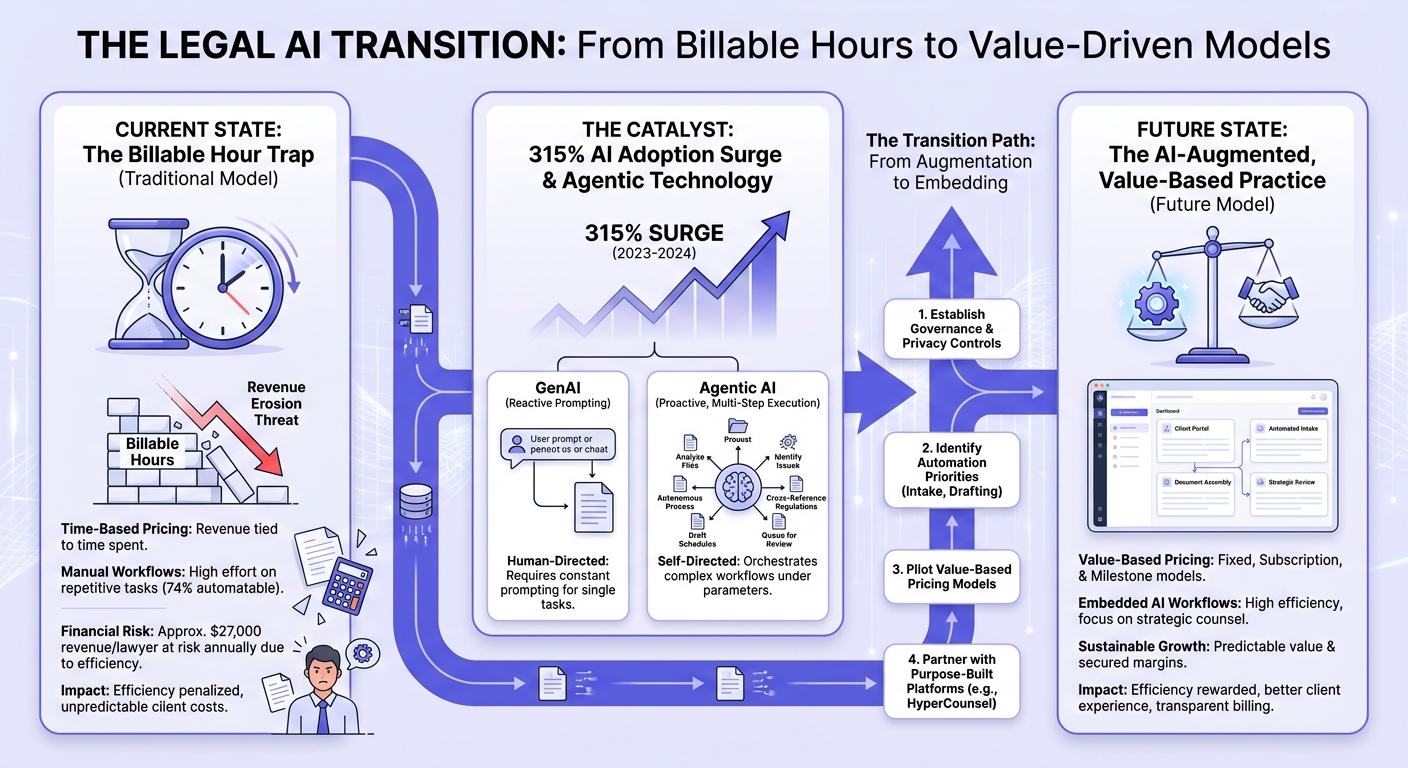
A historic 315% surge in AI adoption among legal professionals between 2023 and 2024 has forced law firm operators to confront an uncomfortable truth: the traditional billing structures that have sustained the legal industry for decades are no longer viable. As automated workflows compress tasks that once took hours into minutes, firms relying purely on the billable hour find themselves facing structural revenue erosion.
To navigate this transition, law offices must understand how to leverage agentic systems and restructure their pricing to retain profitability. Modern platforms like HyperCounsel are designed to help firms master this exact transition by pairing supercharged efficiency with highly predictable, value-driven pricing models.
Table of Contents
- Understanding Legal Artificial Intelligence: GenAI vs Agentic AI
- The 315% Surge in AI Adoption and What It Means for Law Firms
- The Financial Threat: Why Traditional Billing Models Are at Risk
- Shifting from Augmentation to Embedding AI in Legal Work
- Addressing Ethics, Trust, and Privacy Barriers
- Evolving Beyond the Billable Hour: Alternative Pricing Models
- Step-by-Step Implementation Strategy for US Law Firms
- Adapt Your Practice with Confidence
- Frequently Asked Questions
- Recommended
Quick Summary
| Takeaway | Explanation |
|---|---|
| Agentic AI is the New Era | Unlike generative AI that needs constant prompting, agentic AI operates autonomously to handle complex legal processes. |
| Traditional Billing is Failing | Automation compresses task times, causing hourly-billed firms to lose revenue unless they pivot. |
| Massive Value at Risk | Roughly 74% of standard hourly legal work is automatable, putting up to $27,000 per lawyer's revenue at risk. |
| Shift to Value-Based Models | Firms must adopt transparent, fixed-price legal frameworks to preserve margins and satisfy clients. |
| Integration is Essential | Scaling demands embedding AI directly into practice systems while securing robust data-handling controls. |
Understanding Legal Artificial Intelligence: GenAI vs Agentic AI
To understand the future of legal practice, it is crucial to distinguish standard generative AI from its next-generation successor: agentic AI.
Conventional generative AI platforms are transactional. A lawyer enters a prompt, and the AI outputs a summary, document draft, or email. While this increases efficiency, the system requires continuous human prompting, review, and direction for every single micro-task.
By contrast, agentic AI systems act as self-directed digital assistants. They are programmed with high-level objective parameters and allowed to orchestrate multi-step processes on their own. For example, instead of merely drafting a standard non-disclosure agreement, an agentic AI system can:
- Analyze a complex corporate transaction file.
- Identify missing regulatory disclosures or contractual terms.
- Cross-reference guidelines from corporate registries.
- Draft separate schedules and sequentially queue them for attorney review based on internal priority rules.
This step up from passive generation to active task execution transforms legal tech from a tool that merely assists a lawyer to one that actively acts on their behalf under strict supervisory bounds.
The 315% Surge in AI Adoption and What It Means for Law Firms
According to industry data from NetDocuments, there was a staggering 315% increase in AI use by law firm professionals from 2023 to 2024. This rapid rise is fueled by the pressing need for workflow automation and administrative efficiency.

While early legal tech tools focused purely on basic research databases, current systems integrate deep reasoning and contextual analysis. This allows solo practitioners and mid-sized firms to match the output and research capabilities of much larger corporate legal departments.
The Financial Threat: Why Traditional Billing Models Are at Risk
The rise of agentic AI exposes a fundamental flaw in the billable hour. When a lawyer's income is tied directly to the time spent on a task, any technology that cuts that time also cuts their revenue.
Data from the Clio Legal Trends Report indicates that 74% of standard hourly operations performed by legal practitioners can be automated using generative systems. Under a traditional billable framework, this automation puts an estimated $27,000 in revenue per lawyer at risk annually.
If case evaluation, discovery review, or contract drafting drops from 8 hours of partner time to 30 minutes of agentic synthesis, billing a client for 8 hours is unethical, but billing for only 30 minutes is financially unsustainable for the firm. Law firms must adjust their billing methods to charge for the value they deliver, rather than the hours they log.
Shifting from Augmentation to Embedding AI in Legal Work
Historically, firms treated technology as an "add-on"—using standalone apps for isolated tasks like e-discovery. Today, the focus is shifting toward "embedding" AI directly into core daily workflows.
By integrating automated portals, automated tracking, and instant document assembly into your primary workflow, your firm changes how it delivers value. Instead of checking a separate tool, lawyers use systems where draft creation, context checking, and intake filing are fully integrated. This allows legal teams to move away from tedious manual labor and focus their time on strategic advocacy, expert advice, and client relationships.
Addressing Ethics, Trust, and Privacy Barriers
Despite the clear efficiency gains, many US law firms hesitate to fully adopt AI due to several key operational challenges:
- Data Privacy and Client Confidences: Model training runs must not ingest sensitive client data. Practitioners must ensure they use secure enterprise instances that guarantee complete data separation and absolute confidentiality.
- Accuracy and Hallucinations: Model outputs must be rigorously verified. Relying on unverified automated drafts can lead to serious errors in court filings and transactional documents.
- State Bar Compliance Guidelines: State bar regulators are actively introducing rules on predictive pricing systems and automated output disclosures. To stay compliant, firms must maintain thorough oversight and establish clear human-in-the-loop validation processes.
To manage these risks, firms must evaluate how tools protect client data, manage model inputs, and verify outputs before any document is finalized.
Evolving Beyond the Billable Hour: Alternative Pricing Models
Firms that want to grow in this new landscape must adopt billing models that reward efficiency rather than penalizing it. Below are the primary pricing frameworks that successful firms are using to replace the traditional billable hour:
| Pricing Model | Operational Setup | Why It Works with AI |
|---|---|---|
| Value-Based Fixed Pricing | A single set price is established upfront for a specific legal deliverable (e.g., standard corporate restructuring or estate planning). | Because AI speeds up delivery, the firm's hourly cost drops write-downs, while the client gets predictable pricing. |
| Subscription-Based Retainers | Clients pay a monthly flat fee for ongoing advisory access and document review. | AI tools allow firms to handle high-frequency requests profitably without overwhelming their staff. |
| Phased Milestone Fee | Projects are split into distinct, priced phases (e.g., Phase 1: Intake and Assessment, Phase 2: Action Strategy, Phase 3: Resolution). | This approach builds trust with clients through clear check-ins while allowing the firm to adjust project scope as needed. |
Transitioning to these models requires tools that can handle matters quickly and predictably. By leveraging platforms like HyperCounsel, law firms can easily offer predictable, fixed-price structures that align with how modern corporate clients expect to buy legal services.
Step-by-Step Implementation Strategy for US Law Firms
Adopting modern legal tech does not mean replacing your entire staff or overhauling your workflows overnight. A phased, deliberate transition will help you protect your billable revenue while building a highly efficient, value-driven practice.
- Establish Day-One Governance: Define clear guidelines detailing which tasks AI can handle and which require manual work. Restrict the use of free, consumer-grade tools to ensure confidential client data is never leaked or ingested into public models.
- Identify Your Automation Priorities: Start by automating repetitive tasks that take up valuable time but offer low billable yields, such as intake forms, basic document drafting, and initial contract reviews.
- Pilot Value-Based Pricing: Choose a specific practice area or transactional service to test run custom flat-fee models. Use this pilot to track your actual margins, assess how much time you save, and gather client feedback.
- Partner with Purpose-Built Platforms: Avoid complex, fragmented systems that require constant maintenance. Partner with reliable tech providers like HyperCounsel to easily scale your operations with modern, client-focused automation tools.
Adapt Your Practice with Confidence
The rise of agentic legal technology is not a threat to the legal profession—it is a massive opportunity for forward-thinking firms. By automating routine administrative tasks, you can spend less time on tedious paperwork and more time delivering high-value strategic counsel to your clients.
The most successful firms are already moving away from unpredictable hourly billing in favor of clear, fixed-price pricing structures. Partnering with a comprehensive legal platform like HyperCounsel allows you to streamline your administrative workflows, deliver legal services faster, and grow your practice with absolute billing transparency.
To see how modern legal automation can help you protect your margins and deliver a better experience for your clients, Book a Demo or explore our transparent and affordable Pricing today.
This article provides general information and is not legal advice.
Take the Next Step
Ready to protect your business with expert legal support? Explore how HyperCounsel can help:
Frequently Asked Questions
How does agentic AI differ from generative AI in legal practice?
Generative AI acts as a reactive writer, generating text based on a specific, instant prompt. Agentic AI functions as a proactive digital associate, executing multi-step tasks, evaluating files, and organizing complex legal workflows autonomously within set guidelines.
Will AI adoption eliminate the need for billable hours in law firms?
AI will not completely eliminate the billable hour, but it will significantly reduce its use for routine tasks. As automation handles more standard, repetitive work, firms must adopt flat-fee, value-based pricing models to remain profitable.
What are the main ethical concerns when using legal artificial intelligence?
The primary ethical concerns include protecting client confidentiality, securing sensitive data from being ingested into public models, preventing AI hallucinations, and keeping human attorneys fully accountable for all final work products.
How can law firms implement AI without replacing human lawyers?
Firms should focus on "augmented intelligence" rather than complete automation. By using AI to handle tedious, low-value administrative work, lawyers can devote more time and energy to specialized advocacy, complex negotiation, and direct client care.