

The AI Authenticity Crisis: Law Firm Ethics & AI Billing
Learn why 40% of law firms hide AI use and how to prepare for emerging 2026 ethics mandates.
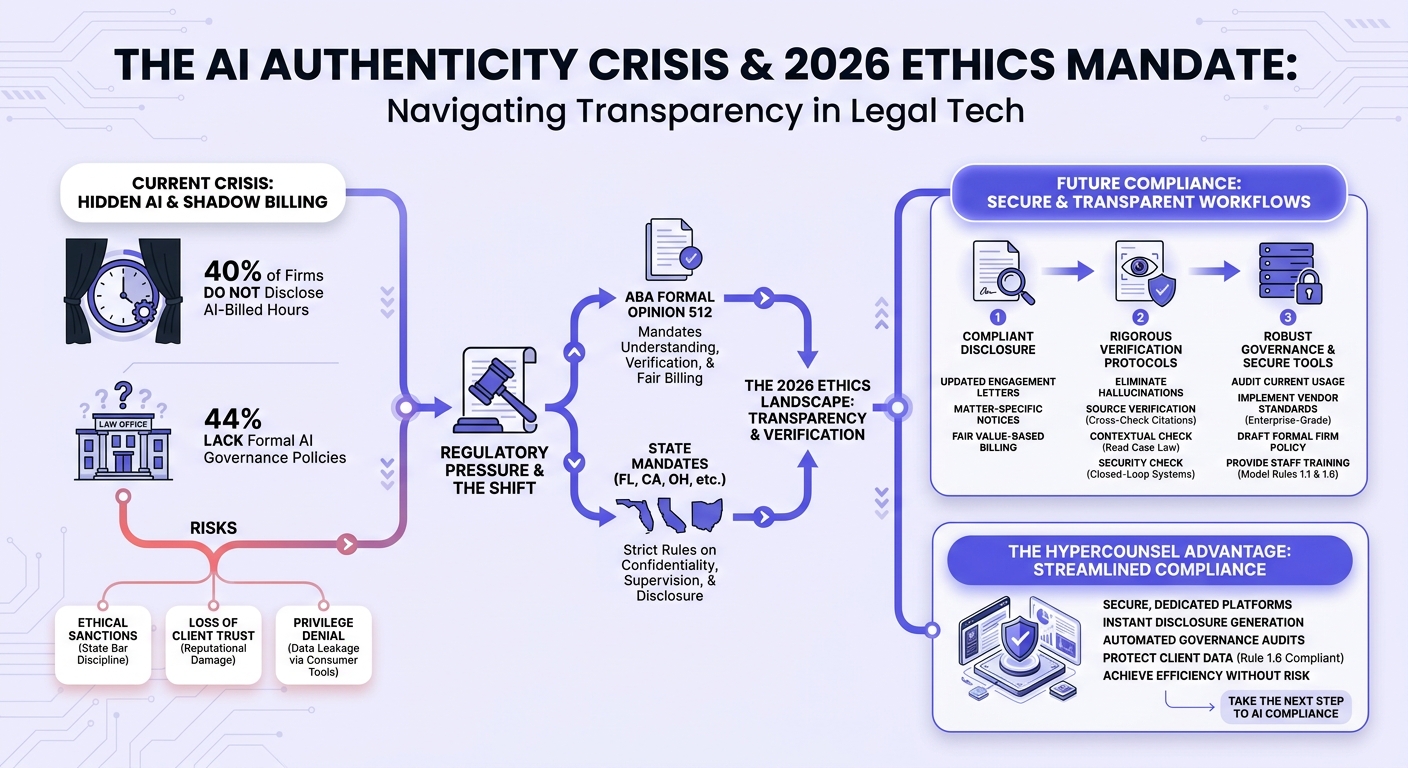
The swift integration of generative tools has sparked rapid change, but 40% of law firms do not disclose AI use on client bills, creating an industry-wide compliance and authenticity crisis. As clients demand greater transparency, the rules surrounding ai in law firms are quickly tightening. Relying on silent automation without clear disclosure protocols now risks massive reputational, ethical, and billing fallout.
With new mandates taking shape across state bar associations and the federal judiciary, legal practitioners must adapt. This guide outlines how to navigate the emerging 2026 ethics landscape while leveraging tech safely and transparently with the help of platforms like HyperCounsel.
Table of Contents
- Quick Summary
- The AI Authenticity Crisis: Billing Behind Closed Doors
- The State of the Law: ABA Opinion 512 and State Mandates
- Ethical Core Obligations Under Model Rules 1.1 and 1.6
- Best Practices for Compliance and AI Disclosures
- Verification Protocols: Eliminating Hallucinations and Citation Errors
- The Risks of Non-Disclosure
- Steps to Build a 2026-Compliant AI Governance Policy
- Take the Next Step to AI Compliance
- Frequently Asked Questions
- Recommended
Quick Summary
| Takeaway | Explanation |
|---|---|
| Billing Transparency | Nearly 40% of firms do not disclose AI billed hours; transparency is now an ethical requirement. |
| ABA Formal Opinion 512 | Mandates that lawyers understand, verify, and appropriately bill for AI-assisted work. |
| State Regulations | Regions like Florida, Ohio, and California are enforcing specific rules on confidentiality and client billing. |
| Governance Lag | While 79% of legal professionals use AI, 44% of firms still lack formal usage policies. |
| Platform Compliance | Utilizing secure, dedicated platforms like HyperCounsel streamlines compliant legal workflows safely. |
The AI Authenticity Crisis: Billing Behind Closed Doors
Many law departments and solo attorneys eagerly adopted automated document drafting, legal research assistants, and contract review algorithms to increase efficiency. However, a significant gap has emerged between technology usage and client communication. Recent studies demonstrate that 79% of legal professionals utilized AI tools, but 44% of law firms had yet implemented formal governance policies to oversee them, according to a recent report published by the North Carolina Bar Association.
This division has triggered what industry regulators call the "AI Authenticity Crisis." When a firm bills a client for hours of manual research that actually took an algorithm seconds to compile, it crosses the line from efficiency into unethical billing. Clients are increasingly demanding to know exactly how, when, and where automated tech is utilized in their active matters.
The State of the Law: ABA Opinion 512 and State Mandates
To address the trust gap, regulatory bodies are stepping in with formal rules. Chief among these is the American Bar Association (ABA) Formal Opinion 512. This landmark opinion outlines that while lawyers are encouraged to use generative tools to improve services, they must do so with complete transparency regarding fees, billing structure, and output verification.
Florida Bar Opinion 24-1
The Florida Bar has led the nation by establishing clear boundaries for generative tools. Florida Opinion 24-1 sets forth four strict conditions for lawyers:
- Confidentiality: Lawyers must protect client data from leaking into public training sets.
- Supervision: Partners must actively supervise junior associates and the systems they use.
- Reasonable Billing: Firms cannot charge inflated hourly fees for instant automated work.
- Chatbot Disclosure: Any customer-facing chatbot on a firm's website must clearly state that it is not a human lawyer.
California's Proposed Amendments
The State Bar of California is pushing forward with formal amendments to its Rules of Professional Conduct. These proposed updates seek to enshrine AI disclosure directly into the rules of professional responsibility, signaling a strong national trend toward mandatory, standardized client notifications.

Ohio's AI Ethics Guide
Ohio’s new guidelines clarify that technological competence requires a functional understanding of how generative tools generate answers. The underlying principle is simple: legal professionals must verify every automated output prior to submission, establishing human review as the absolute baseline for practice.
Ethical Core Obligations Under Model Rules 1.1 and 1.6
Every lawyer must evaluate how generative tools align with basic rules of professional conduct:
- Model Rule 1.1 (Competence): Competence is no longer just about understanding case law. It now requires understanding the benefits and risks associated with relevant technology. If you do not understand how your tech vendor processes data, you might be in violation of Rule 1.1.
- Model Rule 1.6 (Confidentiality): Entering sensitive client data into consumer-grade generative tools often grants those systems the right to use that data for future training. This constitutes an immediate breach of confidentiality.
Using enterprise-grade legal technology via HyperCounsel ensures that client data remains protected within closed-loop systems, keeping firms fully compliant with Rule 1.6.
Best Practices for Compliance and AI Disclosures
Rather than hiding tech usage, progressive firms use transparency as a competitive advantage. Standardizing your communication protocols ensures client trust remains intact:
- Updates to Engagement Letters: Include a standard clause in your retainer agreements that outlines how generative systems are used to streamline document drafting, proofreading, and contract analysis.
- Matter-Specific Notices: For complex litigation or major transactions where automation performs substantial heavy lifting, send a direct notification detailing the tools used.
- Fair Billing Adjustments: If a document that once took five hours now takes one hour of prompt engineering and verification, bill for the actual human time spent or transition to value-blind, transparent fixed-pricing models.
Verification Protocols: Eliminating Hallucinations and Citation Errors
A major operational risk of using generative tech is the phenomenon of "hallucinations," where generative models invent real-sounding court citations out of thin air. To safeguard your practice, implement a mandatory multi-step verification protocol for all filings.
| Step | Action Item | Goal |
|---|---|---|
| 1. Source Verification | Copy-paste and cross-verify every citation inside Westlaw, Lexis, or public court databases. | Eliminate hallucinations completely. |
| 2. Contextual Check | Read the underlying case to ensure the legal holding matches the AI's summary. | Prevent misinterpretation of precedent. |
| 3. Security Check | Ensure the platform used is closed-loop and doesn't train publicly on inputs. | Keep client details private. |
The Risks of Non-Disclosure
Failing to properly notify clients or courts about your automation processes carries heavy penalties:
- Loss of Client Trust: If a client discovers an undisclosed tool was used to run their case, they may feel overcharged and seek alternative counsel.
- Ethical Sanctions: State bars are actively disciplining attorneys who submit unverified, AI-generated filings.
- Privilege Denial: Using unsecure consumer programs can waive attorney-client privilege, exposing confidential discussions to the public record.
Steps to Build a 2026-Compliant AI Governance Policy
Protecting your practice requires a proactive approach. Start building your firm's compliance infrastructure today with these actionable steps:
- Audit Current Usage: Identify which tools your attorneys, paralegals, and administrative staff are currently using.
- Implement Vendor Standards: Only partner with secure legal technology providers. Avoid consumer-facing tools that repurpose entered data.
- Draft a Formal Firm Policy: Create a clear document governing what information can be uploaded, who must verify outputs, and how hours must be recorded.
- Provide Staff Training: Educate your entire legal team on the ethical nuances of Model Rules 1.1 and 1.6 to ensure uniform compliance.
By partnering with compliance-driven systems like HyperCounsel, law firms can easily meet high standards of practice while maintaining complete professional responsibility.
Take the Next Step to AI Compliance
Navigating the rapid evolution of technology in the legal sector does not have to be a guessing game. By instituting transparent billing practices and robust ethics guidelines, your firm can capture massive efficiency gains without risking its reputation.
Get HyperCounsel’s AI compliance toolkit to instantly generate disclosure-ready engagement letters and audit your firm’s governance in under 30 minutes at a fixed price.
To see how we can assist your workspace:
Let us show you how we secure your data: Book a Demo
Explore our straightforward options: View Pricing
Frequently Asked Questions
Do lawyers have to disclose AI use on client bills in 2026?
Yes, under emerging interpretations of ABA Model Rule 1.5 and state bar opinions like Florida’s 24-1, lawyers must charge reasonable fees. Hiding AI utilization to bill normal hourly rates for automated work violates ethical billing guidelines.
What happens if a law firm fails to verify AI-generated citations?
Firms that fail to verify citations face severe sanctions from judges, potential malpractice lawsuits, and disciplinary actions from state bar associations for violating their duty of competence.
When is AI disclosure required by court standing orders?
An increasing number of federal and state judges now require formal standing orders certifying that any legal brief utilizing generative tech has been thoroughly reviewed and verified by a human attorney.
Can law firms use consumer AI tools without client consent?
No. Consumer-grade open tools typically save data inputs for public model training, which violates client confidentiality under Model Rule 1.6. Only private, enterprise-grade tools with strict data protection should be used.