

AI Chatbots in the UK: An Online Safety Act Summary for Legal Tech and Law Firms
How the UK Online Safety Act impacts legal AI chatbot deployment for law firms and tech.
The regulatory landscape for artificial intelligence has shifted dramatically. Under recent statutory expansions in the United Kingdom, generative AI tools and client-facing chatbots now fall squarely within the scope of digital safety legislation. If your practice or technology business deploys interactive tools, this online safety act summary provides the critical compliance architecture you need to avoid crippling penalties.
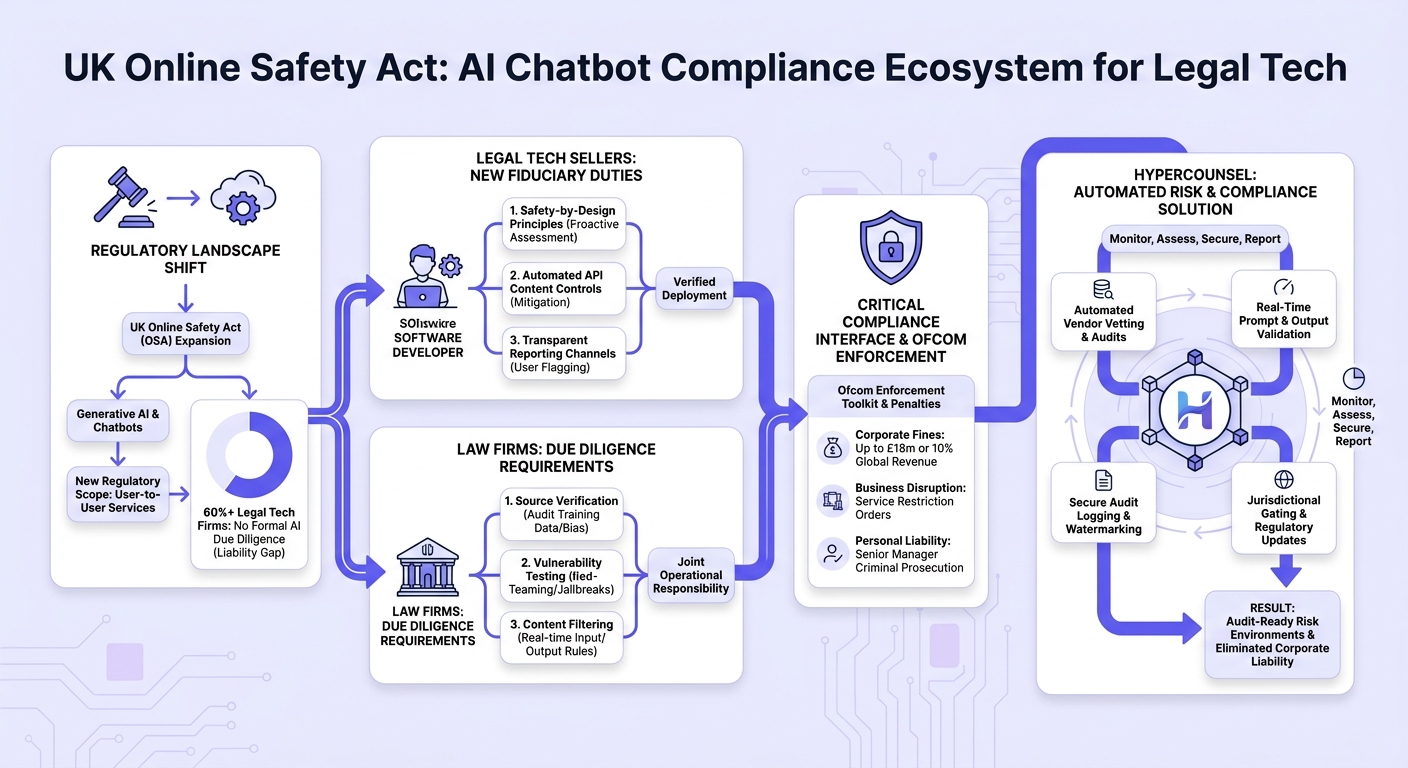
Understanding these changes is no longer optional. Over 60% of UK legal tech firms reported no formal due diligence process for AI chatbot integration in early 2026, creating an immediate liability gap for the firms that rely on them. As enforcement begins, both software sellers and the law firms that license their products must understand their new compliance obligations.
To help you navigate these complex rules, safety practitioners use HyperCounsel to automate vendor vetting and build audit-ready risk environments.
Table of Contents
- Quick Summary
- Scope Assessment: How AI Chatbots Trigger the Online Safety Act
- New Fiduciary Duties for Legal Tech Sellers
- Due Diligence Requirements for Law Firms
- The Ofcom Enforcement Toolkit and Penalties
- Key Technical Safeguards for Legal AI Compliance
- Jurisdictional Gating and Regulatory Engagement
- Eliminate Corporate Risk with HyperCounsel
- Frequently Asked Questions
- Recommended
Quick Summary
| Compliance Area | Core Obligation under the Act |
|---|---|
| Regulatory Scope | Captures generative AI and conversational chatbots that construct user-to-user interfaces or distribute synthetic media. |
| Vendor Liability | Legal tech sellers must implement safety-by-design, running mandatory risk assessments on systemic AI outputs. |
| Law Firm Due Diligence | Buyers must audit internal and external-facing chatbots for illegal content generation and data leaks. |
| Ofcom Penalties | Noncompliance risks fines of up to £18 million or 10% of qualifying worldwide revenue, whichever is higher. |
| Manager Liability | Senior executives can face direct criminal prosecution for systematic, willful safety failures. |
Scope Assessment: How AI Chatbots Trigger the Online Safety Act
The UK Online Safety Act (OSA) regulates services that allow users to generate, share, or interact with user-generated content. For a long time, traditional static software sat outside this regime. However, fast-tracked legislative updates have closed the loop on generative systems.
Under updated statutory rules, conversational AI platforms are classified as user-to-user services if they allow users to prompt, generate, and share information dynamically. If a client triggers a law firm's legal intake chatbot and receives output containing illegal material, the underlying platform is subject to the Act's strict safety standards.
Organizations can no longer argue their tools are private, single-user utilities. If the platform facilitates open-ended communication or creates synthetic legal documents based on user input, it triggers the regulatory framework overseen by Ofcom.
New Fiduciary Duties for Legal Tech Sellers
Technology vendors who sell software to law firms must now adopt "safety-by-design" principles. Under the expanded legislative rules, tech sellers act as fiduciary stewards of the data and content their systems produce.
- Systemic Risk Assessments: Legal tech developers must proactively assess how their tools could generate illegal text, manipulate sensitive evidence, or bypass ethical restrictions.
- Safety Mitigations: Sellers must write automated content controls directly into their application programming interfaces (APIs).
- Reporting Channels: Platforms must give users transparent and responsive mechanisms to flag harmful AI outputs instantly.
For providers targeting UK-based firms, these safety measures must be verified prior to deployment. Failing to perform these assessments leaves developers open to direct enforcement action.
Due Diligence Requirements for Law Firms
Law firms cannot simply shift all compliance risk onto their software vendors. If external clients use an AI chatbot embedded on your firm's website, your firm shares joint operational responsibility for any illegal or harmful outputs.
Before deploying any conversational agent, legal team operators must perform thorough operational due diligence.

When onboarding new systems, review this basic due diligence checklist:
| Checkpoint | Action Required | Expected Outcome |
|---|---|---|
| 1. Source Verification | Audit the developer's training data, third-party reliance, and fine-tuning history. | Certify that the algorithm is free from built-in bias and intellectual property infringements. |
| 2. Vulnerability Testing | Execute regular red-teaming exercises to test for prompt injections and jailbreaks. | Ensure the model cannot be forced to expose confidential firm data or other clients' information. |
| 3. Content Filtering | Confirm the vendor runs real-time input and output monitoring rules. | Verify that illegal material, hate speech, or unethical advice is blocked before reaching clients. |
Managing these technical assessments can quickly overwhelm internal IT resources. Using HyperCounsel allows firms to streamline vendor questionnaires and establish auditable compliance trails in a fraction of the time.
The Ofcom Enforcement Toolkit and Penalties
Ofcom possesses a powerful set of enforcement tools to ensure compliance. The regulator's focus is on structural compliance, not honest mistakes. However, deliberate neglect of safety protocols will trigger severe financial and personal penalties.
- Corporate Financial Penalties: Ofcom can issue fines of up to £18 million or 10% of qualifying worldwide revenue, depending on which figure is higher.
- Business Disruption: The regulator has the authority to issue service restriction orders, effectively taking noncompliant software platforms offline.
- Personal Criminal Liability: Senior corporate officers face direct criminal prosecution if they fail to act on Ofcom's information requests or systematic safety warnings.
These penalties apply directly to firms based in the UK, as well as foreign organizations whose digital systems target or are regularly accessed by users within the United Kingdom.
Key Technical Safeguards for Legal AI Compliance
To comply with the Act's guidelines, legal tech sellers and law firms should implement several standard technical safeguards. Applying these systems creates a reliable "defense in depth" model for automated chatbots:
- Real-Time Prompt Validation: Filter incoming user chats to instantly block malicious inputs, prompt injection attempts, or sensitive keywords.
- Output Moderation Layer: Run all AI-generated content through an independent, lightweight safety classifier before displaying it to the user.
- Digital Watermarking: Embed unique, traceable metadata in all synthetic documents or advice scripts to prove the source and timestamp of the model's response.
- Secure Audit Logging: Keep tamper-proof, timestamped records of all chats and system flags to preserve evidence for regulatory reviews or judicial investigations.
Jurisdictional Gating and Regulatory Engagement
Managing international compliance requires careful geographic control. Because the UK Online Safety Act applies to systems accessible in the country, many firms utilize split setups. If your AI systems cannot guarantee compliance with UK rules, you must set up geofencing to limit access to jurisdictions with lower risk profiles.
Furthermore, forward-thinking legal professionals are proactively participating in Ofcom consultations. By directly engaging with drafts of Ofcom's upcoming codes of practice, legal tech developers and law firms can help shape realistic safety standards that balance modern AI innovation with rigorous consumer protection.
Eliminate Corporate Risk with HyperCounsel
Protecting your firm from regulatory risk does not have to slow down your technology adoption. HyperCounsel simplifies the due diligence process for law firms and legal tech vendors, offering fast, fixed-fee compliance audits and vendor verification structures.
Rather than spending weeks negotiating manual risk questionnaires, our platform helps you quickly implement automated vendor audits, verify prompt safety, and build secure audit trails that satisfy Ofcom standards.
Secure your systems and protect your business today. Book a Demo with our compliance professionals to learn how we can help you navigate the Online Safety Act securely.
This article provides general information and is not legal advice.
Take the Next Step
Ready to protect your business with expert legal support? Explore how HyperCounsel can help:
Frequently Asked Questions
Does the UK Online Safety Act apply to standalone AI chatbots?
Yes. If an AI chatbot operates in a user-to-user scenario — or generates open-ended text based on user prompts that can then be shared — it falls within the scope of Ofcom's regulatory safety guidelines.
What are the new fiduciary duties for legal tech sellers under the Act?
Legal tech sellers must adopt "safety-by-design" practices. This includes running systemic risk assessments on target models, implementing robust content filters, and providing responsive channels for users to flag harmful outputs.
How must law firms conduct due diligence when adopting AI chatbots?
Law firms must vet tech vendors' training data, run regular red-teaming tests, implement prompt validation safeguards, and maintain complete audit logs of all client-facing conversations.
What penalties face noncompliant AI chatbot providers in the UK?
Ofcom can fine noncompliant providers up to £18 million or 10% of their qualifying worldwide revenue. Additionally, senior managers can face direct criminal prosecution for systematic, willful safety failures.