

AI in Law Firms: Why Individual Usage Outpaces Firm-Wide Operational Adoption
Learn why individual AI adoption outpaces law firm operations and how to scale safely.
The conversation surrounding ai in law firms has shifted rapidly from theoretical possibilities to daily practice. Individual attorneys regularly use generative platforms to draft initial correspondence, summarize voluminous discovery files, and extract critical clauses from complex agreements. However, an operational gap exists across the legal industry: while fee earners experiment with tools on their personal workstations, law firms struggle to operationalize artificial intelligence across standardized workflows, governance policies, and matter management systems.
Industry research indicates that 70% of attorneys at law firms report using AI at least once a week, yet more than one-third report receiving no formal guidance or organizational training. This divide leaves firms exposed to professional conduct pitfalls while missing out on compounding institutional efficiency.
Bridging this gap requires moving beyond ad hoc experimentation. Law firm leaders must build clear governance frameworks, secure data pipelines, and practice-specific playbooks that turn isolated productivity gains into scalable, profitable client service.
Table of Contents
- The Growing Adoption Divide
- Why Ad Hoc Tool Use Fails to Scale
- Operational Blockers to Scaling AI
- Step-by-Step Blueprint to Operationalize AI
- Measuring Practical ROI and Value Delivery
- Common Implementation Mistakes to Avoid
- Accelerate Your Firm's AI Roadmap
- Frequently Asked Questions
- Recommended
Quick Summary
| Takeaway | Explanation |
|---|---|
| Adoption Divide | Individual attorneys utilize consumer AI tools, but firms lack centralized infrastructure and compliance policies. |
| Ethical Mandates | Professional responsibility rules require affirmative human review, verification of citations, and data confidentiality protections. |
| Operationalization | Scalable efficiency requires embedding purpose-built legal models directly into matter management and drafting workflows. |
| Phased Rollout | Firms achieve faster buy-in by testing specific practice-group use cases before rolling out firm-wide solutions. |
| Commercial Impact | Strategic adoption unlocks value pricing, shortens turnaround cycles, and improves realization rates across key practice areas. |
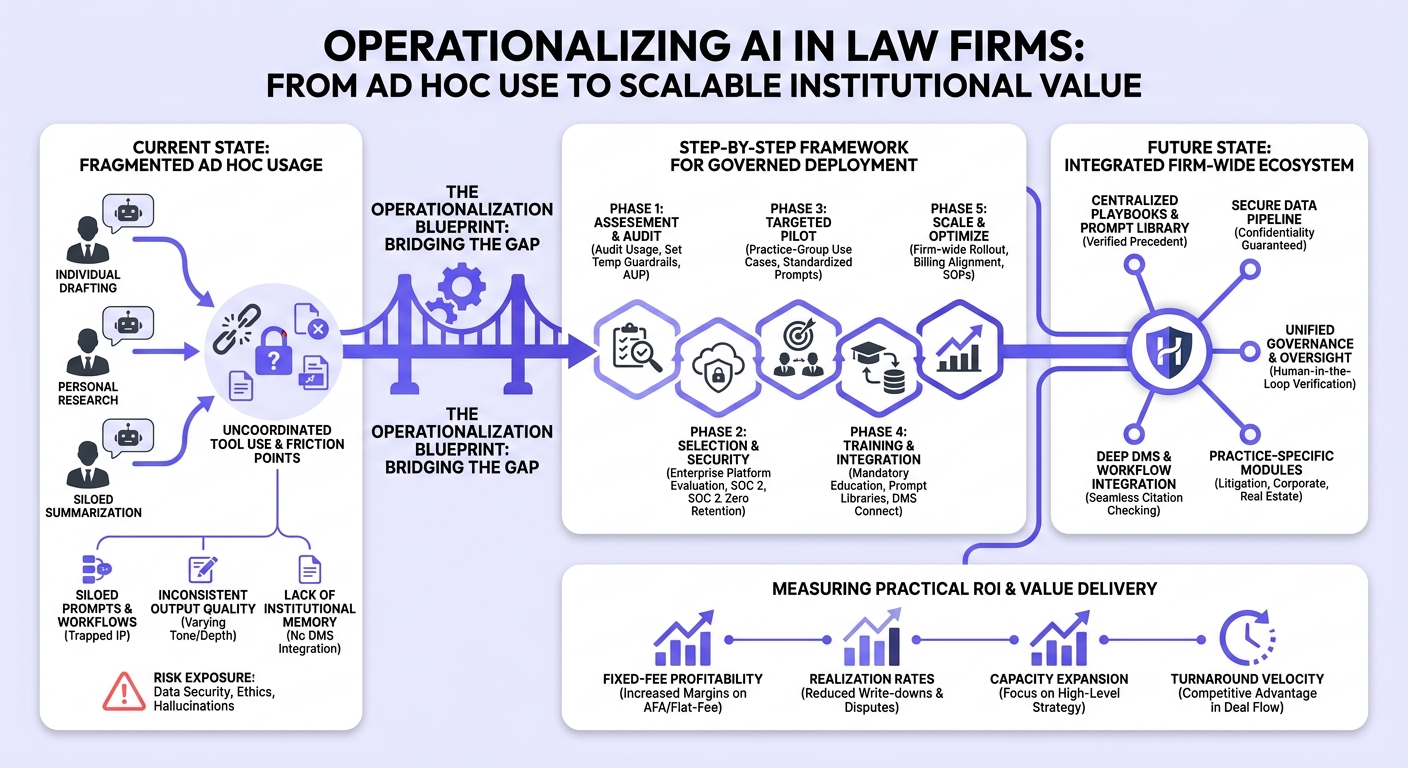
The Growing Adoption Divide
In most legal organizations, technological adoption typically flows from management down to associates through structured IT deployments. With generative intelligence, the dynamic is reversed. Individual practitioners across litigation, corporate, and real estate groups adopted commercial chat interfaces to speed up routine writing tasks long before their partnerships established approved tool lists.
This bottom-up adoption creates an operational paradox. Individual lawyers report meaningful time savings on drafting initial memos and structuring outlines. However, firm leaders see little aggregate impact on firm profitability, realization rates, or risk posture.
When tool use remains uncoordinated, the work product cannot be audited, proprietary firm knowledge is not captured, and quality control depends entirely on the discipline of the individual user. Moving from rogue usage to institutional capability is the central operational challenge for modern law practice management.
Why Ad Hoc Tool Use Fails to Scale
Individual productivity improvements rarely aggregate into institutional value on their own. When attorneys use disparate tools in an ad hoc fashion, several friction points emerge:
- Siloed Prompts and Workflows: If a senior associate develops an effective framework for summarizing deposition transcripts, that intellectual asset remains trapped on a single computer rather than benefiting the entire litigation practice group.
- Inconsistent Output Quality: Public models produce varying tones, structural styles, and analytical depths. Without firm-wide prompt standards, client deliverables vary wildly across matters.
- Lack of Institutional Memory: Consumer-grade tools do not connect directly to a firm's document management systems (DMS) or prior work product repositories, preventing the reuse of verified precedent.
- Billing Ambiguity: Without firm-level billing guidance, practitioners struggle to capture value or account for time spent engineering prompts versus reviewing outputs.
To achieve compound efficiency, legal practices must deploy centralized platforms like HyperCounsel that integrate with existing precedent systems and apply unified compliance safeguards across all users.
Operational Blockers to Scaling AI
Transitioning from casual experimentation to governed deployment requires dismantling several institutional hurdles.

Governance and Ethical Supervision
Legal ethics authorities emphasize that technology does not alter the fundamental duties of competence, diligence, and supervision. For instance, American Bar Association Formal Opinion 512 outlines lawyer obligations regarding generative AI tools, underscoring that practitioners must independently verify all AI-generated factual assertions, statutory interpretations, and case citations before submitting them to a court or client.
Firms must institute formal review policies that treat artificial intelligence outputs as unverified work product requiring partner-level sign-off.
Data Security and Client Confidentiality
Uploading unredacted client files, trade secrets, or non-public financial information into public models creates severe ethical and contractual liabilities. Standard terms of service for consumer tools often allow providers to use input prompts to train future models.
Legal organizations must adopt institutional controls aligned with established risk frameworks, such as the NIST AI Risk Management Framework. Enterprise-grade legal tech solutions must guarantee zero data retention for training, dedicated encryption, and SOC 2 Type II compliance.
Workflow Integration and Training Deficits
Most lawyers receive no formal instruction on how to evaluate algorithmic outputs, structure structured legal queries, or spot subtle hallucinations. Without structured continuous legal education (CLE) and practical workflow integration, junior lawyers may rely too heavily on raw outputs, while risk-averse senior partners reject the technology entirely.
Step-by-Step Blueprint to Operationalize AI
Firms that successfully transition from testing to production follow a structured, phased roadmap:
| Phase | Core Objective | Key Deliverables | Timeline |
|---|---|---|---|
| Phase 1: Assessment | Audit current usage and establish temporary guardrails | Usage audit, temporary acceptable use policy | Weeks 1–2 |
| Phase 2: Selection | Evaluate enterprise-grade legal platforms | Vendor security review, pilot tool selection | Weeks 3–4 |
| Phase 3: Pilot | Run targeted practice-group pilots | Standardized prompts, workflow integration | Weeks 5–8 |
| Phase 4: Training | Educate fee earners on prompt mechanics and verification | Mandatory training sessions, prompt libraries | Weeks 9–10 |
| Phase 5: Scale | Expand firm-wide and align billing structures | Standard operating procedures, client engagement updates | Week 11+ |
- Step 1: Conduct a Usage and Risk Audit: Survey all practice groups anonymously to determine which tools are currently in use, what data is being input, and where the biggest workflow bottlenecks exist.
- Step 2: Formalize an Acceptable Use Policy (AUP): Define approved platforms, prohibited data types, client disclosure requirements, and mandatory verification protocols.
- Step 3: Appoint Practice-Group Champions: Instead of relying solely on IT administrators, select respected partners and senior associates within transactional and litigation groups to lead workflow design.
- Step 4: Build a Centralized Prompt and Playbook Library: Codify tested, defensible prompts for recurring tasks such as lease abstractions, discovery demand drafting, and contract redlining.
- Step 5: Integrate with Existing Technology: Connect generative tools to the firm's document management systems to allow seamless citation checking against internal repositories.
Measuring Practical ROI and Value Delivery
Measuring software ROI in a billable-hour environment requires tracking outcomes beyond simple time reduction. If an associate completes a 6-hour research memo in 2 hours, the firm must determine how that efficiency translates into financial value.
- Fixed-Fee Profitability: For alternative fee arrangements (AFAs) or flat-fee matters, efficiency gains directly increase the profit margin per matter.
- Realization Rates: By eliminating repetitive manual drafting, firms reduce client invoice write-downs and billing disputes.
- Capacity Expansion: Associates spend more time on high-level strategy, client counseling, and business development rather than clerical summarization.
- Turnaround Velocity: Faster turnaround times on deal due diligence and initial pleadings serve as a major competitive differentiator when pitching prospective corporate clients.
Modern practice management platforms like HyperCounsel help firms benchmark efficiency, track adoption metrics, and safeguard client confidentiality across every matter.
Common Implementation Mistakes to Avoid
- Relying on Consumer-Grade Chatbots: Using unvetted public tools exposes client confidences and increases hallucination risks.
- Treating Deployment as an IT Project: Software adoption fails when led solely by technical teams without direct input from practicing lawyers.
- Ignoring Client Billing Guidelines: Many corporate clients now include specific clauses regarding artificial intelligence usage in their outside counsel guidelines.
- Failing to Mandate Human Verification: Relying on unverified legal citations or factual timelines leads directly to court sanctions and reputational damage.
- Implementing Tools Without Ongoing Training: Software licenses go unused if attorneys are not continuously trained on practical, practice-specific use cases.
Accelerate Your Firm's AI Roadmap
Moving from scattered individual experimentation to an integrated, firm-wide capability does not require months of disruption. By implementing enterprise-grade security, practice-specific playbooks, and standardized review protocols, your firm can elevate work quality, protect client confidentiality, and capture higher matter margins.
HyperCounsel provides the purpose-built infrastructure law firms need to scale intelligence safely across transactional, litigation, and advisory teams.
To see how modern legal teams operationalize secure workflows, Book a Demo or explore our flexible Pricing models today.
Take the Next Step
Ready to protect your business with expert legal support? Explore how HyperCounsel can help:
Frequently Asked Questions
Why are lawyers using AI individually while firms still struggle to scale it?
Individual lawyers adopt consumer tools because they offer immediate personal productivity gains for drafting and summarization. Firms struggle to scale because institutional adoption requires addressing strict data security standards, ethical compliance, document management system integration, and billing model adjustments.
What are the biggest barriers to operationalizing AI in a law firm?
The most common barriers include data confidentiality concerns, lack of partner-level workflow training, fear of inaccurate legal citations (hallucinations), uncertainty regarding client disclosure rules, and traditional billable-hour structures that disincentivize raw speed.
How can a firm adopt AI without creating confidentiality or accuracy risks?
Firms must deploy enterprise-grade software that guarantees client data is never used to train foundational models. Additionally, firms must enforce mandatory acceptable use policies requiring human-in-the-loop verification for every output before it reaches a client or court.
What does a practical law firm AI implementation plan look like?
A practical plan begins with an internal audit and risk policy, followed by a 30-day pilot program within one or two receptive practice groups. Once workflows and prompt templates are validated, the firm rolls out formal CLE training, firm-wide software access, and updated client engagement terms.
How does AI integration impact traditional law firm billing models?
While pure billable-hour models may see reduced hours on routine tasks, forward-thinking firms leverage increased speed to transition toward high-margin fixed fees, value-based pricing, and expanded matter capacity without increasing headcount.