

AI in Legal Practice: Risk Governance, Partner Liability, and Supervision
Learn how law firms manage AI risk, partner liability, and ethics rules to protect their practice.
The rapid adoption of generative technology has made the deployment of ai in legal practice an everyday reality for modern law firms. Rather than spending dozens of unbillable hours on routine first drafts or document categorization, attorneys routinely leverage machine learning systems to accelerate brief writing, contract review, and discovery synthesis. However, the legal profession operates under strict duties of competence, candor, and confidentiality that automated systems cannot independently fulfill.
Federal courts and state bar associations across the United States have swiftly moved from informal cautions to aggressive enforcement actions against unverified generative outputs. According to recent litigation tracking data, over 60% of federal courts have now issued formal standing orders or targeted sanctions regarding AI-assisted filings, holding trial lawyers directly accountable for automated inaccuracies and hallucinated case citations.
To safeguard client outcomes and preserve firm reputation, managing partners must transition from informal software guidelines to structured, auditable governance programs. Implementing purpose-built legal technology such as HyperCounsel enables firms to enforce verification workflows, protect proprietary client data, and maintain full compliance with state and federal professional conduct rules.
Table of Contents
- Summary of Key Takeaways
- The Regulatory Shift: From Early Adoption to Strict Judicial Enforcement
- Core Ethical Obligations Impacted by AI Tools
- Partner Liability and Supervisory Duties Under Rules 5.1 and 5.3
- Step-by-Step AI Governance Framework for Law Firms
- Comparing AI Risk Controls: Ad Hoc vs. Enterprise Governance
- Common Implementation Mistakes to Avoid
- Operationalize Responsible AI in Your Firm
- Frequently Asked Questions
- Recommended
Summary of Key Takeaways
| Takeaway | Explanation |
|---|---|
| Strict Judicial Scrutiny | Courts actively enforce Rule 11 sanctions for unverified citations and hallucinated legal briefs. |
| Supervisory Liability | Partners face direct disciplinary liability under Model Rules 5.1 and 5.3 for subordinate and vendor errors. |
| Mandatory Human Verification | All machine-generated work product requires independent review by licensed counsel before filing. |
| Client Data Safeguards | Unsecured consumer platforms risk breaching Model Rule 1.6 confidentiality and privilege protections. |
| Structured Governance | Compliant firms establish approved tool registries, continuous training, and auditable verification logs. |
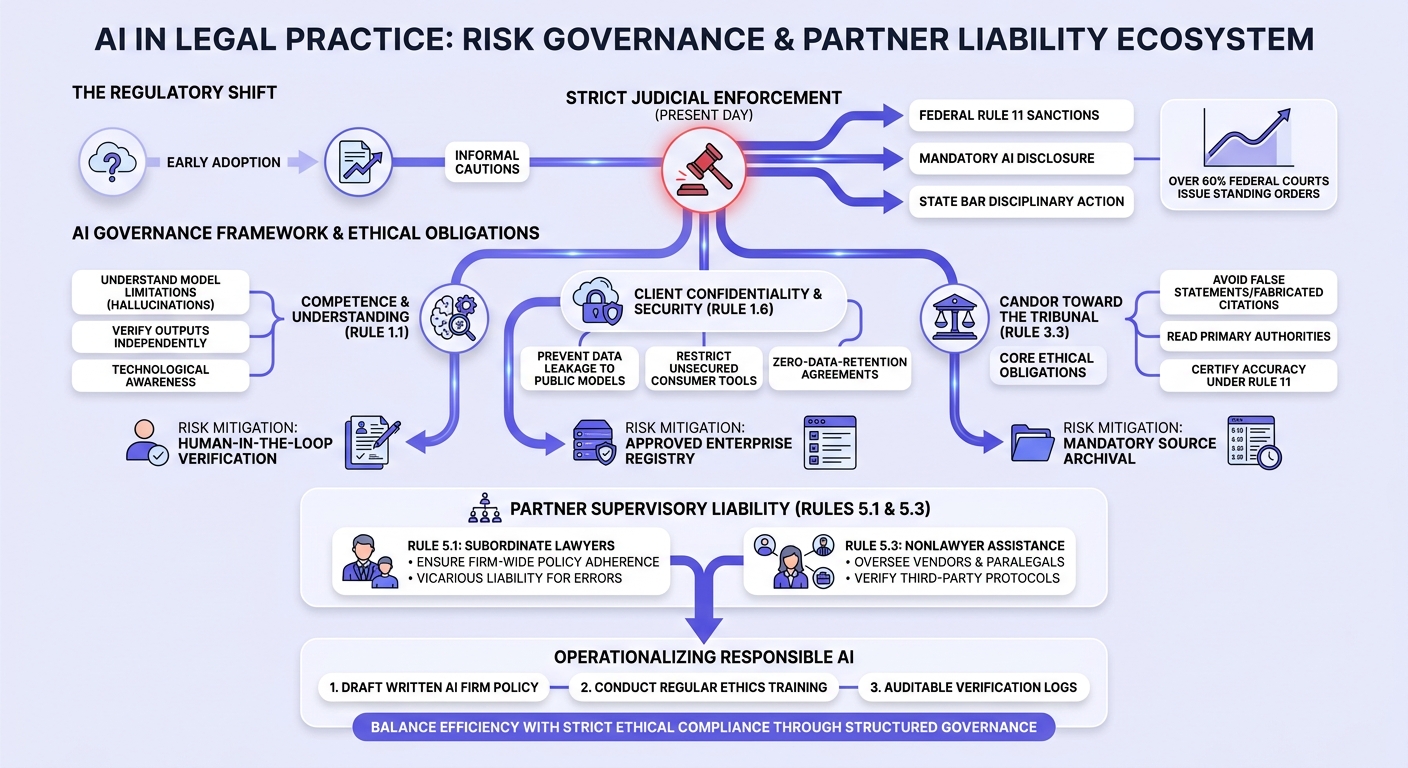
The Regulatory Shift: From Early Adoption to Strict Judicial Enforcement
Early discussions surrounding artificial intelligence in the legal sector focused primarily on theoretical efficiency gains and speculative risks. Today, that landscape has changed dramatically. Federal and state courts routinely handle disputes involving fictitious case citations generated by unmonitored commercial algorithms.
Judges rely on Federal Rule of Civil Procedure 11 to certify that every filed pleading, written motion, and supporting paper is well-grounded in fact and existing law. When an attorney submits a brief containing hallucinated citations generated by an automated assistant, signing counsel commits a sanctionable certification failure.
Sanctions are no longer limited to minor judicial reprimands. Recent appellate and district court rulings have imposed substantial monetary penalties, mandatory disclosures of AI use to prospective clients, and referrals to state disciplinary boards for formal license suspension.
Core Ethical Obligations Impacted by AI Tools
The American Bar Association provided definitive national guidance with ABA Formal Opinion 512, clarifying how the Model Rules of Professional Conduct govern generative tools across multiple practice areas.

Competence and Technological Understanding (Model Rule 1.1)
Under ABA Model Rule 1.1, lawyers must provide competent representation, which includes keeping abreast of the benefits and risks associated with relevant technology. Practitioners do not need a computer science degree, but they must understand:
- How generative models process prompts and predict textual outputs.
- The inherent risk of probabilistic "hallucinations" (confident fabrications of legal precedent or factual assertions).
- The limitations of automated reasoning when parsing complex jurisdictional statutes.
Client Confidentiality and Data Security (Model Rule 1.6)
Model Rule 1.6 requires attorneys to make reasonable efforts to prevent the inadvertent or unauthorized disclosure of client information. Standard consumer AI platforms often retain user prompts to retrain foundational models. Inputting non-public case strategies, trade secrets, or client identifiers into open web tools constitutes an immediate breach of confidentiality and can waive attorney-client privilege.
Firms must restrict staff to zero-data-retention enterprise tools that guarantee inputs will not be stored, shared, or utilized for third-party model training.
Candor Toward the Tribunal (Model Rule 3.3)
Attorneys have an absolute duty under Model Rule 3.3 not to make false statements of fact or law to a tribunal. Relying on an algorithm without reading the underlying primary authorities violates this duty. Even if the error originated from an automated assistant, the signing attorney remains entirely culpable for any misrepresentation presented in open court.
Partner Liability and Supervisory Duties Under Rules 5.1 and 5.3
One of the most consequential developments in legal risk management is the expansion of supervisory liability for law firm partners and department heads under ABA Model Rules 5.1 and 5.3.
- Model Rule 5.1 (Supervision of Subordinate Lawyers): Partners and supervisory lawyers must establish internal policies giving reasonable assurance that all lawyers in the firm conform to professional conduct rules. If a junior associate files an AI-generated brief with fabricated citations, the supervising partner can face disciplinary action if the firm lacked adequate oversight protocols.
- Model Rule 5.3 (Supervision of Nonlawyer Assistance): This obligation extends directly to paralegals, administrative staff, expert witnesses, and third-party software vendors. Partners must ensure that outside technology platforms and internal staff adhere to professional confidentiality and quality benchmarks.
Failing to implement an explicit firm-wide AI policy leaves partners directly exposed to vicarious disciplinary sanctions and malpractice claims.
Step-by-Step AI Governance Framework for Law Firms
To balance practical efficiency with strict ethics compliance, firms should adopt an enterprise risk framework aligned with the NIST AI Risk Management Framework.
- Establish an Approved Technology Registry: Prohibit the use of unauthorized consumer AI applications on firm hardware. Maintain a transparent list of enterprise-vetted tools with end-to-end encryption and strict data isolation.
- Mandate Human-in-the-Loop Verification: Institute a mandatory protocol requiring attorneys to trace every machine-generated legal citation back to its original primary source (e.g., official court reporters or statutory codes) before inclusion in any client deliverable or court filing.
- Draft a Written AI Firm Policy: Document clear guidelines defining permitted use cases (such as initial drafting, document indexing, or proofreading) and prohibited actions (such as inputting unredacted client identifying data into public models).
- Conduct Regular Ethics Training: Schedule recurring internal workshops for associates, paralegals, and legal assistants covering proper prompting, hallucination detection, and prompt-injection vulnerabilities.
- Implement Source Archival Procedures: Require legal teams to preserve underlying prompt chains and source documents in the client matter file to maintain audit-ready documentation in the event of an inquiry.
Comparing AI Risk Controls: Ad Hoc vs. Enterprise Governance
| Feature / Protocol | Ad Hoc Firm Approach | Enterprise Governance Standard |
|---|---|---|
| Tool Authorization | Unregulated use of consumer web apps | Vetted enterprise tools with SOC 2 compliance |
| Citation Verification | Optional spot-checking by drafting associate | Mandatory secondary source verification log |
| Data Privacy Controls | Prompts potentially ingested by third-party models | Zero-data-retention enterprise agreements |
| Supervisory Oversight | Blind reliance on associate certifications | Structured peer review and audit trails |
| Policy Enforcement | Informal verbal instructions | Documented, signed policy with annual training |
Common Implementation Mistakes to Avoid
Even well-intentioned firms encounter severe compliance pitfalls when modernizing their tech stack:
- Assuming Commercial Tools Are Free of Inaccuracies: Brand-name legal research tools with integrated machine learning can still hallucinate secondary references or mischaracterize jurisdictional holdings. Blind trust is never a substitute for independent legal analysis.
- Relying on Generic IT Policies: Standard employee handbooks rarely address legal ethics duties such as tribunal candor or procedural certifications under Rule 11.
- Neglecting Third-Party Vendors: Retaining e-discovery providers, contract review contractors, or expert witnesses without verifying their data handling protocols creates significant Model Rule 5.3 liability.
- Failing to Track Local Standing Orders: Dozens of federal district judges maintain specific local rules requiring formal certifications regarding generative software. Overlooking these local rules can result in struck filings and immediate monetary fines.
Operationalize Responsible AI in Your Firm
Navigating regulatory scrutiny while maintaining a competitive, modern litigation practice does not require sacrificing efficiency for safety. By establishing structured risk controls, thorough training, and auditable verification steps, your firm can capture productivity gains without compromising ethical obligations.
Discover how HyperCounsel helps law firms streamline compliant legal workflows, protect client confidentiality, and scale billable capacity safely. Book a Demo today to see our secure platform in action, or review our transparent Pricing to find the right configuration for your practice.
Take the Next Step
Ready to protect your business with expert legal support? Explore how HyperCounsel can help:
Frequently Asked Questions
What ethics duties apply when lawyers use generative AI in the United States?
Lawyers are governed primarily by ABA Model Rules 1.1 (Competence), 1.6 (Confidentiality), 3.3 (Candor Toward the Tribunal), and 5.1/5.3 (Supervisory Responsibilities). Attorneys must ensure that technical tools do not disclose protected client information, that all factual and legal assertions are independently verified, and that subordinate personnel follow strict compliance measures.
Can a partner be liable if a subordinate or vendor uses AI incorrectly?
Yes. Under Model Rules 5.1 and 5.3, partners with managerial authority must ensure the firm maintains reasonable supervisory systems. If a partner fails to establish verification policies or train staff, they can face direct disciplinary liability alongside the associate or vendor who committed the error.
What supervision and verification steps do firms need before filing AI-assisted work?
Firms must implement mandatory human-in-the-loop review. Every legal citation, factual assertion, and statutory interpretation generated by machine learning must be cross-referenced against primary legal sources by a licensed attorney prior to filing or client distribution.
What happens if AI-generated citations or facts are wrong in a court filing?
Submitting fabricated or erroneous content violates Federal Rule of Civil Procedure 11 and state equivalents. Courts routinely issue monetary sanctions, strike briefs, order formal apologies, require public disclosure of AI use, and refer responsible counsel to state bar disciplinary authorities.