

From $200 To $26,200: The Economic Value of AI Legal Tools for Canadian Law Firms
Discover how Canadian law firms are using AI to slash administrative drafting costs by over 98%.
The economic landscape of the Canadian legal market is undergoing its most rapid shift in decades. Implementing modern ai for lawyers canada is no longer a futuristic option—it is an immediate operational necessity.
According to recent economic data, 80% of Canadian law firms with over 20 lawyers are currently investigating or actively piloting generative AI systems to automate complex workflows. This adoption wave is not about novelty; it is about pure commercial survival. Firms that leverage advanced intelligence platforms are optimizing operating leverage, while those relying entirely on manual billable hours face significant risks of margin compression.
To help your practice adapt, we break down how modern platforms like HyperCounsel transform costly legal tasks into efficient, high-margin assets, keeping Canadian firms competitive, compliant, and highly profitable.
Table of Contents
- Quick Summary
- The Economic Shift: Slashing Commodity Costs
- The Friction: Corporate Pressure and the Death of the Hourly Rate
- Compliance: Navigating Canadian Regulations and AIDA
- Data Sovereignty: Why Canadian Legal Tech Matters
- Step-by-Step AI Implementation Plan for Canadian Firms
- Protect Your Firm and Fuel Your Growth
- Frequently Asked Questions
- Recommended
Quick Summary
| Takeaway | Explanation |
|---|---|
| Immediate Cost Reductions | Standard contract generation costs drop from thousands of dollars to under $50 per file when using custom AI engines. |
| Corporate Pressure | Enterprise clients are actively refusing traditional hourly billing rates for routine tasks like drafting and review. |
| Strict Compliance Matters | AI adoption must respect the upcoming Canadian Artificial Intelligence and Data Act (AIDA) frameworks. |
| Data Sovereignty is Critical | Cross-border data risks can be avoided by running legal workflows through platform infrastructure with secure data paths. |
| Compounding Moats | Early adopters build proprietary legal data sets that permanently lock in higher operating margins. |
The Economic Shift: Slashing Commodity Costs
For generations, Canadian law firms monetized routine manual work. Drafting articles of incorporation, standard commercial leases, non-disclosure agreements (NDAs), and standard wills required hours of junior associate time.
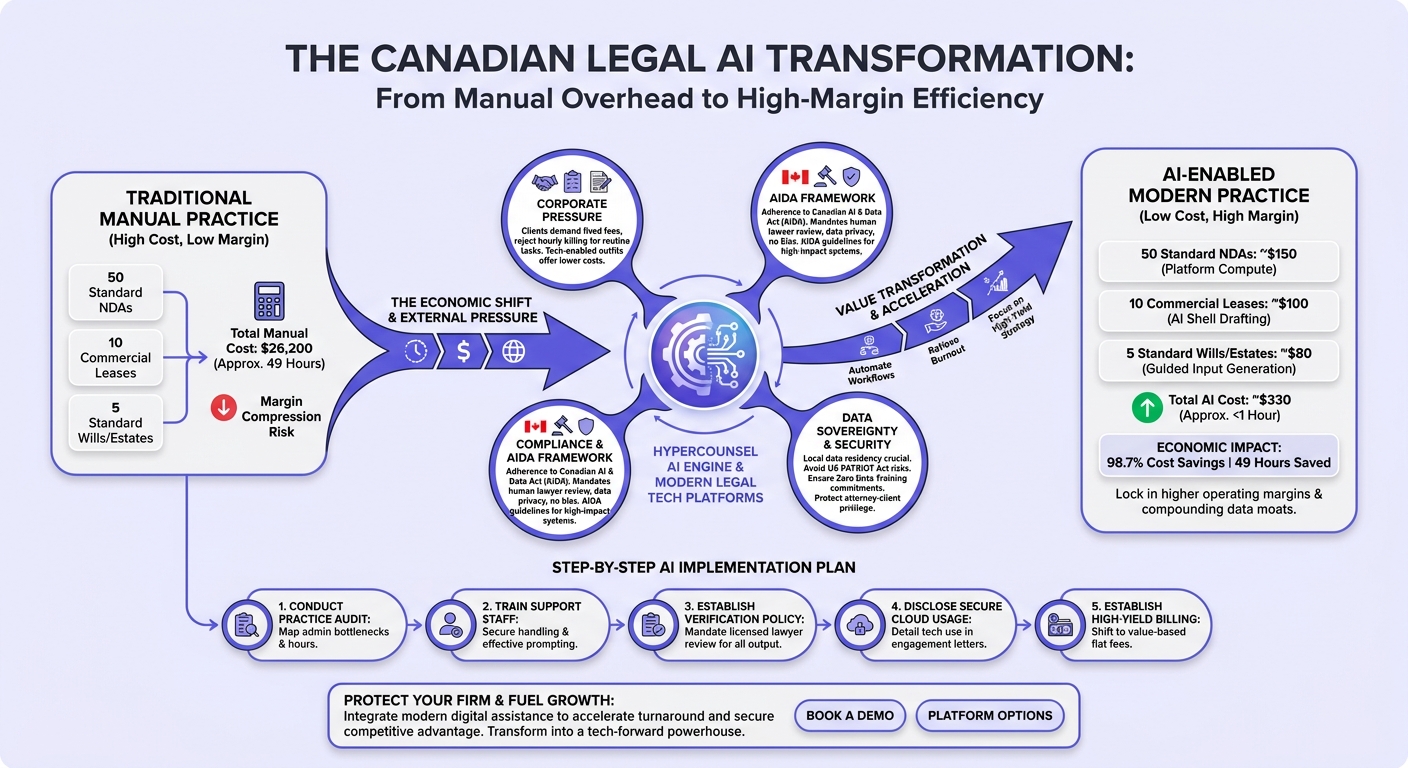
AI-driven workflows have completely rewritten this financial equation. What once cost thousands in billable hours now costs pennies in computing power. Let us examine the actual cost breakdown of processing 50 complex commercial NDAs and standard transactions.
| Legal Work Type | Traditional Manual Drafting Cost | AI-Accelerated Drafting Cost | Total Savings | Time Saved |
|---|---|---|---|---|
| 50 Standard NDAs | $12,500 (25 Hours @ $500/hr) | $150 (Platform Compute) | 98.8% | 24 Hours |
| 10 Commercial Leases | $8,000 (16 Hours @ $500/hr) | $100 (AI Shell Drafting) | 98.7% | 15 Hours |
| 5 Standard Wills/Estates | $5,700 (11.4 Hours @ $500/hr) | $80 (Guided Input Generation) | 98.5% | 10 Hours |
| Total Practice Cost | $26,200 | $330 | 98.7% | 49 Hours |
As outlined by the Canadian Bar Association (CBA), the use of artificial intelligence tools in legal practice significantly streamlines administrative overhead, relieves associate burnout, and allows counsel to focus on high-yield, complex litigation and strategic advisory work.
The Friction: Corporate Pressure and the Death of the Hourly Rate
Many boutique and corporate mid-sized law firms are feeling unprecedented friction from major enterprise clients. Forward-thinking corporate legal departments now understand the fast-paced nature of legal tech. They are rejecting invoices with billable hours assigned to basic agreement generation, database discovery, and historical document search.
- Client Audits: Enterprise procurement groups are auditing law firm invoices for tasks easily done by machine learning.
- Alternative Fee Arrangements (AFAs): In Canada, corporate clients are demanding fixed-fee pricing models that squeeze traditional firm billing models unless those firms use technology to complete the work in minutes rather than hours.
- The Alternative Solution: By employing smart legal assistants, forward-thinking partners can offer extremely competitive fixed rates while keeping net profit margins at 80% or more.
Firms that fail to integrate generative technology run a material risk of being displaced by tech-enabled outfits that provide similar legal outcomes at a fraction of the cost.
Compliance: Navigating Canadian Regulations and AIDA
Adopting AI technology is not entirely without risk. Canadian legal practitioners operate under a strict regulatory system that dictates how client files must be handled.
To remain fully secure and compliant, law partners must understand the statutory landscape:
- The Artificial Intelligence and Data Act (AIDA): Introduced as part of Bill C-27, the Government of Canada's AIDA framework establishes guidelines for high-impact AI systems. It introduces severe penalties for firms utilizing reckless, unverified, or biased systems that harm consumer privacy.
- Law Society Supervision Mandates: Virtually draft-level systems cannot replace physical legal representatives. Provincial bar associations (such as the Law Society of Ontario or the Law Society of British Columbia) explicitly require licensed human attorneys to review and sign off on all client deliverables.
- No Direct Reliance: Relying uncritically on standard output from unspecialized overseas chatbots often results in fabricated legal citations (commonly referred to as "AI hallucinations"). This can lead to public embarrassment and severe disciplinary action.
Data Sovereignty: Why Canadian Legal Tech Matters

When deploying cloud-hosted legal software, Canadian solo practitioners and firm operators must protect their clients' privilege.
Many cloud systems route private legal briefs through servers outside Canada's borders. This exposes sensitive client data to the US USA PATRIOT Act, foreign data subpoenas, and third-party data-mining training programs.
- Data Localization: Using foreign servers compromises attorney-client privilege.
- Zero Data Training Commitments: Professional legal AI platforms must guarantee that your private briefs and drafts are never used to train foreign public models.
- Sovereign Compliant Tech: Managing documents with locally structured platforms like HyperCounsel ensures sensitive IP stays within Canada's regulatory umbrella.
Step-by-Step AI Implementation Plan for Canadian Firms
Adopting modern legal intelligence does not require a complete organizational overhaul or millions of dollars in capital expenditure. Firms can transition cleanly by executing this simple five-step implementation plan:
- Conduct a Practice Audit: Map out exactly where your staff spends administrative hours. Typical administrative bottlenecks include contract review, basic drafting, lease analysis, and file intake.
- Train Support Staff: Ensure your legal assistants, paralegals, and junior associates are thoroughly trained in secure document handling and effective AI prompting.
- Establish an In-House Verification Policy: Mandate that an experienced, licensed Canadian lawyer review every single line of AI-generated legal text to prevent hallucinations or errors.
- Disclose Secure Cloud Usage if Required: Detail in your standard engagement letters how your firm utilizes cloud-based tech to keep customer fees low and output speeds high.
- Establish High-Yield Billing Models: Shift away from standard billing models toward value-based flat fees. This lets you capture the direct financial margin created by your tech stack.
Protect Your Firm and Fuel Your Growth
The future of the legal industry belongs to those who adapt. By integrating modern digital assistance into your everyday practice, your firm can dramatically accelerate case turnarounds, attract larger corporate clients, and unlock new, highly scalable revenue streams.
Transform your traditional practice into a tech-forward power house. Eliminate administrative drag, lower overhead costs, and secure clear, transparent competitive advantages for your business.
Ready to see how fast your legal operations can grow? Book a Demo with HyperCounsel today to secure your firm's market share under a predictable, flat-rate pricing plan.
This article provides general informational guidance and does not constitute formal legal counsel.
Take the Next Step
Ready to protect your business with expert legal support? Explore how HyperCounsel can help:
Frequently Asked Questions
How much money can Canadian law firms save by using AI for routine legal documents like NDAs?
Using a high-performance system like HyperCounsel, document generation and contract review costs drop by over 98%. Drafting dozens of routine documents changes from a multi-day administrative chore into a simple five-minute exercise.
What are the specific AI regulatory requirements for Canadian lawyers under the AIDA framework?
The Artificial Intelligence and Data Act (AIDA) regulates the use of high-impact AI systems. It requires Canadian legal practitioners to ensure that any active automated tools prioritize client data privacy and do not introduce systemic bias or risk to the public.
Do Canadian law societies require licensed lawyers to review AI-generated legal work?
Yes. Provincial law societies across Canada mandate that a human lawyer must review and approve all client drafts. AI applications are designed to help lawyers work faster, not replace the clinical judgment of a licensed professional.
Why should Canadian firms choose Canadian-built AI solutions instead of foreign legal tech?
Canadian-built or localized architectures help maintain complete data sovereignty. They ensure sensitive client files are not exported across international borders, keeping your firm fully compliant with national privacy frameworks and the USA PATRIOT Act.