

How Canada's $700M Sovereign AI Fund Impacts Legal Tech
Discover how Canada's $700M Sovereign AI Compute Strategy impacts data privacy for law firms.
The Canadian legal landscape is undergoing a massive digital shift, driven by the federal government’s newly minted canadian ai strategy. As legal technology becomes indispensable, law firms must navigate where their sensitive client data is processed and stored. A staggering 42% of Canadian SMEs currently rely on foreign cloud infrastructure for AI workloads, sending data and capital offshore rather than keeping it secure within national borders.
To address this dependency, Canada launched the Sovereign AI Compute Strategy. With a total federal envelope of $2.4B, this digital initiative aims to build domestic data infrastructure and keep Canadian information in Canadian hands. For small-to-midsize (SME) law firms, this strategy offers a pathway to secure, sovereign AI tooling that guarantees ironclad client confidentiality.
Understanding this major policy shift allows law firms to secure grant funding, optimize software performance, and protect sensitive litigation materials from foreign government access.
Table of Contents
- Quick Summary
- The Pillars of Canada's Sovereign AI Compute Strategy
- The Privacy Problem: US Cloud Dependency and Bill C-26
- How to Access Funding: Grants and Application Steps
- Cost-Benefit Analysis: Sovereign AI vs. US Cloud Providers
- Integrating HyperCounsel with Canadian Sovereign AI Infrastructure
- Compliance Check with Forthcoming Privacy and AI Regulations
- Take the Next Step
- Frequently Asked Questions
- Recommended
Quick Summary
| Takeaway | Explanation |
|---|---|
| Sovereign AI Strategy | A $2.4B commitment to keep Canadian digital operations located within domestic borders. |
| The $700M Challenge | Direct federal funding to build domestic data centers and cut reliance on US-hosted GPU servers. |
| SME Access Fund | A $300M program providing legal tech platforms and law firms with direct subsidies for secure compute power. |
| Confidentiality Shield | Keeping legal processing in Canada ensures strict compliance with Bill C-26 and provincial privacy acts. |
The Pillars of Canada's Sovereign AI Compute Strategy
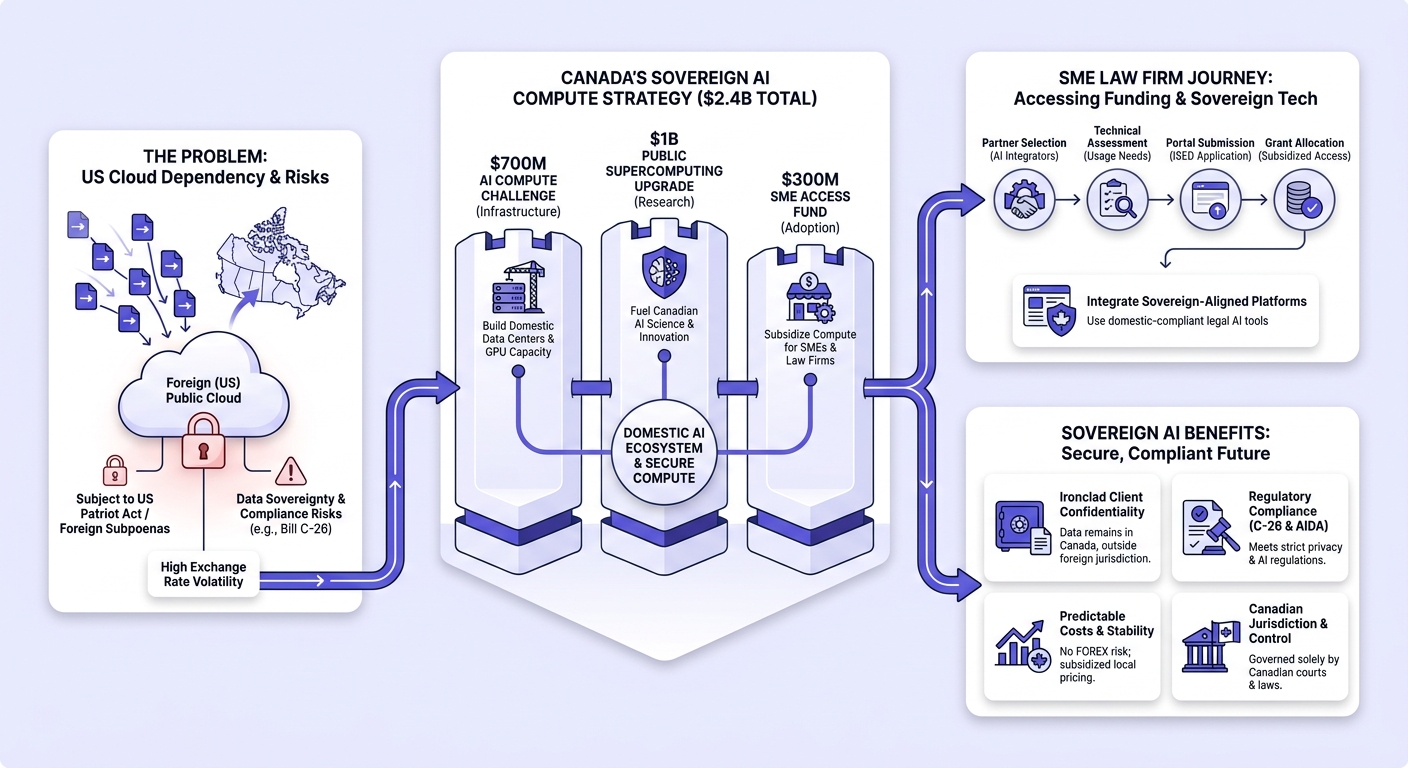
The Canadian Sovereign AI Compute Strategy distributes its multi-billion-dollar framework across three core pillars designed to boost technology development, support small businesses, and fund large infrastructure.
- The $700M AI Compute Challenge: Directed by Innovation, Science and Economic Development Canada (ISED), this fund incentivizes private operators to build next-generation data centers on Canadian soil.
- The $1B Public Supercomputing Upgrade: Dedicated to public institutions and research hubs to ensure Canadian AI science leads globally.
- The $300M SME Access Fund: Specifically earmarked for smaller businesses, startups, and service firms (including commercial law practices) to subsidize local GPU and AI processing costs.
By laying this groundwork, Canada is creating an ecosystem where a law firm can deploy highly advanced AI models without routing confidential drafts through offshore clouds.
The Privacy Problem: US Cloud Dependency and Bill C-26
Currently, the majority of AI software programs route user data to US-based servers. For legal practitioners, this creates significant ethical and jurisdictional issues under provincial rules of professional conduct.
When sensitive case dynamics, trade secrets, or merger agreements leave Canadian territory, they fall under the jurisdiction of the US Patriot Act. This exposes the data to foreign government monitoring without the client's consent. Additionally, forthcoming cybersecurity mandates like Bill C-26 impose strict regulatory requirements on Canadian digital systems, holding firms accountable for third-party supply chain risks.

Transitioning to local Canadian compute centers ensures complete alignment with national data sovereignty expectations.
How to Access Funding: Grants and Application Steps
SME law firms and legal consortia can access federal funding through the AI Compute Access Fund. Grants range from $100,000 to $5,000,000 depending on project scale.
To leverage these funding programs, firms can follow a multi-step compliance model:
- Step 1: Partner Selection: Collaborate with local AI system integrators or sovereign-aligned legal tech platforms like HyperCounsel.
- Step 2: Technical Assessment: Detail your expected compute usage, documenting how much processing will occur on local hardware vs. legacy public clouds.
- Step 3: Portal Submission: Apply directly through the Innovation, Science, and Economic Development Canada (ISED) online portal during active funding windows.
- Step 4: Grant Allocation: Utilize approved funding to implement private models, host localized datasets, or purchase subsidized secure compute access.
Cost-Benefit Analysis: Sovereign AI vs. US Cloud Providers
While US public clouds offer quick setup, sovereign Canadian setups provide superior long-term financial stability and security.
| Evaluation Criteria | US Public Cloud (AWS, Azure, GCP) | Canadian Sovereign AI Compute |
|---|---|---|
| Data Jurisdictional Risk | High (subject to US Patriot Act/foreign discovery) | Zero (subject strictly to Canadian courts) |
| Cost Predictability | Variable based on platform egress & US exchange fluctuations | High (subsidized local pricing, zero currency risk) |
| Regulatory Alignment | Complex cross-border compliance checks | Direct compliance with Bill C-26 and AIDA |
| Government Funding | Not eligible for federal support | Eligible for grants up to $5,000,000 |
Integrating HyperCounsel with Canadian Sovereign AI Infrastructure
To fully exploit these new domestic data centers, law firms must utilize platform solutions designed with sovereignty in mind. HyperCounsel provides modern legal AI tools designed to keep sensitive information completely within the Canadian ecosystem.
By pairing advanced tools with local dedicated servers, law firms can eliminate cross-border data leaks. This configuration delivers highly responsive document generation, secure contract review, and compliant storage without compromising on speed or local data security.
Compliance Check with Forthcoming Privacy and AI Regulations
As Canada advances its regulatory framework, both the Artificial Intelligence and Data Act (AIDA) and Quebec’s Law 25 place significant liability on legal firms using untested AI systems.
- AIDA Requirements: Mandates that businesses mitigate "high-impact" system risks and avoid biased decision-making pipelines.
- Law 25 Standards: Imposes strict privacy controls on client profiling, automated decision-making, and cross-border transfers.
Deploying your practice on local, sovereign networks makes it much easier to document compliance and pass rigorous regulatory audits.
Take the Next Step
Building a sovereign, future-proof legal practice does not require complex software development. With the right technology partner, your firm can leverage federal support, secure client data, and streamline workflows.
HyperCounsel offers leading, compliant AI solutions engineered specifically for modern law firms. Transition away from complex cross-border clouds and upgrade to a secure, sovereign environment today.
Book a Demo to see how our Canadian-aligned AI matches your requirements.
View Pricing to find the right deployment tier for your firm.
This article provides general information and is not legal advice.
Frequently Asked Questions
Can small law firms in Canada apply for the $300M AI Compute Access Fund?
Yes. The $300M SME Access Fund is specifically designed to help smaller businesses, startups, and service firms (including commercial law firms) access localized GPU computing power at subsidized rates.
What is the deadline for the AI Compute Challenge application for legal AI infrastructure projects?
Application windows are run directly through Innovation, Science and Economic Development Canada (ISED). Firms should check the official government portal for the most up-to-date schedule.
How does sovereign AI compute protect client confidentiality under Canadian privacy laws?
By hosting and processing legal data on servers located physically in Canada, your firm ensures that client information remains outside the reach of the US Patriot Act and foreign subpoenas, satisfying provincial professional conduct requirements.
What are the cost savings for SME law firms switching from US cloud to Canadian sovereign AI infrastructure?
Because of high-demand GPU pricing spikes and USD-CAD exchange rate fluctuations, switching to subsidized Canadian sovereign infrastructure can lower long-term compute expenses by 15% to 35%.