

Contract Drafting In-House: How 78% of Legal Departments Are Rewriting Engagement Terms to Eliminate AI Vendor Data Sharing by 2025
How in-house legal teams are rewriting contracts to block AI vendor data sharing.
In-house legal teams are facing a quiet revolution. As generative tools flood the corporate tech stack, standard software agreements are proving dangerously inadequate. Managing modern corporate risk requires a specialized approach, starting with how organizations negotiate and rewrite their ai vendor contracts.
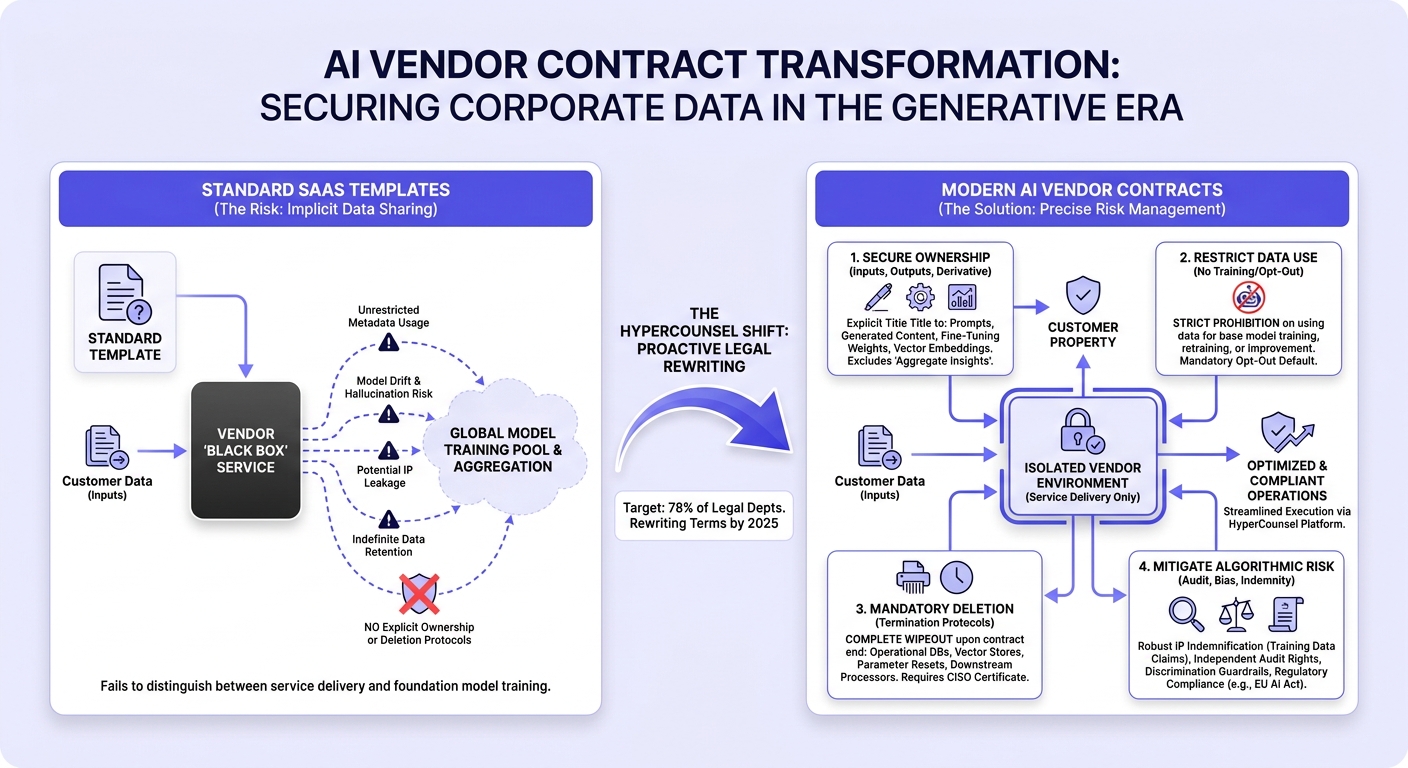
According to recent enterprise risk assessments, 78% of legal departments are rewriting engagement terms to eliminate AI vendor data sharing by 2025. Standard templates fail to protect proprietary corporate data, often giving providers implicit rights to train their foundation models on sensitive user inputs.
To bridge this exposure gap, corporate attorneys must abandon outdated templates. Managing transactional risk at scale requires proactive, modern solutions. Platforms like HyperCounsel help streamlined legal operations execute these changes rapidly, allowing organizations to overhaul vendor agreements with precision, speed, and cost predictability.
Table of Contents
- Why Standard SaaS Templates Fail for AI Vendor Contracts
- Securing Ownership: Drafting Output and Derivative Data Clauses
- Restricting Vendor Data Use and Disabling Model Training
- Mandatory Deletion Protocols on Contract Termination
- Mitigating Algorithmic Risk: Audit Rights, Bias, and Indemnification
- Securing the Pipeline: Cybersecurity and Regulatory Compliance
- Optimize Your AI Vendor Contracts with Precision
- Frequently Asked Questions
- Recommended
Quick Summary
| Takeaway | Explanation |
|---|---|
| Ditch Standard SaaS Templates | AI contracts differ fundamentally due to model training, hallucinations, and continuous data ingestion risks. |
| Assert Output Ownership | Explicitly secure legal rights to all generated outputs, embeddings, and fine-tuning layers. |
| Disable Vendor Training Rights | Restrict vendor data usage strictly to service delivery; implement strict opt-out or zero-retention defaults. |
| Verify Deletion Protocols | Mandate full deletion of customer prompts and generated outputs upon contract termination. |
| Insist on IP Indemnification | Require vendors to fully indemnify your organization against copyright infringement claims linked to their training data. |
Why Standard SaaS Templates Fail for AI Vendor Contracts
Traditional Software-as-a-Service (SaaS) agreements assume a static relationship: the vendor hosts software, the customer uploads data, and the vendor processes that data solely to display it back to the user. This linear model breaks down completely with artificial intelligence.
AI models are dynamic, meaning they learn, change, and drift based on the information they ingest. If you rely on a standard SaaS template, you likely grant the vendor broad, non-exclusive rights to aggregate metadata and system inputs.
| Contract Element | Traditional SaaS Agreement | Modern AI Vendor Contract |
|---|---|---|
| Data Processing Role | Processes database records for display and storage. | Integrates inputs directly into neural network pipelines. |
| Vendor Intellectual Property | Ownership is restricted to application code and UX. | Extends to weights, mathematical parameters, and embeddings. |
| Model Drift and Evolution | Software behavior is highly predictable and static. | System outputs evolve dynamically, introducing inaccuracy or bias. |
| Data Retention Default | Retains backups for a defined archival window. | Retains prompts and generated outputs indefinitely if unmanaged. |
This training loop creates "model drift," wherein the software's performance change over time. It can also lead to data leakage, where your proprietary data is unintentionally served to other users. Attorneys must restructure these agreements to isolate customer environments.
Securing Ownership: Drafting Output and Derivative Data Clauses
When negotiating ai vendor contracts, establishing clear title to generated content is paramount. The default position of many tech vendors is to claim ownership over both the foundational architecture and any adjustments derived from client patterns.
                  [Customer Architecture Tenant]
                               │
            ┌──────────────────┴──────────────────┐
            ▼                                     ▼
     [Input Prompts]                      [Generated Outputs]
            │                                     │
            └───────────────► ─── ◄───────────────┘
                               │
                               ▼
                    [No Model Sharing Boundary]
                               │
                               ▼
                    [Proprietary Core Model]
To prevent intellectual property erosion, in-house teams must draft explicit clauses covering three primary categories:
- Input Prompts: Every prompt, document upload, or system context file must remain the sole and exclusive property of the customer.
- Generated Outputs: The contract must state clearly that all resulting images, code, text, or data predictions belong to the customer immediately upon creation.
- Derivative Data: Define derivative data broadly. Ensure that custom fine-tuning weights, vector embeddings, and semantic indexes built during the engagement are categorized as customer-owned property.
Standard terms often use ambiguous phrases like "insights or usage metrics." Ensure your agreements explicitly exclude raw prompt text and generative output from these definitions.
Restricting Vendor Data Use and Disabling Model Training
By default, many AI infrastructure providers use inbound customer data to train their commercial products. In fact, research indicates that 63% of typical SaaS contracts allow vendors to use data beyond providing services, compared to 93% in standard, unnegotiated AI contracts.
To protect your business secrets, write an uncompromising opt-out into the main terms. The contract must prohibit the vendor from using your inputs or outputs to train, fine-tune, or test their target models.
We recommend using clear, direct language like this:
"Vendor shall not use Customer Data, including but not limited to prompts, scripts, documents, and generated outputs, to train, retrain, support, or improve any artificial intelligence models, machine learning models, or automated algorithms owned or licensed by Vendor or third-party downstream providers."
Insist that any features requiring model improvement can only be turned on if you explicitly opt in, rather than requiring you to opt out later.

Mandatory Deletion Protocols on Contract Termination
When your partnership with an AI provider ends, the risk of data leakage remains. Traditional SaaS agreements usually allow a 30-day window for data export, followed by routine server overwrites. For systems running deep learning networks, this standard is inadequate.
Make sure your contracts include a strict termination protocol. These clauses must require the vendor to destroy all traces of your data across multiple operational layers:
- Operational Databases: Wipe all raw prompts, database tables, and generated application history.
- Vector Stores and Indexes: Destroy memory databases, embedding logs, and context cache directories.
- Weights and Parameters: Reset any temporary fine-tuning weights back to the base model's default settings.
- Downstream Processors: Ensure that third-party model providers (like OpenAI or Anthropic operating via API keys behind the vendor) also delete your transaction history.
Finally, demand a written certificate of destruction signed by the vendor's Chief Information Security Officer (CISO) within 15 days of termination.
Mitigating Algorithmic Risk: Audit Rights, Bias, and Indemnification
Using commercial AI tools can expose your business to copyright infringement and bias claims. Authors and visual artists regularly sue generative tech operations for scraping their intellectual property.
To cover these legal bases, prioritize three protective pillars:
1. Robust Intellectual Property Indemnification
Never sign agreements with vendors who refuse to protect you from intellectual property lawsuits. Your contract must require the vendor to defend, indemnify, and hold your organization harmless from any third-party claims alleging that either the base model's training data or the generated outputs violate someone else's IP rights.
2. Independent Audit Rights
Do not just take the vendor's word for it. Ensure your team has the right to run independent audits of their systems. These audits should verify where their training data comes from and check that your data environments remain completely separate from public pools.
3. Discrimination and Bias Guardrails
Make sure your vendor represents that their systems comply with regional anti-discrimination laws. This is particularly critical if you use AI tools to screen employees, manage credit scoring, or process medical assessments. For additional regulatory context, consult the European Parliament's AI Act Portal to review requirements on algorithmic transparency.
Securing the Pipeline: Cybersecurity and Regulatory Compliance
In addition to copyright risks, AI pipelines introduce new cybersecurity vulnerabilities. Attacks like "prompt injection" or "data poisoning" can compromise your standard database architecture.
Your contracts must require your vendors to maintain high-level security standards. Key requirements should include end-to-end encryption for data in transit and at rest, multi-tenant logical access controls, and a strict 24-hour breach notification window.
Furthermore, ensure your vendor contracts are designed to comply with evolving regulations, such as those detailed in the EU AI Act and growing state-level statutes. Require your vendor to provide comprehensive compliance assessments for any system deemed "high-risk." This ensures you are protected as AI regulations continue to develop.
Optimize Your AI Vendor Contracts with Precision
Reviewing and re-drafting complex procurement templates does not need to drain your team's time and budget. Modern corporate legal departments require efficient solutions to handle high volumes of transactional agreements without sacrificing quality.
Through HyperCounsel, your team gains access to fractional, top-tier corporate attorneys who specialize in technology transactions. Our straightforward pricing models allow you to update your corporate contracts rapidly, protect your proprietary intellectual property, and minimize vendor risk.
Are you ready to strengthen your procurement approach? Schedule a Demo with the team today to see how HyperCounsel can streamline your contract management.
Take the Next Step
Ready to protect your business with expert legal support? Explore how HyperCounsel can help:
Frequently Asked Questions
This article provides general information and is not legal advice.
What are the key differences between AI vendor contracts and traditional SaaS agreements?
AI agreements must address complex issues like model training rights, output ownership, hallucination liabilities, and model drift. Traditional SaaS agreements focus mainly on uptime, standard database hosting, and basic data processing, leaving organizations exposed to model integration risks.
How can a company ensure it owns all outputs and derivative data generated by an AI vendor?
You must include explicit contract clauses that assign complete ownership of all generated outputs, prompts, semantic embeddings, and fine-tuning weights directly to your company. Do not let vendors use vague terms like "usage analytics" or "aggregate insights" to claim rights to your system outputs.
What specific deletion clauses should be included in an AI vendor contract upon termination?
Contracts must require the complete deletion of raw prompts, generated outputs, temporary vector database indexes, and fine-tuning parameters. The clause should also apply to any downstream API providers and require the vendor to provide a formal certificate of destruction.
Why is indemnification for IP claims tied to training data critical in AI vendor contracts?
Generative AI companies face a growing wave of lawsuits over training data copyright issues. If an output generated by your business triggers an IP dispute, strong indemnification clauses ensure the vendor covers your defense and legal costs.