

R1.9 Million Per Lawyer: How Generative AI and Document Management Systems for Law Firms Unlock Billables
Discover how South African law firms use AI and document management to reclaim unbilled hours.
South African law firms are losing hard-earned revenue to administrative overhead. For decades, outdated file structures and manually maintained legacy servers have slowed down processes, keeping practitioners away from high-value tasks. Transitioning toward modern digital document management systems for law firms is no longer just an administrative choice; it is now an essential mechanism for financial recovery.
Industry studies reveal that law firms adopting structured document management systems experience a 30% to 50% reduction in document retrieval time, allowing legal professionals to reallocate their hours toward profitable work. In a highly competitive South African legal market, saving these manual hours translates directly to protected profit margins.
By combining generative artificial intelligence (AI) and automated contract lifecycle management (CLM), firms can reclaim up to R1.9 million per lawyer annually in previously unbillable administrative hours. Let us look at how these integrated workflows transform modern legal practice.
Table of Contents
- The Hidden Cost of Manual Workflows in South Africa
- How Generative AI Transforms Document Management Systems
- Quantifying the ROI: Reclaiming R1.9M Per Lawyer
- Compliance First: POPIA and Professional Standards in South Africa
- Step-by-Step Implementation Roadmap
- Take the Next Step
- Frequently Asked Questions
- Recommended
| Takeaway | Explanation |
|---|---|
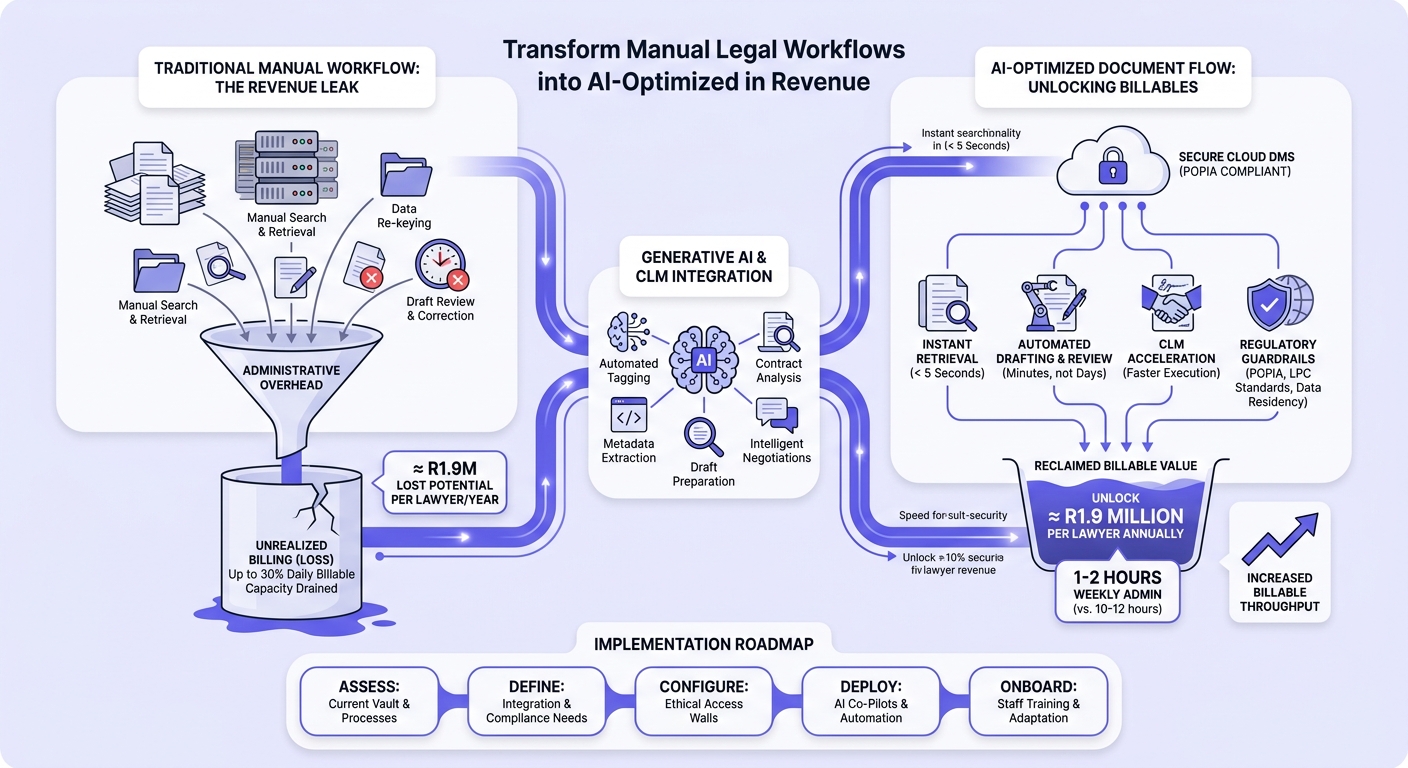
| The Revenue Leak | Manual search and administrative document handling drains up to 30% of a lawyer's daily billable capacity. |
| AI Integration | Generative AI automates metadata sorting, contract analysis, and draft preparation directly inside the document system. |
| Financial Impact | Reclaiming unbilled administrative hours unlocks an estimated R1.9 million in billable value per lawyer annually. |
| CLM Value | Contract Lifecycle Management speeds up contract execution from weeks to hours via automated, compliant workflows. |
| Regulatory Guardrails | AI systems must be calibrated to ensure full POPIA compliance and strict client data confidentiality. |
The Hidden Cost of Manual Workflows in South Africa
South African legal teams struggle with massive volumes of paper files and disorganized network drives. Senior associates and partners often act as high-priced administrative assistants, spending critical billable hours sorting through physical storage, manual spreadsheets, and local server directories.
Traditional folder systems lack the intelligent structural layouts designed for law firms. When your document workflows are slow, your business processes suffer. The time spent manually organizing contracts, reviewing drafts paragraph by paragraph, and correcting version errors represents systemic loss. In typical commercial litigation or transaction practices, this drag directly eats into your bottom line.
How Generative AI Transforms Document Management Systems
Integrating generative AI directly into your secure filing hierarchy turns unstructured storage into your firm's most valuable asset. This change frees your teams to analyze legal risks and generate billable hours rather than perform data entry.
Automated Document Review and Tagging
Using advanced language algorithms, modern AI categorizes incoming documents, registers metadata, and extracts critical dates. It delivers complete, citation-backed intelligence to your team members instantly.
For example, when a new contract is uploaded, HyperCounsel automatically indexes the parties, core liabilities, renewal terms, and governing law provisions without manual file tagging.
Contract Lifecycle Management (CLM) Acceleration
Contract Lifecycle Management (CLM) automates every phase of a lease, merger, or employment deal from initial draft to execution.
- Automated Drafting: Pulling relevant legal clauses dynamically based on transaction standards.
- Intelligent Negotiations: Quickly flagging non-standard language that deviates from corporate playbooks.
- Electronic Approvals: Safe, compliant electronic workflows that cut transit bottlenecks.

Quantifying the ROI: Reclaiming R1.9M Per Lawyer
To understand the financial implications of modernizing your document architecture, let us review a cost model. If a partner or senior associate bills at R3,500 per hour and spends roughly 10 hours a week on manual admin (e.g., retrieving files, re-keying data, and manually checking draft terms), the firm loses significant weekly revenue.
By deploying smart document automation, those 10 hours of admin drop to just 2 hours. The table below illustrates the financial difference over a standard 48-week working year.
| Operational Metric | Traditional Manual Flow | AI-Optimized Document Flow |
|---|---|---|
| Weekly Admin Time Lost | 10 to 12 hours | 1 to 2 hours |
| Document Retrieval Time | 10 to 15 minutes per search | Instant search (< 5 seconds) |
| Contract Review Pipeline | 3 to 5 business days | 15 to 30 minutes |
| Unrealized Billing (Per Lawyer/Year) | R1,920,000 lost potential | R0 (Highly optimized billing output) |
Reclaiming these wasted hours dramatically increases your team's billable throughput without adding internal headcount.
Compliance First: POPIA and Professional Standards in South Africa
Transitioning to high-performance cloud legal systems in South Africa requires strict adherence to regulatory standards:
- POPIA Compliance: Any cloud platform must process personal data inline with the Protection of Personal Information Act (POPIA). This requires secure hosting structures, end-to-end data encryption, and local data warehousing protocols.
- LPC Conduct Standards: The South African Legal Practice Council (LPC) enforces strict rules regarding client privacy. Cloud tools must utilize matter-based ethical walls to prevent internal unauthorized data leaks.
- Data Residency: Leading international providers host on localized cloud nodes (like AWS or Microsoft Azure's South Africa regions) to guarantee compliant data paths.
According to regional studies published by Pericent, moving to specialized, compliant platforms reduces total system storage overhead by up to 30% while protecting confidential legal archives.
Step-by-Step Implementation Roadmap
If your firm is eager to migrate to AI-enhanced file processes, use this step-by-step roadmap to protect your workflow:
- Assess Your Current File Vault: Identify physical file rooms, paper records, legacy shared drives, and chaotic inbox directories.
- Define Integration Requirements: Modern systems should connect directly with your existing billing packages and case systems. South African firms require seamless integrations to satisfy trust accounting duties, as detailed in recent local Legal Software Guides.
- Configure Ethical Access Walls: Define strict access permissions to keep sensitive client files segregated.
- Deploy AI Co-Pilots: Partner with a platform like HyperCounsel to run quick search queries, metadata indexing, and contract drafts.
- Onboard and Train Staff: Run practical training sessions for lawyers and administrative assistants to ensure overall adaptation.
Take the Next Step
Transforming your legal practice begins with shifting away from slow, manual file retrieval. With transparent pricing, rapid custom setup, and enterprise risk protection, HyperCounsel helps South African firms modernize their operations. Our tools automate document processes so your lawyers can focus on billing high-value hours.
Stop losing administrative hours and optimize your workflow.
This article provides general information and is not legal advice.
Frequently Asked Questions
How does generative AI improve document review speed in law firms?
Generative AI scans lengthy corporate portfolios in seconds. It extracts key terms, cross-checks regulatory references, and compiles analytical summaries. This reduces initial contract reviews from hours to minutes.
What is the ROI of implementing AI-driven document management systems for South African law firms?
For an attorney billing R3,500/hour, automating manual file categorization and search releases up to 8 billable hours per week. This totals over R1.3 million to R1.9 million in potential billing output per professional annually.
How does contract lifecycle management integrate with document management systems?
Contract Lifecycle Management acts as the operational layer inside your storage system. It controls contract assembly, flags playbook deviations, logs real-time changes, and processes electronic executions, maintaining a clean change history for all matters.
Are AI document management systems compliant with POPIA and professional conduct standards in South Africa?
Yes, provided they run on secure, POPIA-compliant cloud servers, use enterprise data encryption, and support granular user permissions. This keeps confidential data safe from outside breaches and protects LPC mandates.