

Impact of AI on Lawyers: Opportunities and Challenges in 2025
Discover the impact of AI on lawyers and legal professionals. Learn about new opportunities, key challenges, and how to adapt for future success.
Artificial intelligence is shaking up law firms in ways most people never predicted. Lawyers can now reclaim up to 4 hours each week thanks to AI automation, which stacks up to about $100,000 in new billable time annually. That sounds like a win for everyone. But here’s the twist. The biggest challenge lawyers face is not whether AI will replace them but whether they can keep up with the skills and ethical questions this new tech demands.
Table of Contents
- How Ai Is Changing Legal Workflows
- Key Benefits Of Ai For Lawyers And Firms
- Challenges And Ethical Concerns Of Legal Ai
- Preparing Lawyers For The Future Of Ai
Quick Summary
| Takeaway | Explanation |
|---|---|
| AI Enhances Efficiency and Productivity | AI technologies automate routine legal tasks, allowing lawyers to save time and focus on high-value work, which can lead to increased job satisfaction and productivity. |
| Improved Decision-Making Through Data Analysis | AI-driven systems provide comprehensive insights and predictive analytics, enabling lawyers to make more informed decisions and manage risks effectively. |
| Addressing Ethical Concerns is Essential | Legal professionals must navigate challenges like algorithmic bias, transparency, and data privacy while implementing AI to ensure fair and secure legal outcomes. |
| Continuous Learning and Skill Development | Lawyers need to develop AI-relevant technical skills and engage in ongoing learning to effectively integrate technology into their practice and maintain relevance in the field. |
| Transforming Client Engagement and Access to Justice | AI is revolutionizing client interactions and making legal services more accessible, ensuring a broader reach of assistance to underserved populations. |
How AI Is Changing Legal Workflows
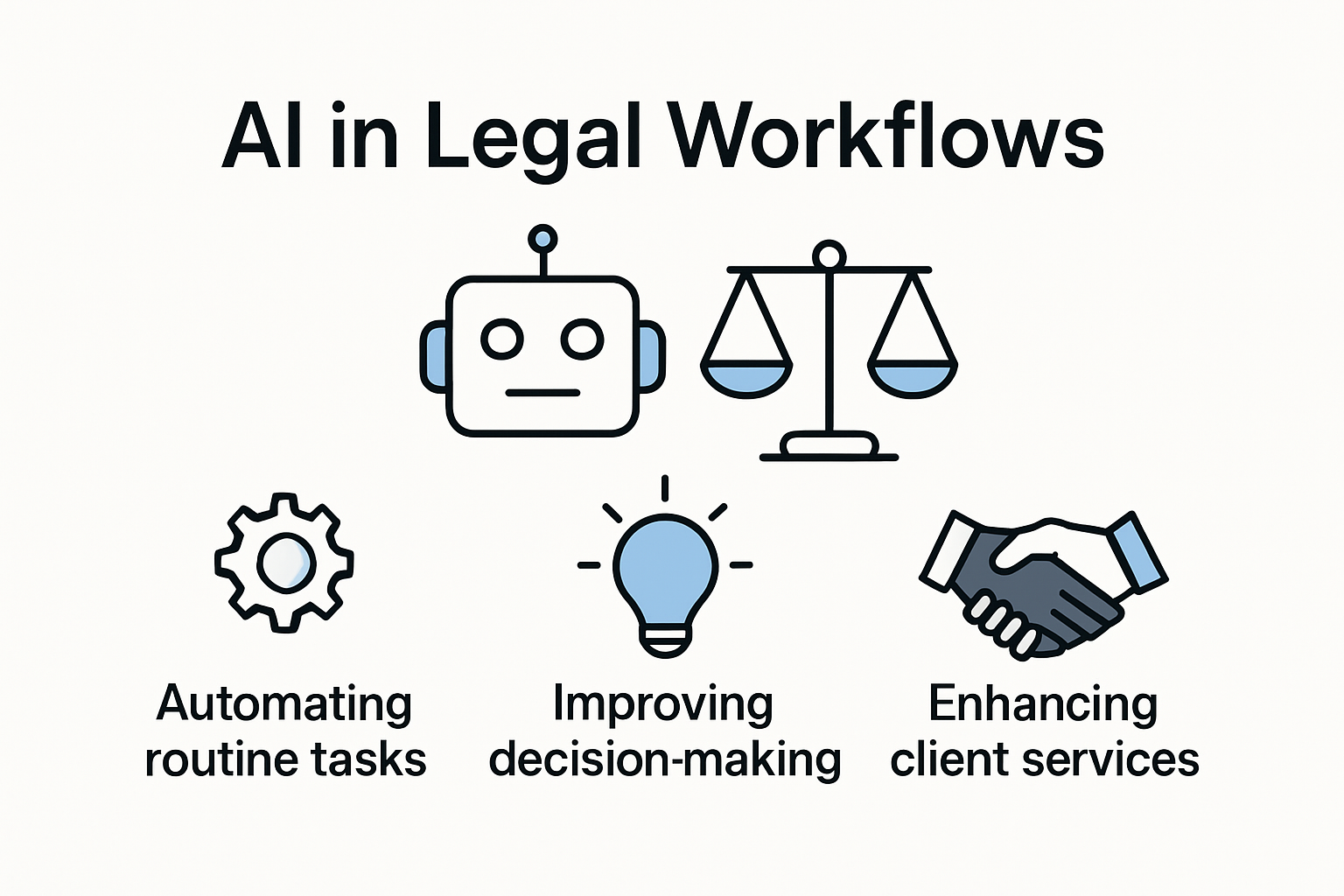
Artificial intelligence is fundamentally transforming legal workflows, creating unprecedented opportunities for efficiency and strategic work in the legal profession. Law firms and legal departments are experiencing a radical shift in how routine tasks are performed, with AI technologies enabling more intelligent and streamlined processes.
Automating Routine Legal Tasks
Legal professionals are witnessing a significant transformation through AI-powered automation. Learn more about contract drafting efficiency reveals that AI can dramatically reduce time spent on repetitive tasks. According to research from Thomson Reuters, lawyers can potentially save up to 4 hours per week through intelligent automation, which translates to approximately $100,000 in new billable time annually.
The most impactful areas of AI integration include document review, legal research, and contract analysis. These technologies can process vast amounts of information exponentially faster than human professionals, identifying patterns and extracting critical insights with remarkable precision. Complex tasks that previously consumed days of manual labor can now be completed in mere hours.
Here is a table summarizing the most impactful areas of AI automation in legal workflows and the benefits mentioned:
| Area of AI Integration | Impact/Benefit |
|---|---|
| Document Review | Faster processing, pattern identification |
| Legal Research | Significant time savings, improved data analysis |
| Contract Analysis | Smart insights, critical error detection |
| Routine Task Automation | Saves up to 4 hours per week, increases billable time |
| Manual Task Reduction | Reduces days of work to hours |
Enhanced Decision Making and Risk Management
Predictive analytics powered by machine learning can now forecast potential legal outcomes, helping attorneys develop more strategic approaches to cases. This capability enables lawyers to make more informed decisions, allocate resources more effectively, and provide more accurate risk assessments for their clients.
Transforming Client Services and Engagement

AI is revolutionizing how legal services are delivered and experienced. Advanced natural language processing and machine learning algorithms enable more personalized and responsive client interactions. Chatbots and AI-powered communication tools can handle initial client inquiries, schedule consultations, and provide basic legal information, allowing lawyers to focus on more complex and high-value tasks.
Moreover, AI technologies are creating more transparent and accessible legal services. By automating routine processes and reducing administrative overhead, law firms can offer more competitive pricing and faster turnaround times. This shift is not just technological but represents a fundamental reimagining of legal service delivery in the digital age.
Key Benefits of AI for Lawyers and Firms
Artificial intelligence is rapidly becoming a game-changing technology for legal professionals, offering transformative benefits that extend far beyond simple task automation. Law firms and individual lawyers are discovering unprecedented opportunities to enhance their practice through intelligent technological solutions.
Increased Efficiency and Productivity
AI technologies are dramatically reshaping legal productivity by eliminating time-consuming manual processes. Explore contract drafting solutions can help lawyers understand how these technologies translate into tangible efficiency gains. According to research from the American Bar Association, AI can significantly reduce the time lawyers spend on routine tasks such as legal research and document review.
Professionals can now redirect their energy toward more strategic and complex legal work. By automating document review, contract analysis, and legal research, AI enables lawyers to focus on high-value activities that require nuanced human judgment. This shift not only improves overall productivity but also enhances job satisfaction by allowing lawyers to engage in more meaningful and intellectually stimulating work.
Enhanced Accuracy and Consistency
One of the most critical advantages of AI in legal practice is its ability to minimize human errors and maintain consistent work quality. Insights from legal technology experts demonstrate that AI-powered tools can significantly improve accuracy in complex legal tasks.
Machine learning algorithms can process vast amounts of information with remarkable precision, identifying patterns and potential risks that might escape human review. This enhanced accuracy is particularly valuable in contract analysis, legal research, and compliance monitoring. By reducing the likelihood of human error, AI helps law firms maintain higher standards of work and mitigate potential legal risks.
Improved Access to Justice
AI technologies are not just transforming large law firms but are also creating opportunities for broader access to legal services. Research from legal innovation centers indicates that AI tools can help legal aid attorneys serve more clients more efficiently.
By streamlining administrative tasks and reducing overhead costs, AI enables smaller practices and public interest lawyers to handle more cases. This democratization of legal technology means that more individuals can receive quality legal assistance, potentially bridging gaps in legal representation. AI-powered chatbots and automated intake systems can provide initial legal guidance, making basic legal information and support more accessible to those who might not traditionally afford comprehensive legal services.
As the legal profession continues to evolve, AI represents not just a technological upgrade but a fundamental reimagining of how legal services can be delivered more effectively, efficiently, and equitably.
Below is a summary table highlighting three key benefits of AI for lawyers and firms, as discussed in the section:
| Benefit | Description |
|---|---|
| Efficiency & Productivity | Reduces manual tasks, allows focus on complex legal work |
| Accuracy & Consistency | Minimizes human error, maintains quality and standards |
| Access to Justice | Expands reach, helps underserved clients more efficiently |
Challenges and Ethical Concerns of Legal AI
As artificial intelligence continues to reshape the legal profession, a complex landscape of ethical challenges and potential risks emerges. While AI offers tremendous benefits, legal professionals must carefully navigate the profound implications of these technological advancements.
Algorithmic Bias and Fairness
One of the most critical ethical concerns surrounding legal AI is the potential for algorithmic bias. Learn about AI contract safeguards can help professionals understand the nuances of technological fairness. According to research on algorithmic bias, AI systems can inadvertently perpetuate existing prejudices embedded in historical legal data.
Machine learning algorithms trained on historical legal documents and case records may unconsciously replicate systemic biases related to race, gender, socioeconomic status, and other protected characteristics. This means AI systems could potentially make recommendations or predictions that reflect historical discrimination, undermining the fundamental principle of equal justice under the law. Legal professionals must be vigilant in identifying and mitigating these biases to ensure fair and equitable legal outcomes.
Transparency and Accountability Challenges
The opaque nature of AI decision-making processes presents significant challenges for legal transparency. Insights from legal technology experts highlight the complex “black box” problem inherent in many AI systems.
Many advanced AI algorithms operate using complex neural networks and machine learning models that make it difficult to understand exactly how specific conclusions are reached. This lack of interpretability creates substantial challenges in legal contexts where reasoning and justification are paramount. Lawyers and judges require clear explanations for legal decisions, but many AI systems cannot provide comprehensive insights into their decision-making processes. This opacity raises critical questions about accountability and the potential for challenging AI-generated recommendations or predictions.
Data Privacy and Confidentiality Risks
The integration of AI into legal practices introduces significant data privacy and confidentiality challenges. Research from legal ethics organizations emphasizes the critical importance of protecting sensitive client information.
AI systems require extensive data to function effectively, which means they must process large volumes of potentially confidential legal documents and personal information. This creates substantial risks for data breaches and unauthorized information disclosure. Legal professionals must implement rigorous security protocols and carefully evaluate AI tools to ensure they meet stringent confidentiality standards. Moreover, international data protection regulations like GDPR and emerging AI governance frameworks further complicate the landscape of technological implementation in legal practices.
As the legal profession continues to integrate AI technologies, addressing these ethical challenges will be crucial. Responsible implementation requires a balanced approach that leverages technological advantages while maintaining core legal principles of fairness, transparency, and client protection.
Preparing Lawyers for the Future of AI
The rapid advancement of artificial intelligence demands a proactive approach from legal professionals. Preparing for the AI-driven future requires strategic skill development, continuous learning, and a comprehensive understanding of technological integration within the legal landscape.
Developing AI-Relevant Technical Skills
Explore contract drafting skills to understand the foundational technological competencies emerging in legal practice. According to research from the Journal of Engineering Research and Reports, legal professionals must develop a nuanced skill set that bridges traditional legal expertise with technological proficiency.
Lawyers will need to cultivate competencies in data analysis, machine learning fundamentals, and AI system interpretation. This includes understanding how AI algorithms work, their limitations, and potential biases. Technical skills such as basic programming, data interpretation, and AI system evaluation will become increasingly valuable. Law schools and professional development programs must evolve to include courses on AI technologies, legal tech tools, and technological risk management.
Strategic Adaptation and Continuous Learning
Insights from legal technology experts emphasize the importance of a proactive learning approach. The legal profession must embrace a culture of continuous technological education and adaptability.
Professional development will require lawyers to regularly update their knowledge about emerging AI technologies, legal tech innovations, and ethical considerations. This might involve participating in specialized workshops, attending technology conferences, and engaging in ongoing certification programs focused on AI and legal technology. The goal is not to compete with AI but to become sophisticated collaborators who can leverage technological tools effectively.
Ethical and Strategic AI Integration
Research in Applied Mathematics and Nonlinear Sciences suggests that legal professionals should approach AI with a balanced perspective, emphasizing both technological leveraging and critical assessment. This means developing skills to critically evaluate AI systems, understand their potential risks, and implement responsible usage strategies.
Lawyers must become adept at managing the intersection of human judgment and artificial intelligence. This involves understanding how to validate AI-generated insights, recognize potential algorithmic biases, and maintain the fundamental ethical standards of legal practice. Strategic AI integration requires a nuanced approach that preserves the irreplaceable human elements of legal reasoning such as empathy, contextual understanding, and complex ethical decision-making.
As the legal profession stands at the cusp of a technological revolution, success will depend on lawyers who can seamlessly blend traditional legal expertise with cutting-edge technological capabilities. The future belongs to those who can navigate this complex landscape with skill, adaptability, and a forward-thinking mindset.
Frequently Asked Questions
How is AI changing the legal profession?
AI is transforming the legal profession by automating routine tasks such as document review and legal research, improving efficiency and enabling lawyers to focus on more complex legal work.
What are the benefits of AI for lawyers and law firms?
AI offers several benefits, including increased efficiency and productivity, enhanced accuracy and consistency in legal tasks, and improved access to justice for underserved populations.
What ethical concerns are associated with the use of AI in law?
The primary ethical concerns include algorithmic bias, transparency and accountability challenges, and risks to data privacy and confidentiality, which legal professionals must navigate to ensure fair legal outcomes.
How can lawyers prepare for the future of AI in legal practice?
Lawyers can prepare for the future of AI by developing relevant technical skills, engaging in continuous learning, and strategically integrating AI into their practice while maintaining ethical standards.
Ready to Transform Your Legal Workflow with AI-Driven Contract Automation?
Lawyers today are under pressure to keep up with rising workloads and shifting demands. The article highlights how many firms lose precious billable hours to manual document review, slow contract drafting, and repetitive legal tasks. If you feel caught between the need for efficiency and the responsibility to uphold legal accuracy and ethical standards, you are not alone. Advanced AI can be the answer to closing that gap while still maintaining control, accuracy, and compliance.
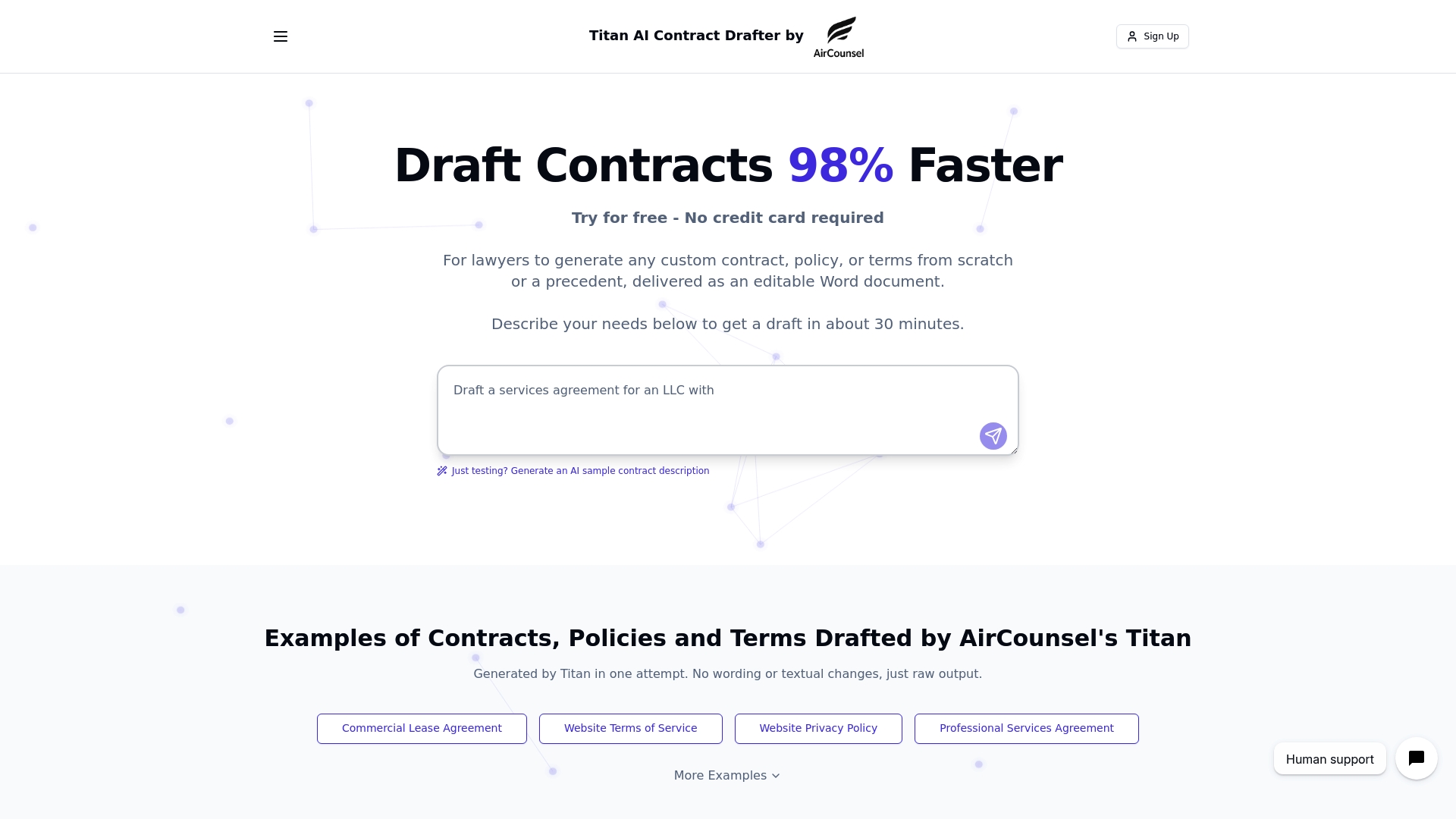
With AI-powered contract automation, you can reclaim lost time, improve consistency, and stay at the forefront of legal innovation. Discover how your practice can draft contracts up to 98 percent faster and serve clients with greater confidence. Visit our platform now to see how easy it is to automate legal document creation and experience faster contract solutions designed for modern lawyers. Take the step forward that your future self will thank you for—start streamlining your legal practice today.
Recommended
- FAQs - AirCounsel AI Contract Drafting Platform | AirCounsel for Lawyers
- AirCounsel for Lawyers - Draft Contracts 98% Faster with AI
- AirCounsel for Lawyers - Draft Contracts 98% Faster with AI
- AirCounsel for Lawyers - Draft Contracts 98% Faster with AI
- Pricing Plans - AirCounsel for Lawyers | AirCounsel for Lawyers
- AirCounsel for Lawyers - Draft Contracts 98% Faster with AI