

Implementing Agentic AI for Law Firms: Operational and Ethical Guardrails
Discover operational controls and ethical guardrails for deploying agentic AI in your law firm.
The rapid adoption of modern software has shifted how legal organizations evaluate artificial intelligence. While early tools focused on drafting simple correspondence or summarizing transcripts, modern ai for law firms increasingly involves agentic systems—software capable of planning multi-step workflows, querying databases, and executing tasks across internal firm tools with minimal human intervention.
Despite this efficiency, organizational safeguards frequently lag behind technology adoption. In recent industry benchmarking, 69% of legal professionals reported using general-purpose AI tools at work, yet fewer than half of law practices have established binding governance frameworks or explicit supervision protocols for automated legal tasks.
When autonomous or semi-autonomous tools handle sensitive client matters, firms must address critical professional responsibility obligations. Establishing robust operational controls, strict vendor vetting, and structured human checkpoints ensures your firm unlocks efficiency while protecting client privilege, confidentiality, and work quality.
Table of Contents
- Understanding Agentic AI in Legal Practice
- The Legal Readiness Gap and Core Ethical Risks
- Minimum Readiness Checklist for Law Firm Deployment
- Vendor Due Diligence and Procurement Red Flags
- Phased Implementation: From Low-Risk Tasks to Live Matters
- Take the Next Step with HyperCounsel
- Frequently Asked Questions
- Recommended
Quick Summary
| Takeaway | Explanation |
|---|---|
| Definition | Agentic AI systems autonomously plan, execute, and iterate multi-step legal workflows rather than just answering single prompts. |
| Ethical Standard | Attorneys maintain non-delegable ethical duties regarding competence, client confidentiality, and supervision under professional rules. |
| Mandatory Controls | Implement role-based permissions, comprehensive audit logging, data siloing, and mandatory human review before work product release. |
| Vendor Safeguards | Contracts must explicitly forbid training external foundational models on law firm or client data. |
| Phased Adoption | Roll out automated workflows across low-risk internal tasks before expanding to active client-facing legal matters. |
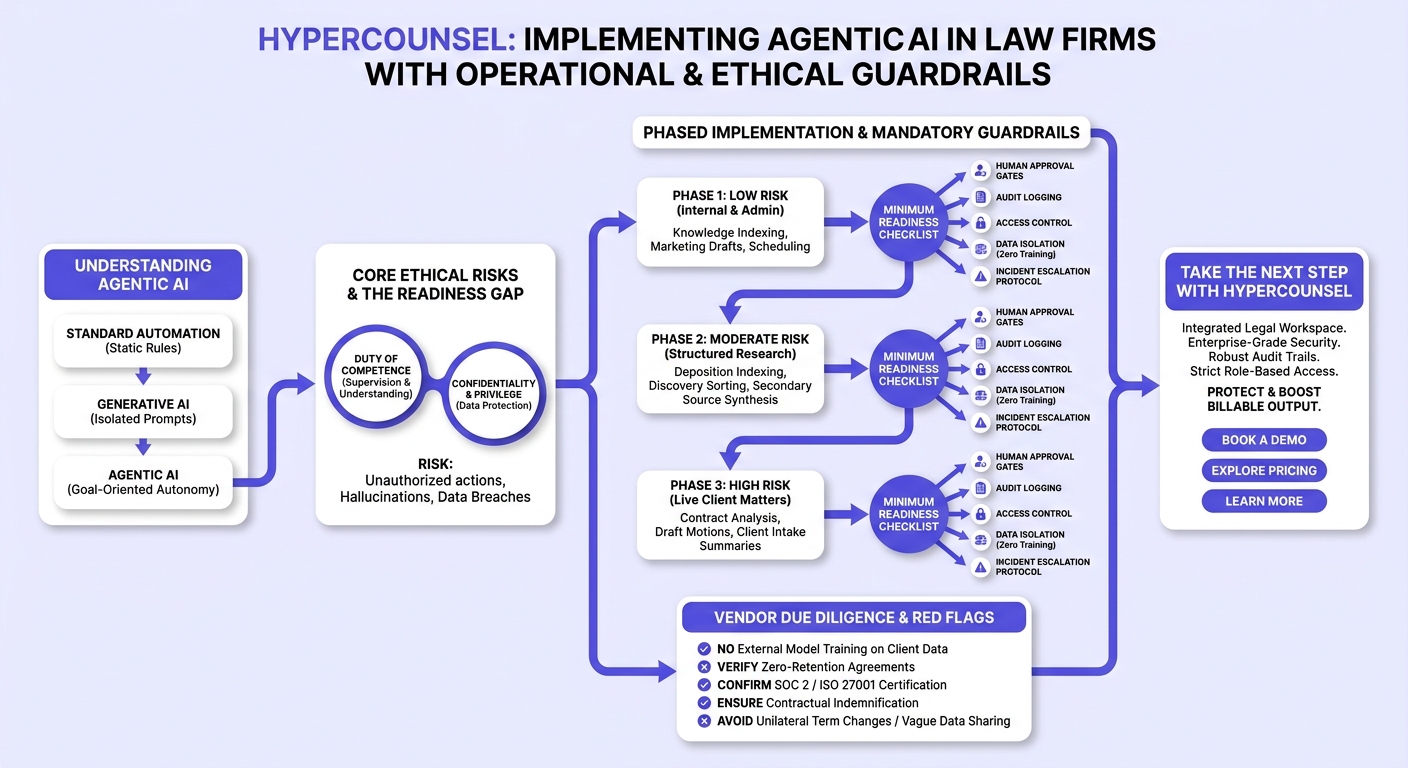
Understanding Agentic AI in Legal Practice
To manage risk effectively, firm leadership must distinguish between basic automation, generative drafting assistants, and agentic systems. Standard generative tools respond to isolated prompts by predicting text. In contrast, agentic AI operates with goal-oriented autonomy: it can break complex instructions into individual sub-tasks, retrieve case files, cross-reference jurisdictional rules, draft initial briefs, and flag missing exhibits.
Standard Automation: Follows deterministic "if-then" rules for static document assembly.
Generative AI: Produces text or summaries based on isolated user prompts.
Agentic AI: Evaluates goals, plans steps, queries multiple data sources, and executes actions across software environments.
While agentic workflows offer substantial time savings for legal research and document review, their autonomous nature introduces unique exposure points. When an AI agent decides which secondary sources to consult or drafts communications without immediate review, traditional supervisory models must adapt to ensure compliance.
The Legal Readiness Gap and Core Ethical Risks
Deploying automated workflows without formal policies creates significant regulatory and professional liability. Legal ethics committees nationwide emphasize that adopting advanced technology does not diminish an attorney's baseline professional responsibilities.
According to ethical standards outlined by the American Bar Association, lawyers must maintain technological competence and properly supervise both human subordinates and non-human tools assisting with client representation.

Supervision and Duty of Competence
Attorneys cannot delegate ultimate legal judgment to automated systems. If an autonomous workflow generates flawed legal analysis, cites non-existent case law, or miscalculates filing deadlines, the supervising attorney remains fully liable. Competence requires understanding how the software reaches conclusions, where its training data originates, and its technical limitations.
Confidentiality and Privilege Protection
Client data entered into AI environments must remain strictly confidential. Inadvertent disclosure to public model repositories can waive attorney-client privilege and breach non-disclosure agreements. Unmanaged browser extensions and consumer-grade AI tools often store inputs for external model retraining, creating severe data breach risks.
Minimum Readiness Checklist for Law Firm Deployment
Before connecting automated tools to firm document management systems or practice management software, firms should implement an internal governance framework. Utilizing an enterprise-grade platform like HyperCounsel helps ensure strict data partitioning and transparent human-in-the-loop workflows.
| Readiness Component | Required Control | Operational Objective |
|---|---|---|
| Human Approval Gates | Mandatory sign-off prior to external transmission | Prevents unreviewed filings or unauthorized client communications. |
| Audit Logging | Immutable system logs capturing prompt histories and sources | Provides traceability for ethical compliance and internal reviews. |
| Access Control | Role-based permissions mapped to matter authorization | Restricts sensitive matter records to assigned team members. |
| Data Isolation | Zero-retention agreements and zero-model-training clauses | Guarantees proprietary client data is never used for external AI training. |
| Incident Escalation | Documented protocol for hallucinations or system errors | Ensures rapid correction and client notification if required. |
Vendor Due Diligence and Procurement Red Flags
Legal technology procurement requires deep technical and contractual evaluation. Consumer software terms of service are rarely suitable for legal practice requirements.
When evaluating external software providers, review these critical factors:
- Data Ownership and Model Training: Verify that the vendor does not use firm prompts, uploaded documents, or matter metadata to train or refine public or proprietary AI models.
- Data Retention Windows: Ensure prompt and output data is purged immediately or retained strictly within your firm's encrypted workspace.
- SOC 2 Type II and ISO 27001 Certification: Confirm third-party audits validate the vendor's data security, access management, and infrastructure controls.
- Contractual Indemnification: Look for clear intellectual property infringement indemnification and explicit warranties regarding data confidentiality.
- Contract Red Flags: Avoid vendors whose contracts allow unilateral terms changes, vague data-sharing arrangements with third-party sub-processors, or undefined data storage locations.
Phased Implementation: From Low-Risk Tasks to Live Matters
A phased rollout allows legal teams to test system reliability, refine internal prompting protocols, and build practitioner confidence without compromising client interests.
Phase 1: Internal Knowledge & Administrative Tasks (Low Risk)
└── Internal policy indexing, marketing drafts, administrative scheduling, and template modernization.

Phase 2: Structured Legal Research & Discovery Support (Moderate Risk)
└── Deposition indexing, initial discovery document sorting, and secondary source synthesis with mandatory peer review.

Phase 3: Client Matter Integration (High Risk)
└── Transactional contract analysis, draft motion preparation, and client intake summaries with mandatory attorney verification.
- Phase 1: Internal Administrative Workflows: Start with internal administrative tasks, non-confidential practice guides, and template standardization. This phase establishes prompt hygiene and tests basic output accuracy.
- Phase 2: Structured Research and Document Review: Transition to closed-universe tasks such as deposition indexing, contract clause comparison, and case law summarization. Every output must be cross-verified against primary source records.
- Phase 3: Active Client Matter Integration: Deploy agentic workflows on live matters only after establishing strict review gates. Every brief, filing, and communication generated with AI assistance must receive documented review from a licensed attorney.
Take the Next Step with HyperCounsel
Navigating autonomous workflows requires software designed specifically for the ethical, security, and operational standards of modern legal practice. HyperCounsel delivers an integrated legal workspace equipped with enterprise-grade data security, robust audit trails, and strict role-based access controls to safeguard firm operations.
Protect your firm against confidentiality breaches and unmonitored automations while boosting billable output. Schedule a consultation to explore our transparent fixed pricing models and discover how structured governance protects your firm.
Frequently Asked Questions
What is agentic AI in a law firm context?
Agentic AI refers to systems capable of pursuing complex legal objectives autonomously. Unlike basic generative chatbots that answer single questions, agentic tools can plan multi-step workflows, search multiple document repositories, cross-reference jurisdictional authorities, and execute tasks across connected software with minimal direct prompting.
What policies should a firm have before using AI on client matters?
Firms should establish an internal AI Governance Policy that defines permitted use cases, lists approved enterprise tools, mandates human verification before external document release, and forbids the entry of confidential client data into public or unapproved consumer AI models.
How do lawyers supervise AI outputs and prevent hallucinations or unauthorized actions?
Lawyers supervise AI by maintaining mandatory human-in-the-loop review checkpoints. Practitioners must verify primary sources, review statutory citations, check calculations, and confirm that all automated drafts align with jurisdictional requirements before submitting filings or transmitting advice to clients.
What security and confidentiality issues should firms evaluate before adopting agentic AI?
Firms must verify that vendors provide enterprise-grade encryption, zero-data-retention guarantees, and binding commitments that matter data will not be used to train external models. In addition, firms must enforce role-based access controls and maintain immutable audit logs for all system interactions.