

The Client Relationship Revolution: How Legal AI UK Reshapes External Counsel Expectations
Learn how UK corporate legal departments use AI and what external law firms must do to adapt.
Corporate legal departments across the United Kingdom are undergoing a rapid technological transformation. Driven by the pressure to reduce overhead and increase internal efficiency, in-house teams are adopting legal ai uk tools to automate high-volume work.
According to recent industry data, 79% of legal professionals use general AI tools in their day-to-day work, and over one-third of in-house teams have invested in dedicated legal AI software (Brightflag). This shift is fundamentally changing what corporate clients expect from their external law firms.
For external counsel, this means the traditional billable-hour model and slow turnaround times are no longer acceptable. Partners at UK law firms must modernize their workflows or risk losing their most valuable corporate accounts. Here is how modern practitioners can leverage HyperCounsel to adapt to these new, AI-driven expectations.
Table of Contents
- Quick Summary
- The Shift in UK Corporate Legal Departments
- Specific In-House AI Use Cases Reducing Dependency
- How External Counsel Must Adapt
- Addressing Barriers to AI Adoption in the UK
- Strategies for External Lawyers to Demonstrate Value
- Adapting Corporate Law Firm Costs and Timelines
- Common Pitfalls When Responding to Client AI Demands
- Elevate Your Practice with Advanced Legal Tech
- Frequently Asked Questions
- Recommended
Quick Summary
| Takeaway | Explanation |
|---|---|
| In-House Independence | UK in-house teams are using legal AI to handle contract reviews and basic drafting internally, reducing reliance on external advice. |
| Evolving Expectations | Clients now demand faster turnaround times, data-backed risk analysis, and transparent pricing structures from panel firms. |
| Adapting Workflows | External law firms must adopt tools like HyperCounsel to automate routine tasks and focus on complex, high-value strategy. |
| Predictive Analytics | General counsel expect external firms to provide predictive insights and proactive risk modeling rather than retrospective legal advice. |
| Overcoming Friction | Security and reliability remain top concerns; law firms that use secure, compliant AI systems gain a competitive edge. |
The Shift in UK Corporate Legal Departments
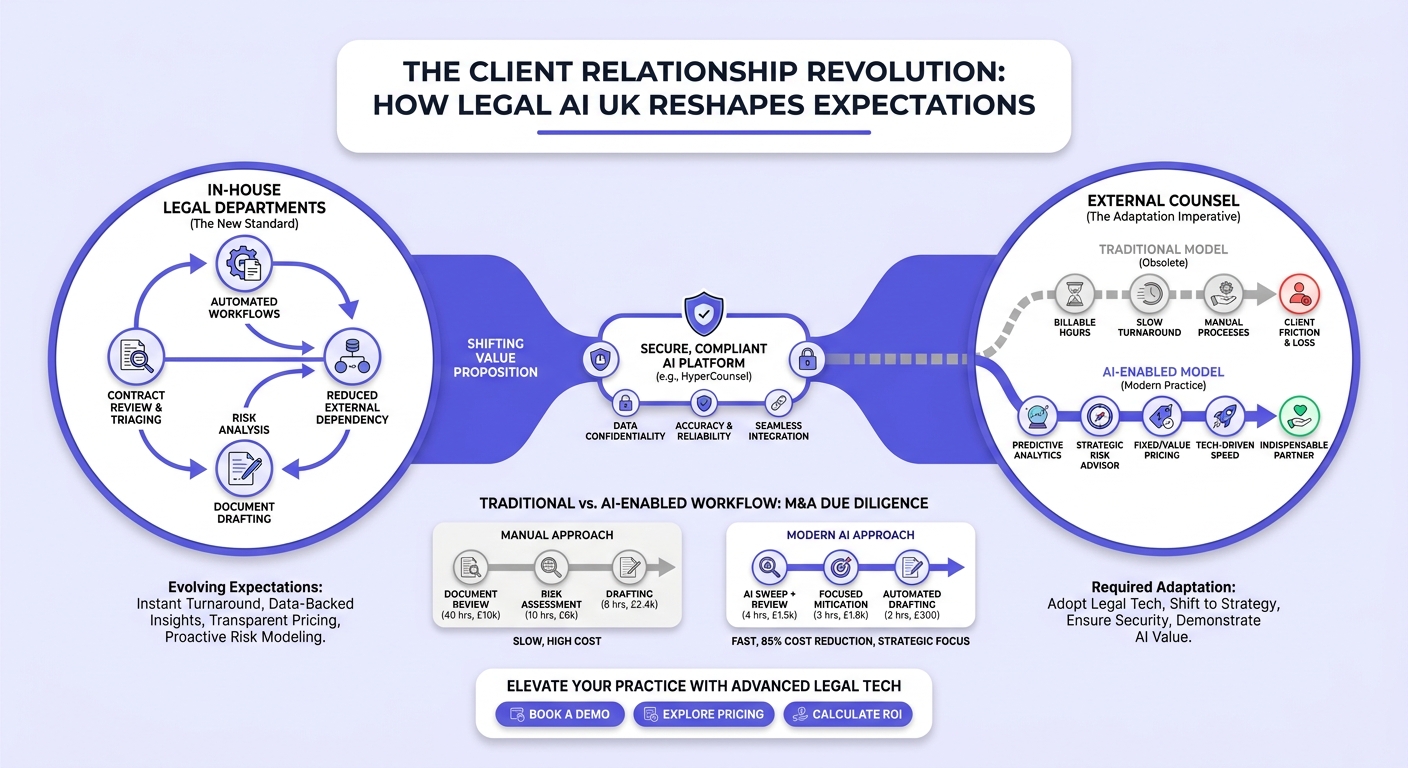
UK corporate legal departments are no longer passive consumers of external legal advice. Today, general counsel (GC) face intense pressure to operate like traditional business units—optimizing budgets, measuring output, and embracing automation. The rapid adoption of legal ai uk systems has enabled these teams to claw back work that was previously farmed out to external solicitors.
As in-house teams build their own internal technological capabilities, they expect a matching level of technical expertise from their panel firms. Law firms that continue to use outdated manual processes are seen as highly inefficient and unnecessarily expensive.
Specific In-House AI Use Cases Reducing Dependency
In-house legal teams are actively using AI to automate several key workflows. By integrating these systems, corporate clients can self-serve on routine legal matters, bypassing external law firms altogether.
- Contract Review and Triaging: AI models scan incoming commercial contracts, highlight non-standard clauses, and suggest edits based on pre-approved company playbooks. This reduces the need for external associates to conduct first-pass reviews.
- Risk Analysis: Corporate legal departments run high-volume portfolios through AI platforms to identify concentration risks, regulatory exposure, and non-compliance issues within seconds.
- Document Drafting: Rather than paying an external firm to draft a standard non-disclosure agreement (NDA) or service level agreement (SLA), in-house teams rely on AI templates optimized with past company transaction data.
By handling these tasks internally, in-house teams drastically reduce their instruction volume to external counsel.

How External Counsel Must Adapt
To survive in this new ecosystem, external law firms must align their service delivery with the AI-optimized speed of their clients. This requires a shift in three main areas.
Speed and Responsiveness
When an in-house team can analyze a 100-page lease agreement using AI in 5 minutes, they will not tolerate an external firm taking 3 days to return a basic redline. External counsel must adopt advanced legal-tech platforms to speed up drafting and analysis.
Transparent, Fixed Pricing
The billable hour is fundamentally at odds with AI efficiency. Clients know when a task has been automated, and they refuse to pay premium hourly rates for automated work. Firms must move toward fixed-fee structures, value-based pricing, and transparent subscription agreements.
Standard Collaboration and Systems Integration
Law firms must be able to securely integrate with their clients' internal AI systems. If a corporate legal team uses a specific contract management system, external lawyers should be ready to plug directly into that system to maintain a seamless workflow. Refer to the Harvey AI research on how corporate teams build case studies for integrations across the legal ecosystem.
Addressing Barriers to AI Adoption in the UK
While the push toward AI is powerful, UK corporate legal departments still face significant challenges that slow down full-scale deployment.
- Data Confidentiality and Security: Corporate teams must ensure that client-privileged info is not used to train public models. The Solictors Regulation Authority (SRA) and The Law Society place strict professional duties on UK lawyers to protect client data.
- Accuracy and Reliability: Legal professionals remain highly skeptical of AI "hallucinations." Research suggests that 72% of legal professionals only trust AI if the source answers stand up to strict scrutiny.
- Integration and Integration Costs: Legacy systems within older UK corporations make it difficult to implement new AI systems smoothly without significant IT overhead.
Law firms that address these bottlenecks for their clients—by offering secure, pre-vetted AI platforms—will position themselves as indispensable partners.
Strategies for External Lawyers to Demonstrate Value
With basic legal tasks automated, how do external lawyers prove their worth? The answer lies in shifting from a "document producer" to a "strategic risk advisor."
- Leverage Predictive Analytics: Use advanced data tools to analyze past judicial decisions, litigation trends, and regulatory changes in the UK, offering predictive outcomes for your client's specific business.
- Provide Deep Commercial Context: AI can flag a risky clause, but it cannot understand the nuance of a highly sensitive commercial relationship. External counsel must interpret AI findings within the context of the client's broader business goals.
- Lead the AI Transition: Don't wait for your client to ask about AI. Proactively recommend secure legal-tech tools like HyperCounsel to help your clients streamline their legal operations.
Adapting Corporate Law Firm Costs and Timelines
To show how adopting legal-tech changes the economic reality for firms and their corporate clients, let's look at a comparative timeline and cost structure for a standard M&A due diligence project in the UK market.
| Legal Task Phase | Traditional Approach (Manual) | AI-Enabled Approach (Modern) | Impact on Corporate Clients |
|---|---|---|---|
| Document Review | 40 hours of junior associate time (£10,000) | 2 hours AI sweep + 2 hours review (£1,500) | 85% cost reduction, immediate turnaround. |
| Risk Assessment | 10 hours of partner-level review (£6,000) | 3 hours of hyper-focused risk mitigation (£1,800) | Better strategic insights based on broad risk-mapping. |
| Drafting and Redlining | 8 hours manual generation (£2,400) | 1 hour automated drafting + customize (£300) | Turnaround time reduced from days to under 2 hours. |
Common Pitfalls When Responding to Client AI Demands
Many UK law firms make critical mistakes when attempting to adapt to the rise of legal ai uk tools:
- Ignoring the Tech Shift: Assuming corporate clients will continue to pay premium rates for low-complexity advisory work out of loyalty.
- Using General Consumer Tools: Using public generative AI models (like free versions of ChatGPT) that risk violating UK General Data Protection Regulation (GDPR) and Competition and Markets Authority guidelines on proprietary data handling.
- Over-promising on Automation: Failing to quality-control AI outputs, leading to critical drafting errors that damage the client-lawyer trust relationship.
Elevate Your Practice with Advanced Legal Tech
As in-house teams automate their routine legal processes, external law firms must adapt to a new standard of speed, transparency, and data-driven insights. HyperCounsel helps modern law practices meet these evolving demands. By integrating secure, UK-compliant AI tools directly into your firm's workflows, you can cut project delivery timelines and transition to high-value, fixed-fee services that your clients will love.
Protect your key accounts, improve your profit margins, and deliver the real-time insights your corporate clients expect.
Ready to transform your practice? Book a Demo with our legal-ops experts today, or explore our transparent options on our Pricing Page. You can also use our ROI Calculator to see exactly how much time and money your firm can save by introducing secure AI automation.
This article provides general information and is not legal advice.
Take the Next Step
Ready to protect your business with expert legal support? Explore how HyperCounsel can help:
Frequently Asked Questions
How is legal ai uk changing what corporate clients expect from external lawyers?
Corporate clients in the United Kingdom now expect near-instantaneous turnaround times and greater cost predictability. Because in-house teams are adopting automation internally, they refuse to pay high hourly rates for routine tasks like document drafting or first-pass review, forcing external solicitors to focus on strategic, bespoke advisory work.
What AI tools are UK in-house legal teams using most in 2025?
In-house legal teams utility specialized AI tools for contract lifecycle management (CLM), automated compliance checking, and contract review. They also rely on secure generative AI platforms designed specifically for legal work to draft standard corporate documents and extract historical data from internal repositories.
Do external lawyers need to adopt AI to stay competitive with UK corporate clients?
Yes. Firms that fail to leverage AI will struggle to deliver work at the speed, volume, and fixed price points that modern corporate legal departments demand. Embracing technology like HyperCounsel is no longer optional; it is a critical strategy for client retention.
What are the main risks of using AI in UK legal departments?
The primary risks include data security under the UK GDPR, maintaining solicitor-client privilege, and handling AI errors or "hallucinations." Law firms must use enterprise-grade, secure systems that do not use proprietary client data to train public models.