

Legal Tech South Africa: AI Competence, Supervision, and Risk Policy for Modern Law Firms
A guide to AI competence, partner supervision, and POPIA compliance for South African law firms.
South Africa's legal sector is undergoing rapid digital modernization. As generative software, automated drafting platforms, and intelligent discovery tools accelerate across commercial and litigation practices, adopting legal tech south africa solutions has shifted from an optional innovation project into a baseline practice-management responsibility.
While the country does not currently have a standalone artificial intelligence act, legal practitioners remain bound by comprehensive statutory obligations and professional conduct rules. According to official government gazette notices, the South African National AI Policy Framework proposes establishing a dedicated AI Regulatory Council and Ethics Board to govern emerging technology across all professional sectors.
To remain competitive and compliant, partners, solo practitioners, and legal operations leads must translate technical competence into practical day-to-day controls. This requires updating continuing professional development (CPD) programs, modernizing supervisory workflows, and implementing structured internal governance policies.
Table of Contents
- The Current Legal Tech Landscape in South Africa
- Core Regulatory Framework: POPIA and the Legal Practice Act
- Translating AI Competence into Law Firm Controls
- Supervision Standards for Partners and Practice Leaders
- Designing an Effective Internal AI Policy
- CPD Curriculum Checklist for Legal Practitioners
- Implementation Costs, Timelines, and Risk Mitigation
- Modernize Your Practice Governance
- Frequently Asked Questions
- Recommended
Quick Summary
| Takeaway | Explanation |
|---|---|
| Regulatory Standard | Legal AI adoption in South Africa is governed primarily by the Legal Practice Act 28 of 2014 and the Protection of Personal Information Act 4 of 2013 (POPIA). |
| AI Competence | Technical competence requires lawyers to understand system limitations, prevent data leakage, and independently verify citations against local jurisprudence. |
| Supervisory Duty | Partners and directors bear ultimate professional responsibility for outputs produced by candidate legal practitioners, associates, or algorithmic tools. |
| Policy Requirements | Law firms must maintain written policies defining permitted tools, confidential data boundaries, cross-border hosting rules, and audit logging. |
| Operational Speed | Establishing an enterprise-grade AI risk and practice-management framework typically takes 2 to 4 weeks under a structured rollout plan. |
The Current Legal Tech Landscape in South Africa
South African law firms face a dual challenge: rising client demand for fixed-fee efficiency and increased administrative friction in traditional litigation and transactional practices. Digital court platforms like Court Online and CaseLines have established digital baselines in superior courts, while generative technologies are transforming research, contract analysis, and client intake.
Adopting modern legal tech allows firms to eliminate repetitive drafting bottlenecks and deliver faster turnaround times. However, deploying automated platforms without governance creates serious exposure to data breaches, fictitious citations, and breaches of client confidentiality.
Establishing baseline technological literacy ensures that attorneys leverage automation without compromising ethical standards or client trust.
Core Regulatory Framework: POPIA and the Legal Practice Act
South African law firms must evaluate all legal tech platforms against two foundational regulatory pillars:
- The Legal Practice Act (LPA) and Code of Conduct: Administered by the Legal Practice Council, the LPA Code of Conduct requires practitioners to maintain professional competence, exercise reasonable care and skill, maintain absolute client confidentiality, and ensure adequate supervision over subordinates and automated outputs.
- Protection of Personal Information Act (POPIA): Client records, litigation briefs, and transactional documents routinely contain special personal information. Uploading unredacted client files to public or unvetted commercial cloud models violates condition-specific data processing mandates, operator oversight obligations, and cross-border transfer restrictions under Section 72 of POPIA.

Translating AI Competence into Law Firm Controls
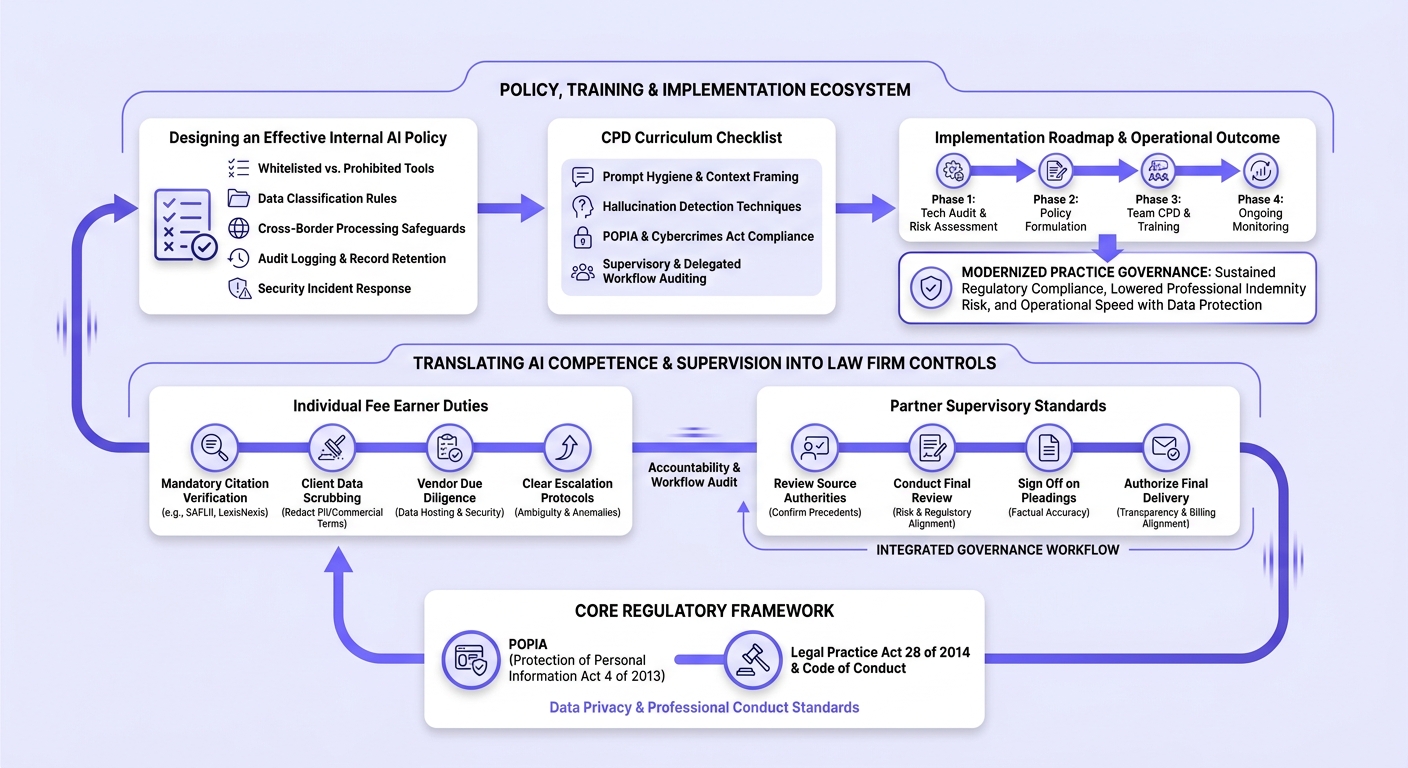
Technological competence is not merely understanding software interfaces; it requires managing operational risk across the entire matter lifecycle. Firms should integrate four non-negotiable operational controls:
- Mandatory Citation Verification: Practitioners must cross-reference all automated legal citations, statutory sections, and case law summaries against verified South African databases such as SAFLII, Juta, or LexisNexis prior to filing or advising.
- Client Data Scrubbing: Fee earners must never input personally identifiable information, confidential commercial terms, or privileged communications into open or consumer-grade AI systems.
- Vendor Due Diligence: Practice managers must verify whether software vendors host data in South African data centers, use client data to train public models, or provide SOC 2 Type II and ISO 27001 certified environments.
- Clear Escalation Protocols: Fee earners require a documented process for escalating ambiguous outputs, flagged data anomalies, or unexpected software behaviors to senior partners.
Firms seeking tailored oversight can deploy HyperCounsel to establish end-to-end governance and workflow standardization across their teams.
Supervision Standards for Partners and Practice Leaders
Under South African legal practice norms, delegating tasks to candidate legal practitioners, paralegals, or automated systems does not relieve admitted attorneys of their ultimate accountability.
Partners must establish a transparent chain of custody for all AI-assisted work product.
| Work Product Stage | Associate / Candidate Practitioner Duty | Partner Supervisory Duty |
|---|---|---|
| Legal Research & Case Analysis | Log search queries, check primary sources on SAFLII, and document verification notes. | Review source authorities directly; confirm that cited precedents remain good law in South African courts. |
| Contract Drafting & Review | Use approved templates, apply firm-standard clauses, and scrub proprietary data. | Conduct final review on commercial risk allocation, indemnity caps, and regulatory alignment. |
| Pleadings & Court Filings | Run hallucination checks, verify factual affidavits, and ensure formatting complies with court rules. | Sign off on pleadings, confirming full factual accuracy and compliance with ethical obligations. |
| Client Communications | Draft preliminary advice, flag assumptions, and summarize statutory provisions. | Authorize final delivery, ensuring transparency and billing alignment. |
Designing an Effective Internal AI Policy
Every South African law firm must implement a standalone, written AI and Legal Tech Policy. Leaving tool selection to individual fee earners creates fragmented security and increases malpractice liability.
A comprehensive internal policy should clearly specify:
- Whitelisted vs. Prohibited Tools: A clear list of software tools approved for client work versus consumer platforms strictly banned for firm business.
- Data Classification Rules: Guidelines identifying what information can be processed electronically (e.g., public statutes) versus restricted data that requires on-premise or isolated processing.
- Cross-Border Processing Safeguards: Requirements ensuring vendor cloud instances comply with POPIA cross-border transfer requirements.
- Audit Logging and Record Retention: Rules for retaining query logs, drafted iterations, and primary source verifications for professional indemnity protection.
- Security Incident Response: Immediate notification steps if sensitive client data is inadvertently exposed to an unapproved model or third-party service.
CPD Curriculum Checklist for Legal Practitioners
Continuing Professional Development (CPD) programs must evolve beyond theoretical seminars into practical, risk-focused technical training.
Firms should structure their ongoing legal tech training around these core competencies:
- Prompt Hygiene and Context Framing: Structuring structured queries without disclosing confidential client details or sensitive commercial terms.
- Hallucination Detection Techniques: Identifying fabricated citations, distorted statutory sections, and false procedural claims generated by large language models.
- POPIA and Cybercrimes Act Compliance: Practical handling of data operator agreements, encryption standards, and digital evidence retention under the Cybercrimes Act 19 of 2020.
- Supervisory and Delegated Workflow Auditing: Teaching senior attorneys how to audit AI-assisted drafts submitted by junior staff efficiently.
Implementation Costs, Timelines, and Risk Mitigation
Implementing a sound technology policy does not require months of disruption. Law firms can modernize their practice infrastructure through structured, fixed-scope phases.
| Phase | Core Deliverables | Timeline | Primary Outcome |
|---|---|---|---|
| Phase 1: Tech Audit & Risk Assessment | Review existing software stack, data storage practices, and vendor operator contracts. | Week 1–2 | Full visibility into current compliance gaps and shadow IT usage. |
| Phase 2: Policy Formulation | Draft customized internal AI policies, data classification guidelines, and supervisory workflows. | Week 2–3 | Clear, enforceable rules governing daily fee-earner software usage. |
| Phase 3: Team CPD & Training | Conduct role-specific workshops for partners, associates, and candidate legal practitioners. | Week 3–4 | Immediate firm-wide adherence to verification and privacy standards. |
| Phase 4: Ongoing Monitoring | Implement quarterly vendor reviews, log auditing, and updated training modules. | Ongoing | Sustained regulatory compliance and lowered professional indemnity risk. |
Modernize Your Practice Governance
Integrating artificial intelligence into daily legal workflows provides unmatched speed, draft consistency, and operational leverage. However, scalable efficiency requires robust compliance structures that protect client confidentiality and satisfy professional regulatory standards.
If your firm needs a fast, fixed-scope legal tech governance policy and team training baseline mapped to South African practice requirements, HyperCounsel delivers proven frameworks to protect your practice without slowing down fee earners.
Explore flexible Pricing and Plans to find an implementation package tailored to your firm, or Book a Demo today to see how modern compliance tools elevate practice performance.
Take the Next Step
Ready to protect your business with expert legal support? Explore how HyperCounsel can help:
Frequently Asked Questions
Do South African law firms need a formal AI policy right now?
Yes. Even without a standalone AI statute, law firms are subject to POPIA and the Legal Practice Act. A formal policy establishes binding rules for data protection, prohibits unapproved consumer tools, and protects the firm against malpractice and confidentiality breaches.
What should be included in CPD training for lawyers using AI tools?
CPD training should cover prompt engineering without disclosing client data, verifying citations against primary South African law reports, understanding algorithmic hallucinations, POPIA data processing compliance, and partner supervisory obligations.
How should partners supervise associates and candidate legal practitioners who use AI?
Partners must require fee earners to document verification steps, maintain query logs, and confirm that all citations exist in primary legal databases. The partner remains professionally liable for all work submitted under their signature.
What are the biggest POPIA and confidentiality risks when legal teams use AI?
The primary risks include uploading unredacted personal information to consumer AI models, transmitting client data to jurisdictions lacking adequate privacy laws without consent, and utilizing software vendors that use confidential firm inputs to train public machine learning models.