

Legal Tech South Africa in 2026: Building a Verified AI Stack for Modern Law Firms
Discover how South African law firms build secure, verified AI stacks to stay compliant and grow.
The landscape of legal tech South Africa law firms rely on is experiencing a structural shift. Law practices across Johannesburg, Cape Town, and Durban are moving away from ad-hoc consumer chatbots and transitioning toward integrated, verified artificial intelligence architectures. What began as experimental drafting prompts has evolved into a demand for secure, source-grounded legal infrastructure.
According to research from the Oxford University Tech & Justice Project, South African courts have already confronted fake AI-generated case citations, highlighting the urgent operational need for verified legal intelligence over general-purpose language models. Unchecked generative tools expose attorneys to severe reputational damage, professional conduct sanctions, and regulatory penalties.
To remain competitive and protect client privilege, firms must implement structured technology stacks that combine legal research, drafting, internal knowledge reuse, and compliance oversight. This guide outlines how South African practitioners can build an enterprise-ready legal AI workflow that satisfies local data privacy laws and professional ethics.
Table of Contents
- The Evolution of Legal Tech in South Africa
- The Four Core Layers of a Modern Legal AI Stack
- Regulatory Compliance: POPIA and Professional Conduct
- Comparing Generic Chatbots with Purpose-Built Legal Tech
- Practical Selection Checklist for Law Firms
- Accelerate Your Practice with HyperCounsel
- Frequently Asked Questions
- Recommended
Quick Summary
| Takeaway | Explanation |
|---|---|
| Market Shift | South African firms are replacing open consumer AI with source-verified legal platforms to prevent hallucinations. |
| Four-Layer Stack | A production-grade stack requires verified research, precision drafting, internal knowledge management, and audit trails. |
| POPIA Compliance | Processing client data through non-compliant cloud models creates direct liability under local privacy legislation. |
| LPC Obligations | Attorneys remain strictly accountable under the Legal Practice Council Code of Conduct for AI-generated court filings. |
| Fixed-Cost Value | Verified legal AI platforms deliver predictable costs, matter-level data segregation, and immediate operational ROI. |
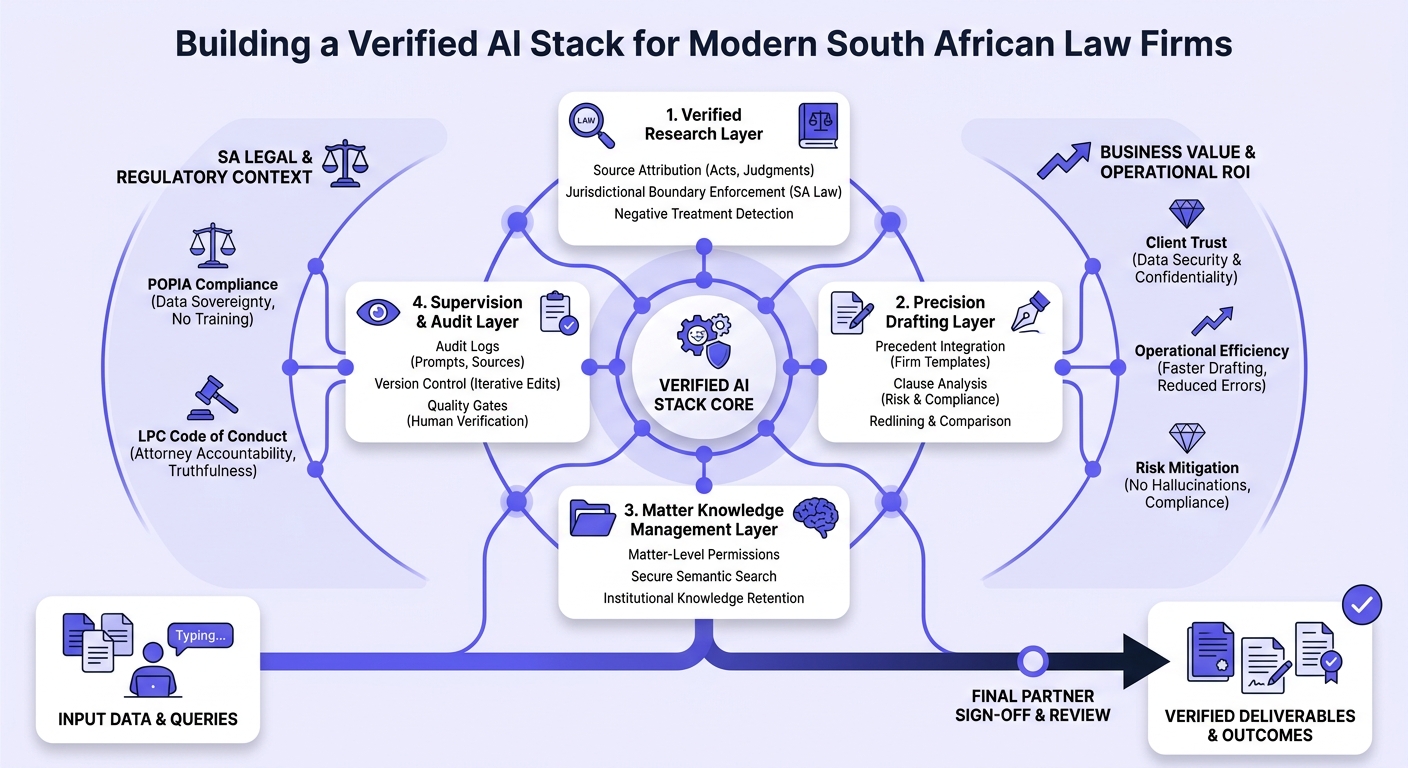
The Evolution of Legal Tech in South Africa
For years, legal technology adoption in South Africa centered primarily on practice management, trust accounting, and basic electronic billing software. The arrival of generative AI expanded automation possibilities, but early adopters quickly encountered significant limitations with standard consumer tools.
Generalist artificial intelligence platforms frequently hallucinate citations, misinterpret South African statutory provisions, and ingest client data into public training sets. Because South Africa operates on a hybrid legal system blending Roman-Dutch civil law, English common law, and customary law, off-the-shelf tools trained primarily on US or UK commercial data often misstate applicable legal standards.
Forward-thinking firms are therefore upgrading their digital infrastructure. By deploying specialized platforms such as HyperCounsel, legal teams maintain strict control over document context, verify primary source authorities, and uphold client confidentiality obligations without sacrificing operational speed.

The Four Core Layers of a Modern Legal AI Stack
A complete legal AI architecture must handle the entire lifecycle of client matters. Relying solely on a single prompt window creates workflow bottlenecks and leaves firms vulnerable to accuracy errors.
Verified Research Layer
The research layer must tie all output to verified primary legal authorities, including Acts of Parliament, provincial regulations, and reported judgments from the Constitutional Court, Supreme Court of Appeal, and High Courts.
- Source Attribution: Every legal proposition must link directly to verifiable paragraph and page citations.
- Jurisdictional Boundary Enforcement: The engine must recognize South African legal principles rather than defaulting to foreign legal doctrines.
- Negative Treatment Detection: Modern tools flag overturned decisions and outdated statutory provisions before citations reach court pleadings.
Precision Drafting Layer
Legal drafting requires strict alignment with firm templates, local court rules, and statutory drafting conventions. Purpose-built drafting tools use retrieval-augmented generation (RAG) to draft contracts, particulars of claim, affidavits, and legal opinions directly within authorized matter context.
- Precedent Integration: Automates document generation using the firm's approved master agreements.
- Clause Analysis: Identifies missing indemnities, non-standard dispute resolution clauses, and regulatory non-compliance.
- Redlining and Comparison: Summarizes counterparty amendments and assesses deviation from standard risk positions.
Matter Knowledge Management Layer
Firms often lose unbilled hours searching for past work product buried in local file servers or email archives. An integrated knowledge layer indexes historical contracts, memos, and court records across the firm.
- Matter-Level Permissions: Ensures that sensitive corporate transactions or litigation files remain restricted to authorized team members.
- Secure Semantic Search: Enables fee earners to find prior research memos and settlement strategies using natural language queries.
- Institutional Knowledge Retention: Preserves partner-level expertise and standard operating procedures across associate turnover.
Supervision and Audit Layer
Senior partners must verify associate output before delivery to clients or courts. A dedicated supervision layer provides comprehensive oversight and governance.
- Audit Logs: Records user prompts, generated responses, and source files referenced for every deliverable.
- Version Control: Tracks iterative edits between initial AI-generated drafts and final partner sign-off.
- Quality Gates: Requires explicit human verification of all statutory interpretations and case references.
Regulatory Compliance: POPIA and Professional Conduct
Adopting artificial intelligence in South African law firms does not occur in a legal vacuum. Practice leaders must align their technology deployments with binding statutory mandates and professional ethics rules.
Under the Protection of Personal Information Act (POPIA), enforced by the Information Regulator South Africa, law firms qualify as responsible parties. Inputting confidential client data, medical records, or corporate financial records into public AI models without adequate cross-border data transfer safeguards violates Section 72 of POPIA. Dedicated enterprise platforms isolate data within encrypted environments and guarantee that client records are never used to train public foundation models.
Simultaneously, the Legal Practice Council Code of Conduct places non-delegable duties of competence, diligence, and truthfulness on admitted attorneys and advocates. Practitioners cannot shift blame to an automated system for misleading authorities or fabricated citations submitted in court pleadings. Every output generated by technology must be independently verified by a qualified practitioner.
Comparing Generic Chatbots with Purpose-Built Legal Tech
Firms evaluating their software stack must distinguish between mass-market consumer tools and secure, legal-specific platforms.
| Feature | Generic Consumer AI | Verified Legal Tech Stack |
|---|---|---|
| Primary Authority Validation | Unreliable; prone to hallucinated citations | Strict source grounding with paragraph-level references |
| Data Privacy (POPIA) | Public clouds may use inputs for model training | Enterprise encryption with zero data retention for training |
| Matter Permissions | Single-user account or basic workspace access | Granular, role-based matter access controls |
| South African Legal Context | Often defaults to US/UK legal concepts | Configured for South African statutes and case law |
| Cost Predictability | Variable credit/usage spikes | Transparent, fixed subscription pricing |
| Audit Trails | Basic prompt history without compliance logs | Complete matter audit logs for risk management |
Practical Selection Checklist for Law Firms
Before procuring or expanding artificial intelligence tools, partners and practice managers should run candidate vendors through a rigorous evaluation checklist:
- Data Sovereignty and Processing: Does the vendor provide written guarantees that client data will not be retained or used for global model training?
- Source-Backed Citations: Can the platform provide direct reference links to primary South African legal texts for every factual or legal claim?
- Matter Isolation: Does the system enforce strict boundary controls so confidential information from one matter cannot leak into another?
- Integration Capabilities: Does the software integrate smoothly into daily word processing, document management, and billing workflows?
- Transparent Pricing: Does the provider offer predictable pricing tiers without hidden token surcharges or opaque consumption fees?
Practitioners who implement platforms meeting these standards achieve substantial productivity gains while eliminating compliance and ethical exposure.
Accelerate Your Practice with HyperCounsel
Modern legal practice requires speed, precision, and uncompromised client security. HyperCounsel delivers an enterprise legal AI platform engineered specifically for the demands of forward-looking legal teams.
By combining verified legal research, intelligent contract drafting, and secure matter knowledge management into a unified workspace, HyperCounsel enables your firm to reduce drafting hours, eliminate hallucination risk, and maintain strict POPIA compliance.
Take the next step in modernizing your firm's operations. Book a Demo with our legal technology specialists, or explore our Transparent Pricing and Security Architecture to see how verified AI transforms practice profitability.
Take the Next Step
Ready to protect your business with expert legal support? Explore how HyperCounsel can help:
Frequently Asked Questions
What makes a legal AI tool safer for South African law firms than a general-purpose chatbot?
Purpose-built legal AI tools ground their answers in verified legal databases and specific matter documents rather than generating answers from broad internet data. They provide exact statutory and case citations, enforce strict matter-level security, and guarantee that confidential client information is not retained or used to train third-party foundation models.
How does POPIA affect a law firm's use of AI for research and drafting?
Under the Protection of Personal Information Act (POPIA), law firms are responsible parties obligated to safeguard personal data against unauthorized processing and unlawful cross-border transfers. Uploading client files into consumer AI tools with open training policies risks severe POPIA non-compliance. Firms must use enterprise-grade software featuring robust encryption and clear data handling boundaries.
What should partners look for when comparing AI tools for legal research and drafting?
Partners should evaluate whether the platform provides direct source citations, enforces strict data privacy, supports matter-level permissioning, and integrates seamlessly into existing drafting workflows. Predictable subscription pricing and dedicated security protocols are also essential considerations.
Can law firms use AI while still meeting professional conduct and client confidentiality obligations?
Yes, provided that human practitioners retain oversight over all deliverables. The Legal Practice Council requires attorneys to exercise professional competence and verify all legal authorities submitted to courts or clients. AI should serve as an efficiency accelerator that supports, rather than replaces, independent legal judgment.