

The Loop AI Mandate: Preparing for 2026/27 South African AI Guidelines to Avoid Employment Bias Litigation
Prepare South African law firms for the 2026/27 AI guidelines to avoid recruitment bias.
As South African law firms increasingly turn to machine learning to automate recruitment, managing compliance risks has become a top priority. Adopting robust "human-in-the-loop" or loop ai protocols prevents algorithmic bias and secures trust during the hiring process.
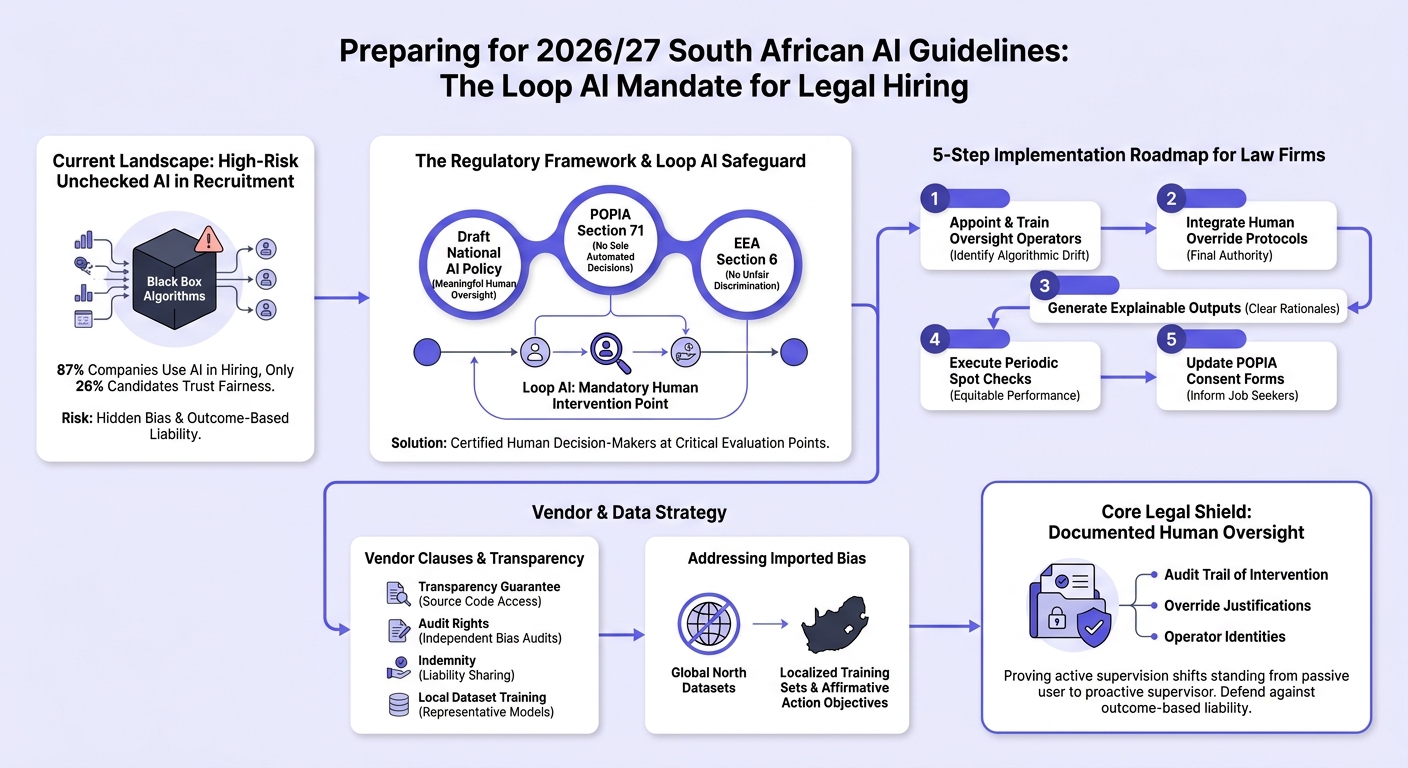
Deploying artificial intelligence in talent acquisition offers incredible speed, but it carries deep compliance liabilities if left unchecked. A recent global survey shows that 87 percent of companies use AI in hiring, yet only 26 percent of candidates trust it to evaluate them fairly. In South Africa, where historical inequalities and demographic diversity require careful equity mapping, relying blindly on automated recruitment platforms can trigger costly litigation.
To mitigate these risks, law firms must implement robust loop ai design strategies. This means placing certified human decision-makers at critical evaluation points, ensuring that software aids rather than entirely replaces human judgment. Let's look at how South Africa's evolving legal frameworks regulate AI-driven hiring and how to safeguard your firm before the 2026/27 guidelines take shape.
Table of Contents
- Understanding the Loop AI Safeguard and Legal Frameworks
- Why Liability Under SA Law Is Outcome-Based
- High-Risk AI in Recruitment: Mandatory Bias Auditing
- Step-By-Step Guide: Implementing Loop AI Oversight in Your Firm
- Addressing Imported Bias and Cross-Border Data Risks
- Essential Vendor Clauses for Legal Tech Contracts
- Documenting Human Oversight as Your Core Legal Shield
- Streamline Your AI Compliance Roadmap
- Frequently Asked Questions
- Recommended
| Takeaway | Explanation |
|---|---|
| Loop AI Safeguard | Mandatory system integration of human oversight to intercept and correct algorithmic hiring bias. |
| Outcome-Based Liability | Under SA law, firms are liable for discriminatory hiring outcomes regardless of discriminatory intent. |
| Imminent Guidelines | Prepare for the stringent oversight expectations detailed in the 2026/27 South African AI policies. |
| POPIA & EEA Compliance | Automated candidate profiling requires explicit consent, impact analysis, and adherence to demographic goals. |
| Vendor Controllability | Tech contracts must guarantee annual bias audits, algorithmic transparency, and localized training datasets. |
Understanding the Loop AI Safeguard and Legal Frameworks
To protect your firm from non-compliance, you must first understand how South African regulators view automated talent acquisition. The concept of loop ai centers on embedding meaningful human oversight directly into automated intelligence workflows. This prevents machines from having unilateral control over resume screening, shortlisting, and candidate evaluation.
The Draft National AI Policy and Meaningful Human Oversight
The Draft South Africa National Artificial Intelligence Policy explicitly outlines ethical governance, bias mitigation, and "human-centered" deployment as its primary pillars. This policy rejects "black box" systems, where the logic behind automated decisions is completely hidden. Firms using these systems must be able to explain, audit, and override algorithmic outputs.
According to insights from Baker McKenzie, South Africa's structural approach shifts heavily toward prioritizing human-centered control. Even as policies shift and undergo revision, including temporary withdrawals and updates as noted by DLA Piper, the commitment to preventing unilateral automated decision-making remains strong.
POPIA and the Employment Equity Act Obligations
These principles closely align with Section 71 of the Protection of Personal Information Act (POPIA), which prohibits automated decision-making that significantly affects data subjects unless a human reviews the decision or specific safe harbors apply. Simultaneously, Section 6 of the Employment Equity Act (EEA) strictly outlaws unfair discrimination. Using an unmonitored machine hiring process that inadvertently filters out applicants based on race, gender, or age constitutes a direct breach of the EEA.
Why Liability Under SA Law Is Outcome-Based
In South Africa, liability for discriminatory hiring is outcome-based, not intent-based. It is not a valid legal defense to claim your firm did not intend to discriminate, or that your third-party software vendor promised their system was fair.
Courts evaluate hiring decisions under established employment frameworks. If an automated system produces systemic, disproportionate exclusions of protected groups, your firm will bear direct liability. Under the EEA, the burden of proof shifts to the employer to show that the selection criteria used was rational, fair, and non-discriminatory.
High-Risk AI in Recruitment: Mandatory Bias Auditing
Because recruitment is classified as a high-risk activity, automated systems require regular validation. Annual, independent bias audits are becoming standard practice worldwide and are highly anticipated under South Africa's upcoming AI standards.
For your talent acquisition workflow, an audit includes analyzing selection rates across demographic groups. By calculating impact ratios, your compliance team can pinpoint whether underlying algorithmic models favor particular profiles, allowing you to intervene before a civil claim is filed.
Step-By-Step Guide: Implementing Loop AI Oversight in Your Firm
Transitioning to a collaborative loop ai configuration involves deliberate policy modifications. Here is a practical roadmap for South African legal organizations:
- Step 1: Appoint and Train Oversight Operators - Select HR professionals or partners to supervise the AI recruitment pipeline. Train them specifically on identifying algorithmic drift and systemic cognitive bias.
- Step 2: Integrate Human Override Protocols - Ensure the software possesses active override features. Humans must have the final authority to reinstate candidates filtered out in early automated rounds.
- Step 3: Generate Explainable Outputs - Configure the hiring program to output clear, natural-language rationales for why candidates were scored or grouped in a specific way.
- Step 4: Execute Periodic Spot Checks - Regularly evaluate a random sample of rejected applications to ensure the model continues to perform equitably.
- Step 5: Update Your POPIA Consent Forms - Explicitly inform job seekers that automated assessment tools are supported by experienced human reviewers, fulfilling your duties under POPIA Section 71.
Using platforms like HyperCounsel can simplify these steps by providing structured templates, policy tools, and expert networks to keep your firm ahead of regulatory shifts.
Addressing Imported Bias and Cross-Border Data Risks
Many software systems are trained on foreign datasets (primarily based in the United States or Western Europe). This introduces "imported bias."
Because these foreign datasets do not account for South Africa’s unique historical socio-economic realities or demographic requirements, relying on them creates high litigation exposure. The Employment Equity Act mandates affirmative action measures to address domestic inequalities. A system that screens for candidates based on Global North education profiles can quickly dismantle local transformation objectives.
Essential Vendor Clauses for Legal Tech Contracts
When onboarding an artificial intelligence vendor, do not sign standard terms of service without negotiating customized protections. Legal operations experts should mandate specific compliance and indemnity clauses.
| Contract Clause | Implementation Standard |
|---|---|
| Transparency Guarantee | Vendor must provide complete source code architecture or accessible algorithmic documentation upon request. |
| Audit Rights | Vendor must allow independent, third-party bias audits and share their own historical data logs annually. |
| Indemnity for Algorithmic Default | Vendor shares liability if a court finds that the system’s design directly caused unlawful, discriminatory outcomes. |
| Local Dataset Training | Vendor must guarantee that the model uses representative localized training sets to prevent demographic distortion. |
Documenting Human Oversight as Your Core Legal Shield
Your best defense in an employment tribunal is a clear audit trail of human intervention. Whenever a manager overrides or confirms an automated decision, register that choice in a secure document storage facility.
Documenting critical parameters—such as the human-reviewed criteria, the specific override justification, and the names of the certified operators—proves to regulators that decisions were never completely automated. This operational record shifts your standing from passive user to proactive supervisor, proving that a loop ai governance framework is fully functioning in your workplace.
Streamline Your AI Compliance Roadmap
Proactively addressing bias in recruitment is not just about avoiding regulatory penalties; it is about building a modern, competitive, and diverse legal practice. Manually drafting compliance protocols, negotiating vendor terms, and verifying POPIA alignment can redirect valuable billable hours away from your core practice.
By leveraging the legal tech solutions curated by HyperCounsel, you can simplify compliance checks and protect your firm from emerging regulatory challenges. Our modern platform is built to optimize administrative workflows, helping law firms confidently implement safe technology strategies.

Ready to prepare your firm for South Africa's upcoming AI standards? Visit our team to Book a Demo or explore our Pricing options today to protect your practice with tailormade solutions.
This article provides general information and is not legal advice.
Take the Next Step
Ready to protect your business with expert legal support? Explore how HyperCounsel can help:
Frequently Asked Questions
What is the 'human-in-the-loop' requirement under South Africa's Draft AI Policy?
It is a regulatory directive requiring meaningful human supervision, evaluation, and override authority over automated systems, ensuring technology does not make unilateral high-impact decisions.
Why can South African law firms be liable for AI-driven employment bias even if they did not intend discrimination?
Liability under South African labor law is outcome-based. If a hiring tool disproportionately disadvantages candidate pools of protected classes, the firm is liable regardless of intent.
Do South African law firms need to conduct annual bias audits for AI hiring tools?
Yes. Regular, independent bias auditing is recommended to identify demographic discrepancies, and it aligns with the strict requirements of Section 6 of the Employment Equity Act.
How can law firms ensure their AI hiring tools do not perpetuate imported bias from Global North datasets?
Firms must explicitly mandate that providers use localized training data and customize their algorithms to align with South Africa's demographic context and transformation imperatives.