

The Legal Practice Council's 2026 Mandate: Integrating AI Competence into Mandatory CPD for South African Lawyers
Discover how the LPC's 2026 mandate changes mandatory CPD for South African lawyers.
South Africa's legal landscape is undergoing a massive transformation as regulatory frameworks catch up with rapid technological progress. Under the Legal Practice Council (LPC) coursework shifts, AI and emergent tech are no longer optional tools for forward-thinking practitioners.
According to recent industry insights, 78% of South African law firms plan to invest in AI training for staff by 2026 to meet the LPC's new mandatory Continuing Professional Development (CPD) guidelines. Adapting to this shift requires a thorough understanding of compliance, ethical automation, and practical integration in the realm of legal tech South Africa.
As courts clamp down on unverified filings, lawyers must learn how to balance innovation with professional responsibility. This guide breaks down exactly what the 2026 mandate means for your practice and how HyperCounsel can help you stay compliant.
Table of Contents
- Understanding the LPC 2026 Mandatory AI Competence Curriculum
- Courtroom Requirements Verifying AI Generated Content
- Data Security Vendor Vetting and Ethical Compliance
- Compliance Costs Timelines and Execution Steps
- Common Mistakes South African Firm Operators Make
- Take the Next Step
- Frequently Asked Questions
- Recommended
Quick Summary
| Takeaway | Explanation |
|---|---|
| Mandate Deadline | By 2026, the LPC officially integrates AI competence into mandatory CPD and candidate attorney structures. |
| Court Verification | South African courts hold lawyers personally accountable for verifying every electronic or AI-generated output prior to filing. |
| Ethics & Security | Firms must establish "human-in-the-loop" operations, audit data pathways, and perform POPIA-aligned assessments. |
| Client Transparency | Practitioners must explicitly state when and how generative automation functions within their practice. |
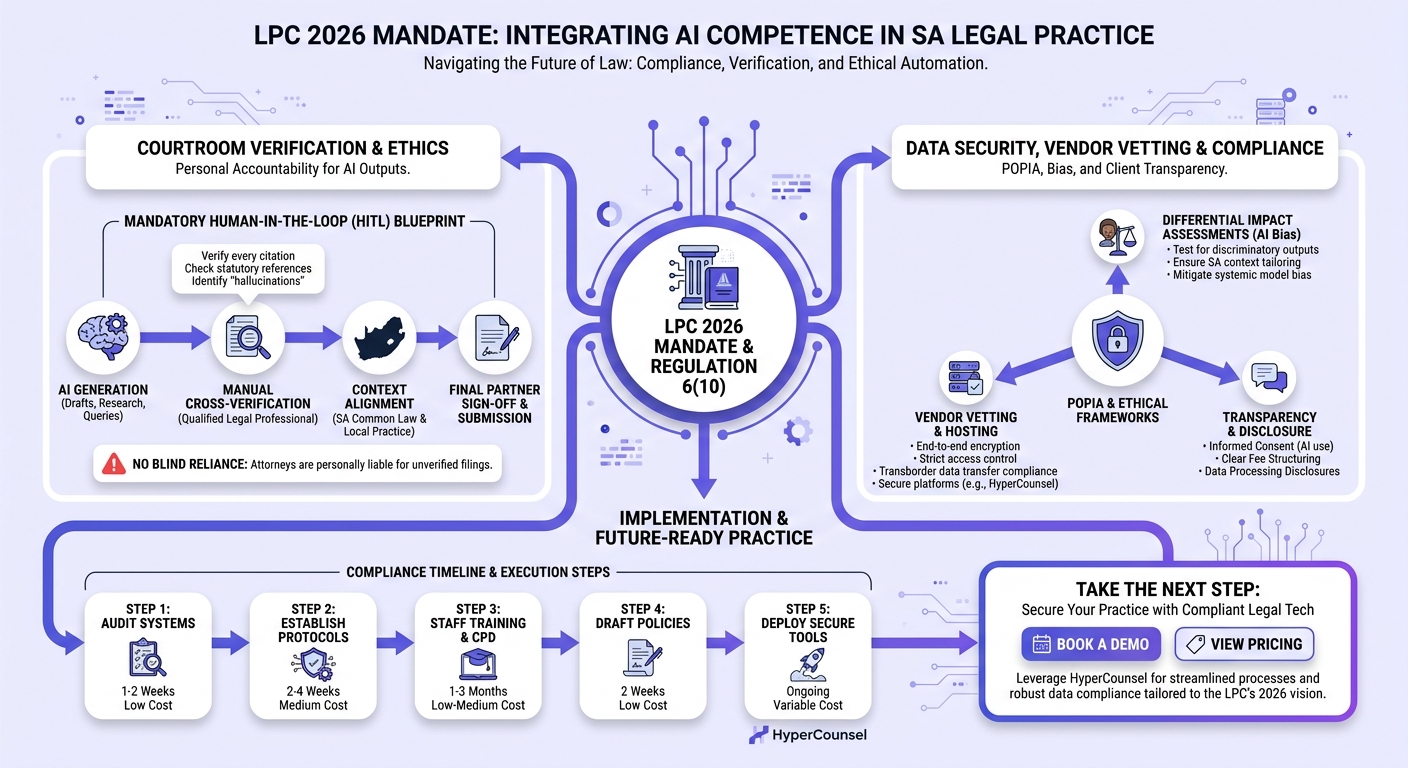
Understanding the LPC 2026 Mandatory AI Competence Curriculum
The Legal Practice Council is introducing competency-based shifts to prepare candidate attorneys and established practitioners for the realities of modern justice. Under Regulation 6(10), officially documented updates to candidate training syllabi highlight that the Government Gazette curriculum now actively incorporates modern digital frameworks, including AI, blockchain, and cyberattack awareness tools.
This represents a systemic shift. Rather than viewing technology as a back-office utility, regulators now categorize AI literacy as a fundamental legal skill. The upcoming professional development framework makes understanding the risks and benefits of generative tools a mandatory criterion for license renewal and training verification.
The Core Objectives of Regulation 610
The upcoming structured coursework plans to embed technical competency directly into professional entry and advancement pathways. This curriculum is designed to:
Ensure legal professionals understand the foundational mechanics of legal generative AI tools.
Equip practitioners with the skills needed to identify "hallucinations" or false legal citations outputted by public models.
Establish ethical boundaries around the preservation of client confidentiality in digital ecosystems.
Courtroom Requirements Verifying AI Generated Content
South African courts have recognized the immense potential—and danger—associated with artificial intelligence. Relying blindly on software to draft heads of argument or pleadings is no longer just poor practice; it is a breach of professional ethics.
The De Rebus Legal Journal has highlighted that courts expect lawyers to take full personal ownership of every document filed in their name. This shift is a reaction to high-profile international and local incidents where automated tools fabricated case law citations.
Practitioners have an absolute ethical obligation to verify the integrity, existence, and relevance of every piece of legal research generated by AI software. If an AI tool produces a citation, the attorney of record must trace that citation back to an official, authorized South African law report before it is submitted.
The Mandatory Human in the Loop Review Blueprint
To comply with the LPC's modern expectations, South African firms must implement a rigid Human-in-the-Loop (HITL) operational framework. This model ensures that no machine-generated legal output is delivered directly to clients or filed in court without human validation.

To operationalize this review system, your firm should adopt the following workflow:
Primary Generation: Utilize vetted AI tools to draft rough structures, analyze large trial transcripts, or retrieve initial query points.
Manual Cross-Verification: A qualified legal professional must manually read and check every statutory reference and case citation.
Context Alignment: Tailor the drafted advice to the specific nuances of South African common law, current provincial court practices, and local regulations.
Final Partner Sign-off: Ensure senior attorneys review output documents for strategic alignment and risk prevention before client distribution.
Data Security Vendor Vetting and Ethical Compliance
When integrating technological systems into your South African practice, data security is non-negotiable. The Protection of Personal Information Act (POPIA) imposes strict standards on how personal information is processed, stored, and sent across digital networks.
Under the incoming CPD and regulatory trends, firms must actively vet their technology vendors. Simply accepting a software provider's standard terms is insufficient. Lawyers must ensure all legal tech vendors provide end-to-end encryption, strict access control, and absolute host data isolation.
If your software provider hosts client files or legal queries on servers outside of South Africa, you must ensure compliance with POPIA's guidelines on transborder data transfers. Using secure platforms like HyperCounsel ensures your firm stays aligned with strict operational, regulatory, and secure practices.
Differential Impact Assessments and AI Bias
An overlooked aspect of the LPC's emerging guidelines is the risk of systemic bias in large language models. Many generic tools are trained on North American or European source materials, which can lead to biased or culturally inaccurate conclusions when applied contextually in South Africa.
To remedy this, firms must advocate for and request differential impact assessments from their AI developers. These evaluations test the algorithms to verify they do not produce discriminatory outputs or disproportionately disadvantage certain groups. Ensuring your tools are custom-tailored for South African justice reduces the risk of biased advisory work.
Transparency and Client Disclosure Rules
Transparency builds trust and satisfies professional regulations. Under the emergent frameworks, client communication must be clear regarding the use of automated technologies:
Informed Consent: Let clients know if generative engines are used to perform routine research or preliminary draft assemblies.
Fee Structuring: Disclose how AI use impacts billing. Doing so is critical for maintaining transparent, reliable customer relationships.
Data Processing Disclosures: Ensure clients are aware of where their case parameters are processed, keeping details aligned with POPIA requirements.
Compliance Costs Timelines and Execution Steps
Adapting to the LPC’s 2026 vision requires tactical preparation. Transitioning your firm does not have to be an expensive or overwhelming process. Below is a structured implementation guide outlining steps, realistic timelines, and expected costs for South African practitioners.
| Step | Phase | Key Objective | Est. Timeline | Cost Level |
|---|---|---|---|---|
| 1 | Audit Current Systems | Identify current data storage, software licenses, and AI habits across staff. | 1 - 2 Weeks | Low / None |
| 2 | Establish Vetting Protocols | Perform POPIA-compliance audits on existing legal tech tools and secure vendors. | 2 - 4 Weeks | Medium |
| 3 | Staff Training & CPD | Enroll legal practitioners in structured programs focusing on AI prompt engineering and data security rules. | 1 - 3 Months | Low to Medium |
| 4 | Draft Firm-Wide Policies | Establish written standards for human-in-the-loop verification, transparency, and disclosure. | 2 Weeks | Low |
| 5 | Deploy Secure Modern Tools | Onboard compliant platforms like HyperCounsel that offer robust security controls. | Ongoing | Variable / Cost-Efficient |
Common Mistakes South African Firm Operators Make
Blind Reliance on Public Tools: Using open-access public chat engines exposes sensitive client data to public training pools, creating a massive POPIA breach.
Neglecting South African Context: Utilizing systems trained purely on US law can lead to inaccurate citations of foreign precedents that have no bearing on local courts.
Skipping Mandatory Human Verification: Assuming legal software is infallible without performing manual audits on all draft outputs before litigation submissions.
Ignoring Vendor Security Audits: Believing all platforms are naturally secure without verifying host networks and checking vendor compliance sheets.
Take the Next Step
Preparing your practice for the upcoming 2026 LPC mandate does not need to disrupt your workflows. Deploying compliant, highly secure legal technology is the most reliable way to maintain efficiency while ensuring absolute ethical adherence.
By implementing HyperCounsel, your firm gains access to streamlined processes, robust data compliance frameworks, and professional support tailored specifically to legal trends. Take control of your practice's digital migration, reduce regulatory risks, and leverage transparently priced solutions designed for modern advocates.
Ready to protect your practice and scale your efficiency? Book a Demo or view our Pricing plans today to get started.
Frequently Asked Questions
This article provides general information and is not legal advice.
What exactly does the Legal Practice Council's 2026 mandate require regarding AI competence in CPD?
The LPC's updated goals aim to integrate mandatory competencies covering generative AI, blockchain, and cyberattack risks into both local Continuing Professional Development (CPD) and structured candidate attorney frameworks under Regulation 6(10).
Are South African lawyers now legally required to verify all AI-generated content before submitting to courts?
Yes. South African courts hold legal practitioners personally accountable for all filings. Relying on unverified, hallucinated case citations compiled by AI tools is considered a serious breach of professional ethics.
Does "human-in-the-loop" mean I must manually check every AI output before using it?
Absolutely. The "human-in-the-loop" concept requires a qualified legal professional to review, check, verify, and potentially rewrite any draft or research material compiled by automated tools to ensure contextual accuracy and adherence to South African common law.
When must I disclose to clients that I'm using AI in my legal work?
You must disclose AI usage when it directly processes sensitive client information or fundamentally alters the administrative or research fee structures. Transparent communication maintains professional integrity and POPIA compliance.