
The 'No Fakes' Act Preemption: Why Federal Voice Law Overrides State Legal AI Marketing Rules
Learn how federal NO FAKES Act preemption simplifies AI voice marketing for law firms by 2026.
As law firms increasingly leverage legal artificial intelligence to scale their client acquisition and internal operations, a complex web of state-level AI regulations has emerged. Managing compliance across multiple jurisdictions has become a massive administrative headache for modern firms. This regulatory fragmentation, however, is about to change significantly.
According to legal industry tracking, 78% of law firms reported using AI for marketing content generation in 2025, with voice synthesis being the fastest-growing segment. This rapid adoption has forced state legislatures to pass wildly varying restrictions on digital replicas and AI-generated voices. However, the bipartisan Nurture Originals, Foster Art, and Keep Entertainment Safe (NO FAKES) Act of 2026 (S. 1367) is poised to clean up this regulatory mess through structural federal preemption.
For law firm operators, understanding this shift is critical. This guide breaks down how federal preemption under the NO FAKES Act will simplify your compliance landscape, protect your marketing investments, and how HyperCounsel can help safeguard your growth.
Table of Contents
- The Rise of Legal Artificial Intelligence and the NO FAKES Act
- Understanding the NO FAKES Act: S. 1367 Core Mechanism
- How Federal Preemption Overrides State AI Rules
- The Limits of Preemption: What States Can Still Regulate
- The Constitutional Basis for Preemption Under the Commerce Clause
- First Amendment Exclusions and Legal Commentary
- Step-by-Step Compliance Checklist for Law Firms
- Take the Next Step to Secure Your Practice
- Frequently Asked Questions
- Recommended
| Takeaway | Explanation |
|---|---|
| Federal Preemption | S. 1367 will override state-level voice and likeness replica laws, creating one federal baseline. |
| Standardized Rights | It establishes a clear, nationwide intellectual property right over individuals' voices and digital likenesses. |
| State Exceptions | States retain their police powers to fight fraud, prevent child exploitation, and enforce broad consumer protection. |
| Firms' Immediate Duty | Attorneys must maintain state-level compliance programs until the federal law takes full effect in 2026. |
| Legal AI Advantages | Compliance automation tools like HyperCounsel can handle dynamic regulatory changes. |
The Rise of Legal Artificial Intelligence and the NO FAKES Act
The meteoric rise of legal artificial intelligence tools has transformed how modern firms communicate. Many lawyers now utilize synthetic voice technology to scale their localized audio marketing, create dynamic client intake systems, and produce engaging educational legal content. While high-quality voice cloning saves hundreds of billable hours, it also carries potential liability under varying state-level right-of-publicity laws.
To address these digital replica concerns, Congress introduced the bipartisan NO FAKES Act (S. 1367). Rather than leaving lawyers to navigate 50 individual state-level legal frameworks, the Act is designed to create a uniform federal baseline. This legislation targets unauthorized digital voice and likeness replicas, establishing a structured mechanism that aligns with nationwide marketing best practices.
Understanding the NO FAKES Act: S. 1367 Core Mechanism
The NO FAKES Act functions by creating a recognized federal intellectual property right. This right protects your voice and digital likeness from being used in commerce without explicit authorization. Under the Act, any individual whose voice-replica or digital-likeness is synthesized without consent has a robust federal cause of action.
This mechanism applies directly to law firms utilizing synthetic voice technologies for video commercials, podcasts, and automated localized radio ads. If a marketing agency or partner synthesizes an attorney's voice or likeness without a concrete, written license agreement, they can face substantial civil statutory damages. This federal baseline ensures that legal content developers must maintain strict records of consent and licensing, as noted by the Carnegie Endowment on public-private regulatory frameworks.
How Federal Preemption Overrides State AI Rules
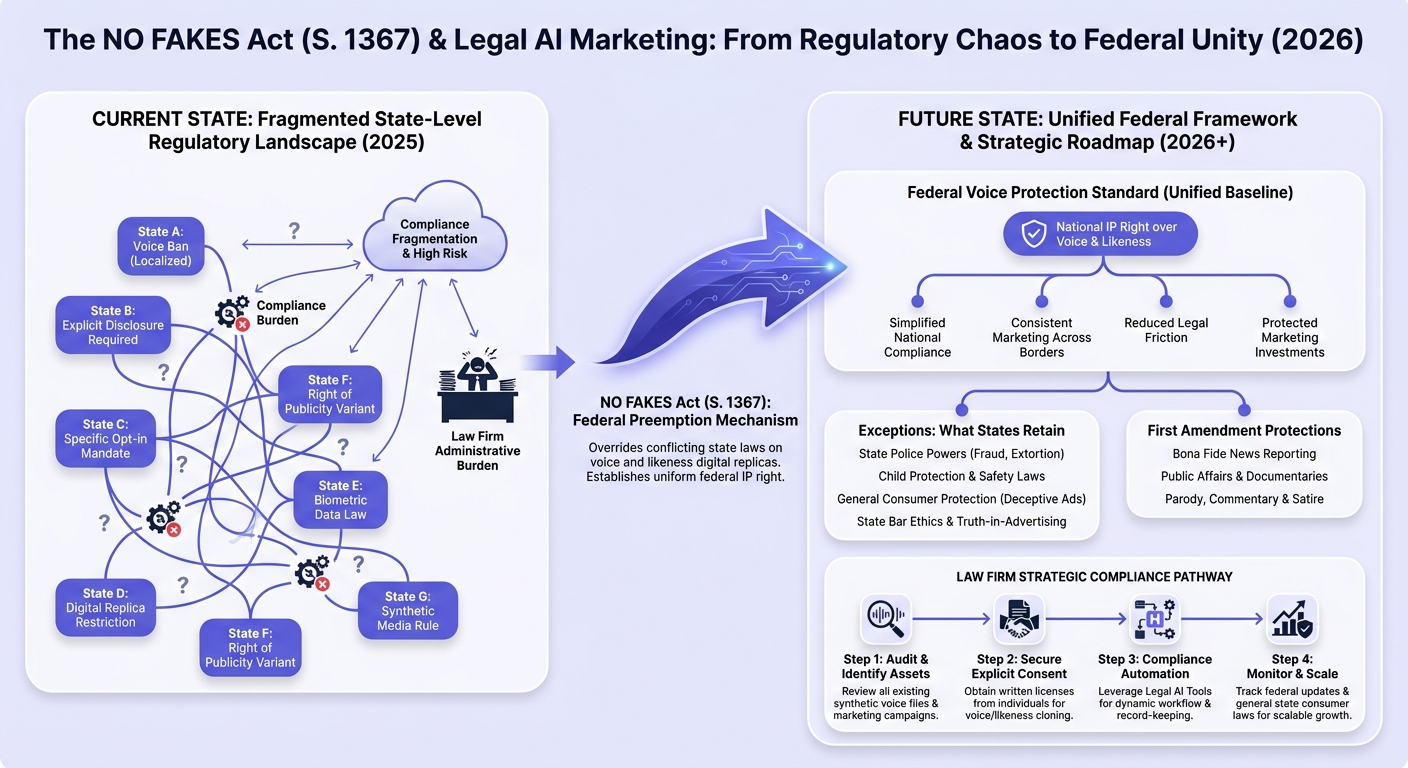
Currently, law firm operators face an incredibly fragmented compliance environment. For example, some states require explicit disclosure on any AI-generated video asset, while others outright ban certain synthetic voice applications unless specific, localized opt-ins are provided. This makes executing multi-state, high-reach digital marketing campaigns extremely risky.
Federal preemption under the NO FAKES Act addresses this issue directly. The legislation explicitly overrides conflicting state laws that attempt to regulate digital replicality and voice protection. Once fully implemented in 2026, firms will no longer need to audit their collateral against separate state-specific statutes for voice protection: the federal standard will govern nationwide campaigns completely.
The Limits of Preemption: What States Can Still Regulate
Crucially, federal preemption under S. 1367 is not a blanket shield that nullifies all state-level authorities. State exceptions remain highly active, and attorneys must continue to monitor them carefully.
- State Police Powers: States retain the authority to prosecute digital replication when it is tied directly to intentional fraud, extortion, or criminal impersonation.
- Child Protection and Safety: Local prosecutors maintain full authority to combat synthetic child exploitation.
- General Consumer Protection: Generally applicable state consumer protection laws and truth-in-advertising guidelines remain fully operative.
This means that while specific "voice and likeness replica" laws are preempted, state bar ethics boards and general consumer watchdogs still hold power to penalize deceptive marketing, as articulated in analyses by the R Street Institute.
The Constitutional Basis for Preemption Under the Commerce Clause
The constitutional authority for Congress to preempt state-level digital replica laws rests squarely on the Commerce Clause. Because digital marketing utilizing legal artificial intelligence processes is distributed via global platforms like YouTube, LinkedIn, and programmatic ad networks, it undeniably impacts interstate commerce.
State-by-state barriers to voice marketing disrupt the national economy. By establishing a uniform federal framework, Congress is exercising its constitutional power to streamline commercial communication and reduce friction for businesses operating across borders.
First Amendment Exclusions and Legal Commentary
The NO FAKES Act does not restrict free expression or standard legal analysis. It contains explicit First Amendment exemptions that protect the use of digital replicas in specific fields:
- Bona Fide News Reporting: Using digital voice replication inside analytical news coverage.
- Public Affairs and Documentaries: Utilizing historical voice likeness recreation for factual educational recordings.
- Parody and Commentary: Allowing creative commentary, reviews, or satire within legal limits.
These safeguards ensure that lawyers publishing podcasts, educational legal analyses, and live commentary on emerging legal events remain protected under standard freedom of speech provisions.
Step-by-Step Compliance Checklist for Law Firms
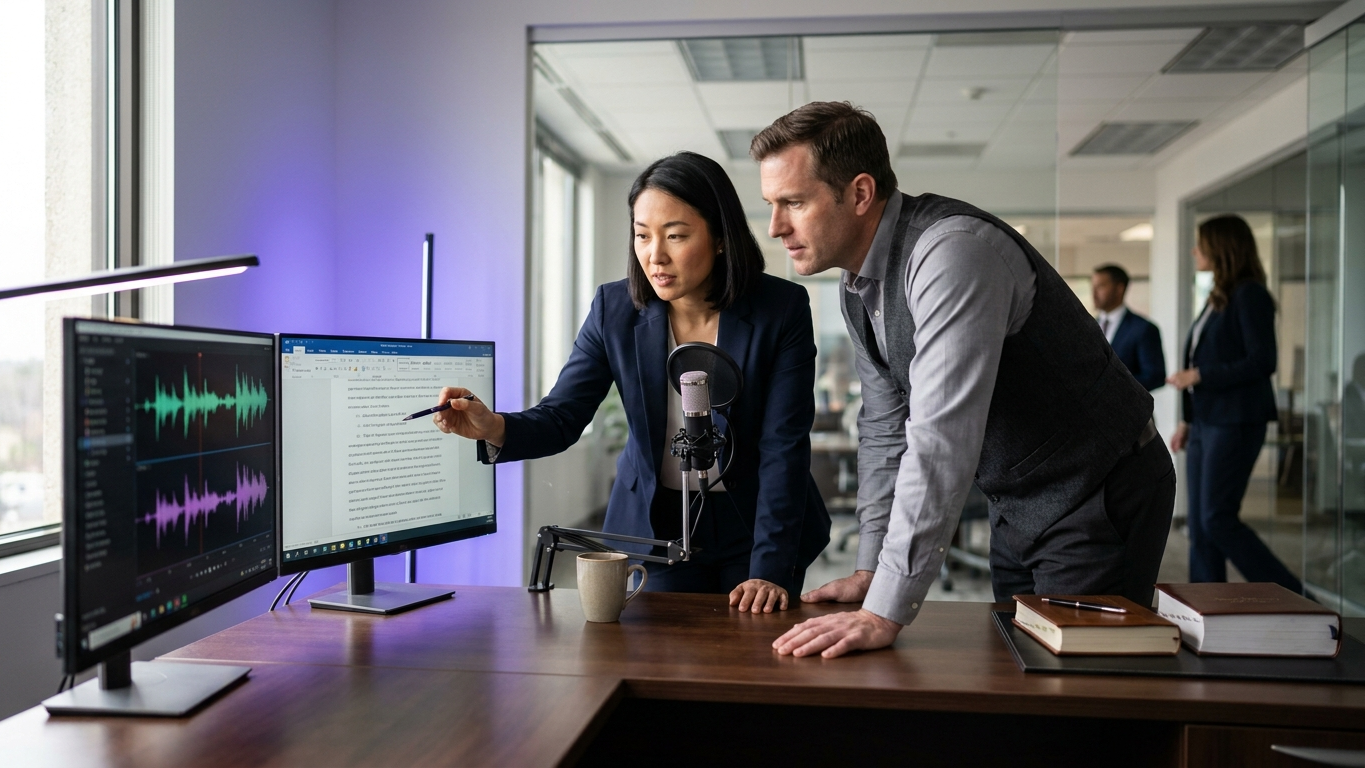
To prepare for 2026, firm owners must establish solid baseline compliance workflows. Using unified legal tech workflows managed by HyperCounsel can ensure your assets remain aligned with emerging federal trends.
| Step | Action Item | Firm Compliance Impact |
|---|---|---|
| Step 1 | Audit existing marketing assets. | Identify all voice synthetic or cloned dynamic files currently used in campaigns. |
| Step 2 | Secure explicit written consent. | Obtain release agreements from any law firm employee or contractor whose voice or likeness is cloned. |
| Step 3 | Implement automated compliance. | Partner with platforms like HyperCounsel to ensure real-time tracking of preemption timelines. |
| Step 4 | Monitor state consumer laws. | Track local general consumer protection guidelines, as they are not blanket-preempted. |
Take the Next Step to Secure Your Practice
Using legal artificial intelligence in your firm's marketing assets can generate massive ROI, but it requires highly specialized compliance monitoring. As the regulatory climate shifts toward federal preemption in 2026, leading law practices choose to de-risk their marketing channels early.
At HyperCounsel, we provide top-tier legal operations and workflow support to lawyers seeking transparent, fixed-pricing expertise. We assist firms with structural compliance, contract draft review, and AI-era risk mitigation, ensuring your firm's brand is legally bulletproof both today and in 2026.
Partner with us to secure predictable growth, accelerate your workflows, and build an airtight legal brand.
To see our plans or schedule a personal strategic consultation, visit our primary pathways:
Frequently Asked Questions
Does the NO FAKES Act override all state laws on AI marketing for lawyers?
No, it does not. The preemption strictly targets state laws governing voice and likeness digital replicas. General state laws on business fraud, false advertising, and ethics codes issued by local State Bar Associations remain active and enforceable.
What happens if a state law on voice protection is more restrictive than the federal NO FAKES Act?
Upon full implementation of the federal statute, the state's specific restrictions regarding digital voice and likeness replicas will be legally preempted and overridden by the unified federal framework established under S. 1367.
Do lawyers still need to comply with state consumer protection laws when using AI voice marketing?
Yes. General state consumer protection and truth-in-advertising guidelines remain fully operative. If your synthetic voice marketing deceptive or misleadingly represents professional legal credentials, you could face state-level consumer protection enforcement.
When will the NO FAKES Act preemption officially take effect for legal marketing in 2026?
The act is designed to take effect globally across federal jurisdictions in late 2026. Law firm operators are highly encouraged to maintain active compliance with existing localized state laws until the federal implementation date is fully finalized.