

The 2026 Competence Mandate: Why New York Rule 1.1 Now Requires AI Literacy for Every Attorney
Under NY's new Part 161, AI literacy is no longer optional for lawyers. Here is how to comply.
The legal profession is experiencing a massive technological evolution, and the rules of professional conduct are rapidly keeping pace. In New York, the introduction of Part 161 has solidified a critical paradigm shift: understanding legal artificial intelligence is no longer an optional skill for tech-savvy lawyers—it is now a mandatory professional competency.
As of March 2026, over 35 state bar associations have issued formal ethical guidance on AI in legal practice, reflecting a growing national consensus that attorneys must understand the underlying tech they use to represent their clients. For New York attorneys, the countdown to compliance has officially begun.
Failing to understand the mechanics of generative tools is no longer just a business disadvantage; it is an active threat to your license. By learning how to safely operationalize this technology, firms can remain compliant while driving massive efficiency gains using advanced platforms like HyperCounsel.
Table of Contents
- The Core Mandate: New York Part 161 (Effective June 1, 2026)
- Rule 1.1: Competence in the Age of Legal Artificial Intelligence
- Key Compliance Requirements Under the New Rule
- The Risks of Non-Compliance: Sanctions and Fee-Shifting
- Practical Steps to Operationalize Compliance
- Take Control of Your Compliance and AI Literacy
- Frequently Asked Questions
- Recommended
Quick Summary Table
| Takeaway | Explanation |
|---|---|
| Effective Date | Part 161 takes effect on June 1, 2026, in the New York State Unified Court System. |
| Competence Standard | Rule 1.1 requires lawyers to understand AI capabilities and limitations before using them in practice. |
| No Mandatory Disclosure | Part 161 rejects blanket disclosure of AI use but mandates independent verification of all filings. |
| Sanctions & Liability | Lawyers face personal sanctions and fee-shifting for fictitious citations under Rule 130-1.1. |
| Supervision Obligation | Rule 5.1/5.3 requires partners to supervise subordinate lawyers and non-lawyer staff using technology. |
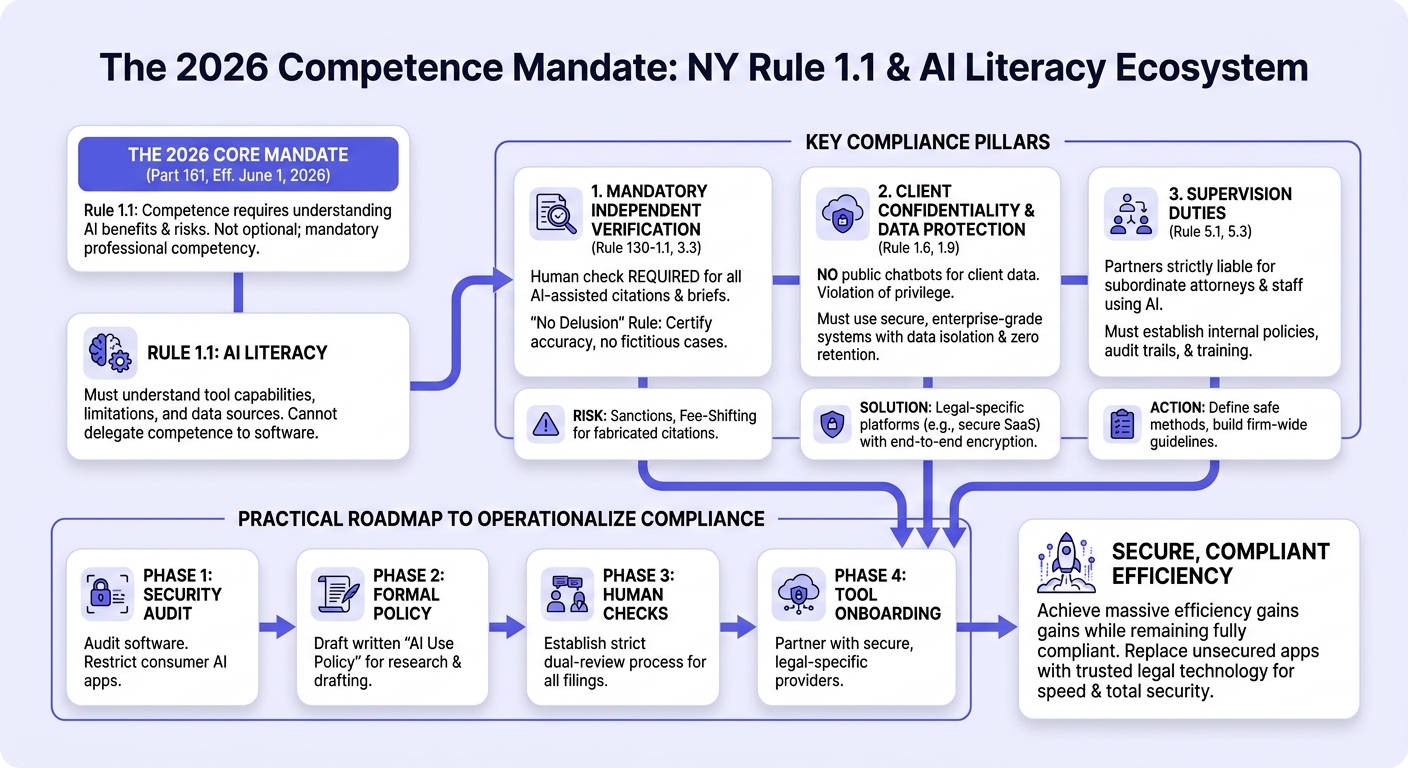
The Core Mandate: New York Part 161 (Effective June 1, 2026)
The New York State Unified Court System has adopted a groundbreaking regulatory package under Part 161. Scheduled to take effect on June 1, 2026, this rule directly impacts litigation practices, ethics management, and back-office legal research.
Part 161 does not ban artificial intelligence tools; rather, it establishes a proactive framework for safe adoption. The rule is strictly grounded in the foundations of Rule 22 NYCRR 130-1.1 (concerning frivolous conduct in court) and Rule 3.3 (which governs an attorney's duty of candor toward the tribunal).
According to the official New York State Bar Association (NYSBA) announcement, Part 161 rejects the idea of a blanket mandatory disclosure requirement. It focuses instead on individual attorney accountability: if you submit work to a court, you are certifying its absolute accuracy, regardless of how that work was compiled.
Rule 1.1: Competence in the Age of Legal Artificial Intelligence
Under standard legal ethics, New York Rules of Professional Conduct (NYRPC) Rule 1.1 mandates that a lawyer must provide competent representation to a client. Competency is no longer limited to knowing the case law; it now explicitly requires an understanding of the benefits and risks associated with technology.
Lawyers must possess a working literacy of AI capabilities and limitations before integrating these systems into their representation. Crucially, a lawyer cannot delegate competence to a software program. If you deploy an automated tool, you must understand how it arrives at its conclusions, what data sources it references, and its margin of error.
Using generative tools blindly violates your ethical obligations of competence. Legal professionals must ensure their technology uses reliable legal databases constructed specifically for attorney workflows, rather than relying on consumer-grade search engines prone to general web errors.

Key Compliance Requirements Under the New Rule
Compliance with Part 161 requires targeted systemic adjustments in how modern law firms handle legal discovery, research, and client information.
Mandatory Independent Verification (Rule 130-1.1 and Rule 3.3)
Attorneys filing papers with a New York court must verify that every cited authority is real, factual, and correct. Law firms cannot rely on automated checklists as an absolute defense if a citation is false.
- The Verification Mandate: Attorneys must run independent human checks on all AI-assisted briefs, draft pleadings, and citations.
- The "No Delusion" Rule: Legal practitioners must certify that filings contain no fictitious or fabricated cases.
Client Confidentiality and Data Protection (Rules 1.6 and 1.9)
Uploading client files, trade secrets, or private case narratives to consumer-focused public chatbots is a direct violation of Rule 1.6 (client confidentiality) and Rule 1.9 (duties to former clients).
Public tools often store text inputs to train future models, which can destroy the attorney-client privilege. To stay compliant, firms must adopt secure, enterprise-grade systems like HyperCounsel that guarantee data isolation, zero retention for model training, and end-to-end encryption.
Supervision Duties (Rules 5.1 and 5.3)
Under Rules 5.1 and 5.3, managing partners and supervisory lawyers are strictly responsible for ensuring that subordinate lawyers and non-lawyer staff (such as paralegals, legal assistants, and external contractors) comply with these ethical standards when utilizing AI.
If a junior associate drafts a brief using unverified legal tools, the senior partner signing off on the brief faces shared liability. Firms must build internal guidelines, audit trails, and strict data-handling policies.
The Risks of Non-Compliance: Sanctions and Fee-Shifting
The regulatory trend highlights a zero-tolerance policy toward tech-based carelessness in the courtroom. Reviewing developments in state-by-state legal ethics guidelines shows that judges are actively punishing inadequate oversight.
Under New York Part 161 and Rule 130-1.1, the consequences of filing fictitious or hallucinated legal citations include:
- Financial Sanctions: Courts can levy direct monetary penalties against both the offending attorney and the law firm.
- Fee-Shifting Orders: Courts may force compliance-violating attorneys to pay the opposing party’s incurred attorneys' fees.
- Disciplinary Action: The local character and fitness committees can suspend or disbar attorneys who engage in systemic violations.
Even a single unverified, fabricated case citation can quickly derail a litigation team and damage a firm's long-term reputation.
Practical Steps to Operationalize Compliance
To align with the June 1, 2026 deadline, your firm should deploy a practical roadmap designed to build secure workflow habits.
| Milestone Phase | Ethical Driver | Action Item for Law Firms |
|---|---|---|
| Phase 1: Security Audit | Rule 1.6 & Rule 1.9 | Audit existing software. Restrict the use of personal, consumer-grade AI apps on firm devices. |
| Phase 2: Formal Policy | Rule 5.1 & Rule 5.3 | draft a formal, written "AI Use Policy" explaining safe methods for research and draft compilation. |
| Phase 3: Mandated Human Checks | Rule 1.1 & Rule 3.3 | Establish a strict dual-review process for verification of all citations, cases, and codes prior to filing. |
| Phase 4: Tool Onboarding | Rule 1.1 Competence | Partner with secure, legal-specific providers like HyperCounsel to safeguard data. |
Take Control of Your Compliance and AI Literacy
Developing technology competence doesn't have to carry extreme risk. By replacing unsecured public apps with legal-specific technology, your firm can dramatically accelerate contract review, discovery, and legal research while staying completely compliant under Part 161.
HyperCounsel matches extreme speed with total security. Our platform offers fixed pricing, ironclad data isolation, and robust protection systems designed specifically to align with Rule 1.1 and 1.6 requirements.
Ready to protect your practice and scale your efficiency? Let us guide your transition:
Take the Next Step
Ready to protect your business with expert legal support? Explore how HyperCounsel can help:
Frequently Asked Questions
Does New York Rule 1.1 require attorneys to disclose AI use to the court?
No. Part 161 deliberately rejected mandatory disclosure policies across all platforms. Instead, it places the absolute responsibility of verification on the attorney’s shoulders. Whether you use tech tools or paper libraries, your submission of documents is your personal certification under Rule 130-1.1 that everything contained therein is accurate.
What happens if an AI tool generates a fictitious case in my court filing?
Under Rule 22 NYCRR 130-1.1, submitting a fabricated case or statute is treated as frivolous conduct. Courts can impose heavy monetary sanctions, order fee-shifting patterns to charge you for the opponent's costs, and issue direct referrals to disciplinary and state ethics boards.
How do I verify that an AI tool protects client confidential data before uploading materials?
You must verify that your service provider does not store client inputs to train their baseline public algorithms. Secure legal tools like HyperCounsel sign rigorous data-protection additions and protect user data within private environments, ensuring compliance under Rules 1.6 and 1.9.
Is understanding AI capabilities part of the competence duty under Rule 1.1?
Yes. Competent representation under Rule 1.1 requires attorneys to understand both the operational benefits and systemic risks of any technological tool they implement. Failing to acquire basic literacy in artificial intelligence before using it violates this duty.