

The 2026 Competence Mandate: How New York Rule 1.1 Requires Verified AI Literacy
New York's Part 161 makes AI competence a binding ethical duty under Rule 1.1 by June 2026.
The integration of technology into the courtroom has reached a critical regulatory tipping point. For years, attorneys used basic algorithms for e-discovery and keyword searches. However, the rise of generative legal artificial intelligence has prompted the judiciary to transition from voluntary guidance to hard, binding compliance structures.
According to legal industry tracking, 74% of corporate legal departments plan to audit outside counsel compliance frameworks specifically for software-driven risk. In New York, this mandate has become institutionalized. Effective June 1, 2026, the New York State Unified Court System has adopted Part 161 (22 NYCRR), legally cementing AI competency as a core element of Rule 1.1 ethical duties of professional competence.
To remain compliant and avoid severe administrative sanctions, legal practitioners must understand the requirements of this rule, transition from passive tool use to verified literacy, and secure their workflows. Using HyperCounsel allows firms to deploy secure, verified AI models that mitigate hallucination risks while matching strict ethical frameworks.
Table of Contents
- Understanding New York Part 161 and Rule 1.1
- Ethical Boundaries: ABA Formal Opinion 512 and Your Sanction Risks
- Practical Verification Checklist for AI-Generated Filings
- How Local Judges Maintain Discretion on AI Disclosure
- Implementation Guide: Transitioning Your Firm to Verified AI Literacy
- Take the Next Step with HyperCounsel
- Frequently Asked Questions
- Recommended
Quick Summary
| Takeaway | Explanation |
|---|---|
| Rule Mandate | Part 161 requires complete, active verification of all AI-generated citations and text. |
| Core Standard | Aligned with NY Rule 1.1; lawyers cannot blame technology for legal inaccuracies. |
| Sanctions Risk | Under ABA Formal Opinion 512, attorneys face severe fee-shifting or career suspensions for hallucinations. |
| Workflow Solution | Use secure AI tools via HyperCounsel to ensure end-to-end data safety. |
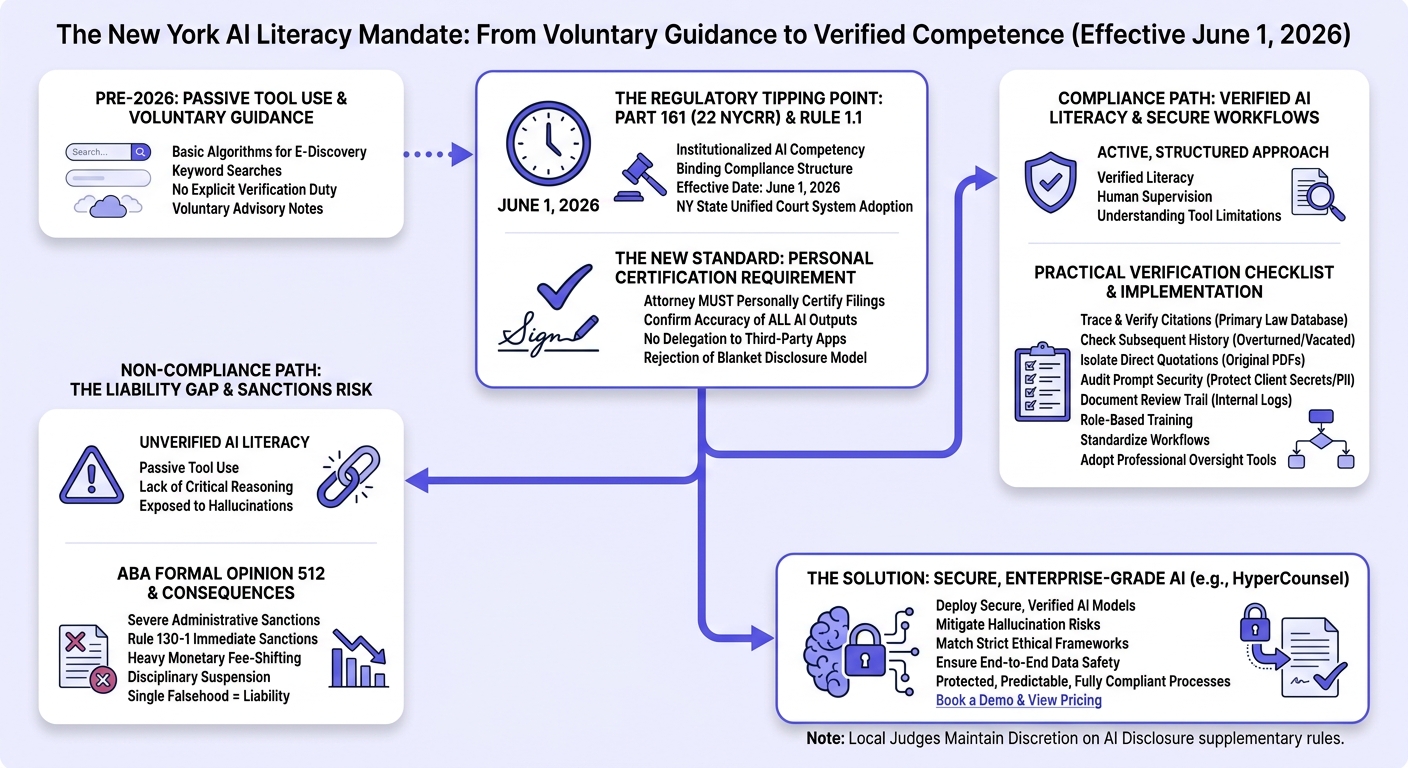
Understanding New York Part 161 and Rule 1.1
New York is the first major jurisdiction to move away from voluntary advisory notes on legal technology in favor of binding rules. Under the newly enacted Part 161 of the Rules of the Chief Administrator of the Courts, attorneys bear the explicit burden of confirming that all generative AI outputs submitted in judicial proceedings are fully accurate and verifiable.
The June 1, 2026 Deadline
Marking a massive shift in state court practice, beginning June 1, 2026, New York attorneys must personally certify their filings. This rule has been widely publicized in resources such as the New York State Bar Association's official notice. If you have not adapted your workflow before this deadline, you put every pending case at immediate risk.
Rule 1.1 Competence in the AI Era
Ethical competence used to mean knowing the law; now, it requires understanding the tools used to find the law. New York Rule 1.1 mandates that attorneys maintain "technological competence." If your firm uses legal artificial intelligence to draft briefs, research citations, or structure contracts without understanding how those systems retrieve information, you are violating this fundamental competence standard.
Ethical Boundaries: ABA Formal Opinion 512 and Your Sanction Risks
The American Bar Association released ABA Formal Opinion 512 to establish a framework for how lawyers can ethically utilize generative systems. This opinion outlines that while legal artificial intelligence delivers unprecedented efficiency, its lack of critical reasoning requires human supervision. To read more about national perspectives on ethical standards, look at AI & Legal Ethics 2026: Bar Rules Every Lawyer Must Know.
The Personal Certification Requirement
Unlike other state drafts that suggested a broad "disclosure" rule (demanding lawyers declare if they used AI), New York's Part 161 deliberately rejected a blanket disclosure model. Instead, it mandates a compliance certification. By signing a court filing, the attorney certifies they have independently checked and confirmed the truth and existence of every authority, case, and quote cited within. You cannot delegate this ethical duty to a third-party application.
The Liability Gap and Single Falsehood Sanctions
The liability gap refers to the space between a software hallucination and the attorney’s personal responsibility. In the judicial arena, there is no shared liability. A single fabricated citation generated by an unverified legal artificial intelligence tool and submitted in a briefing can lead to immediate sanctions under Rule 130-1, heavy monetary fee-shifting remedies, or even disciplinary suspension.
Practical Verification Checklist for AI-Generated Filings
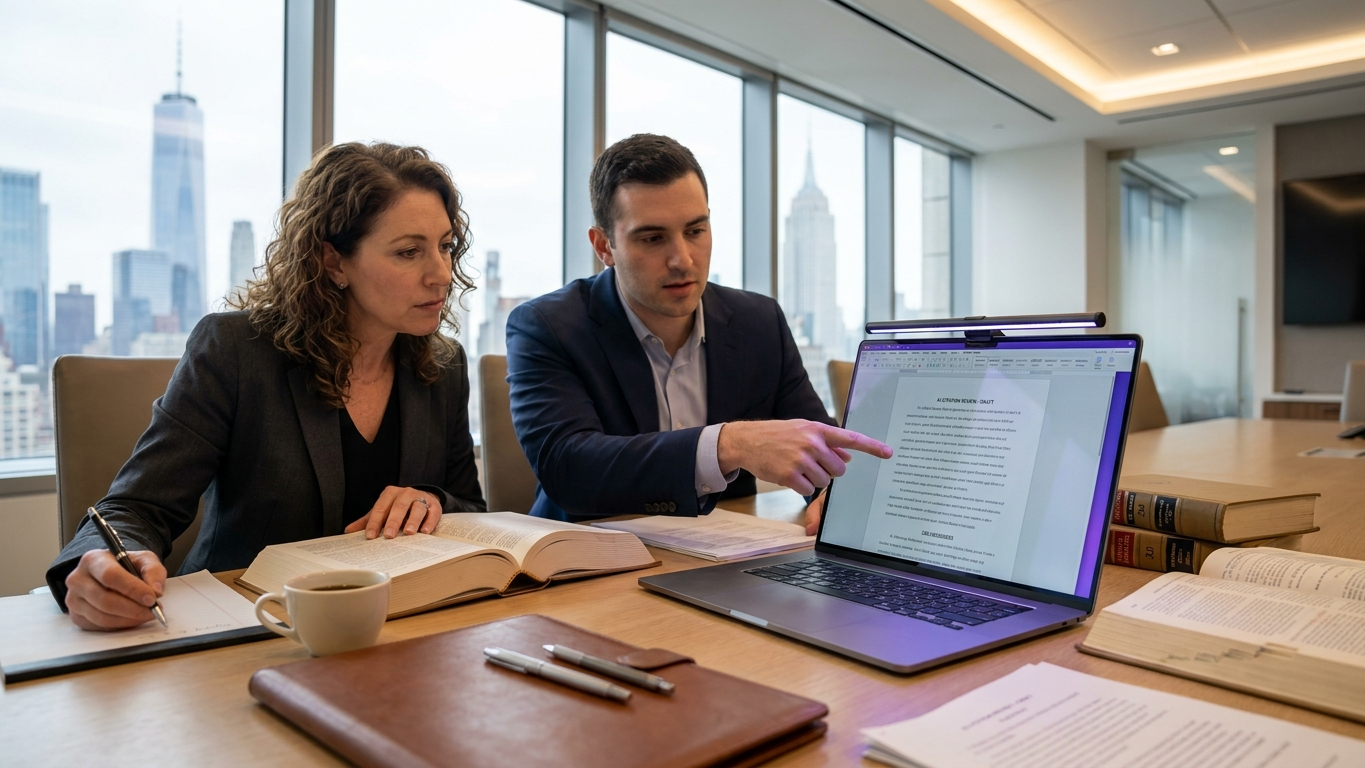
To make sure your submissions remain strictly compliant with Part 161, your legal team must employ a systematic verification workflow for all legal artificial intelligence outputs. Refer to the checklist below for every draft before final filing print:
- Trace and Verify Citations: Cross-reference every legal citation against a curated primary-law database to confirm the case title, reporter volume, and page number actually exist.
- Check Subsequent History: Ensure any case cited has not been overturned, vacated, or superseded. AI models can slip on negative history.
- Isolate Direct Quotations: Compare direct text quotes against original PDFs of court opinions, checking for accuracy in punctuation and context.
- Audit Prompt Security: Protect client secrets. Avoid entering personally identifiable information (PII) or trade secrets into public AI search engines.
- Document Your Review Trail: Keep internal logs detailing who verified each source, and when, to demonstrate compliance in the event of an inquiry.
| Verification Phase | Action Item | Responsibility |
|---|---|---|
| Draft Ingestion | Review citation generation | Drafting Attorney |
| Core Check | Cross-reference with primary authorities | Lead Paralegal |
| Final Sign-off | Formally execute the Part 161 certification | Lead Counsel |
How Local Judges Maintain Discretion on AI Disclosure
Although the New York State Unified Court System took a statewide approach that does not require generic disclosure of AI usage, individual judges retain ultimate authority over their respective courts. They have the discretion to issue supplementary rules via local chambers, demanding detailed disclosures regarding which generative models were used and what specific inputs were fed into the software. Practitioners must review local rules of individual judges before filing to ensure no conflicts occur with Part 161.
Implementation Guide: Transitioning Your Firm to Verified AI Literacy
Achieving literacy with legal artificial intelligence is not a one-hour seminar; it requires an active, structured approach across your entire organization.
- Conduct a Security Audit: Review your current tech stack. If your lawyers are using generic, free web tools, they are exposing sensitive client information. Shift your team to secure, enterprise-grade frameworks.
- Implement Role-Based Training: Develop comprehensive training programs geared toward practical verification. Every associate, paralegal, and partner must know how AI fails (hallucinations, bias, over-reliance) to correctly catch mistakes.
- Standardize Workflows with Secure Legal Assistants: Shift workloads over to closed systems that don't train on your proprietary data, maintaining compliance with ABA Formal Opinion 512.
- Adopt Professional Oversight Tools: Leverage professional workflows that streamline document analysis, such as those provided by HyperCounsel, which can greatly reduce verification times while ensuring accuracy.
Take the Next Step with HyperCounsel
Navigating the rapidly shifting demands of legal artificial intelligence and strict state compliance requirements like New York's Part 161 requires robust, secure, and intuitive systems. Doing manual checks for every generative output drains valuable hours, but leaving it to chance can destroy your reputation.
Prepare your practice for the June 1, 2026 deadline with the help of HyperCounsel. Our software helps law firms implement secure, enterprise-grade AI procedures that ensure your legal research processes remain protected, predictable, and fully compliant with ethical mandates.
To see our system in action and discover transparent pricing solutions, you can Book a Demo or view our Pricing Structures. Ensure your practice operates at the highest levels of safety and efficiency today.
This article provides general information and is not legal advice.
Frequently Asked Questions
Does New York Part 161 require attorneys to disclose AI use in court filings?
No, New York's statewide Part 161 explicitly rejects a generic disclosure requirement. Instead of forcing attorneys to disclose if they utilized artificial intelligence tools, it mandates a personal certification that all content, citations, and authority mentioned in the filing have been human-verified and contain no fabricated citations.
What specific sanctions apply if an attorney submits a filing with an AI-generated fabricated case?
Under Part 130-1 of the Rules of the Chief Administrator, submission of fabricated legal materials or false citations can lead to monetary sanctions, payment of structural attorney fees to the opposing counsel (fee-shifting remedies), case dismissal, and referral to the state disciplinary committee for license suspension.
How does Model Rule 1.1 define the level of competence required for using legal artificial intelligence?
Model Rule 1.1 of professional responsibility requires that lawyers understand the benefits and risks associated with relevant technology. In the context of AI tools, this competency standard translates to knowing how AI operates, identifying potential failures such as hallucinations, and maintaining rigorous supervision over output.
Can individual New York judges impose stricter AI disclosure rules than the statewide rule Part 161?
Yes, individual judges retain broad, inherent authority over their courtrooms. This means a judge can issue supplementary orders or stand-alone chambers rules that demand specific disclosures regarding AI usage, despite the statewide rule's focus entirely on certification rather than mandatory disclosure.