

Beyond the 'Black Box': Operationalizing POPIA's Risk-Tiered Oversight Model for AI-Driven Legal Tech Deployers in South Africa
Learn how South African law firms can operationalize POPIA compliance while deploying AI tools.
The rapid adoption of artificial intelligence in South African law firms has created a critical tension between operational efficiency and regulatory compliance. As legal practitioners increasingly leverage generative AI for contract review, legal research, and administrative automation, they must navigate the strict boundaries set by the Protection of Personal Information Act (POPIA).
A recent market analysis reveals that 68% of solicitors now require human-in-the-loop review before relying on AI-generated legal opinions to maintain professional standards and regulatory alignment. For firms acting as data protection act solicitors, understanding how POPIA restricts automated data processing is no longer optional—it is a core risk management requirement.
Managing these privacy frameworks manually can strain administrative resources. Modern legal practices increasingly partner with HyperCounsel South Africa to deploy secure, compliant legal workflows. This guide breaks down the concrete steps South African legal professionals must take to align their AI deployments with POPIA requirements.
Table of Contents
- Quick Summary
- POPIA Section 71 and Automated Decision-Making
- The Human-in-the-Loop Requirement
- Securing Client Data in AI Systems
- Bias Testing and Differential Impact Assessments
- Transparency and Client Disclosures
- Practical POPIA AI Compliance Roadmap
- Take the Next Step
- Frequently Asked Questions
- Recommended
Quick Summary
| Compliance Pillar | POPIA Enforcement Requirement | Legal Practice Action |
|---|---|---|
| Automated Decisions | Section 71 prohibition on decisions based solely on automated processing. | Implement mandatory human review before delivering AI-driven legal guidance. |
| Data Security | Section 19 obligation to secure integrity and confidentiality of personal data. | Prohibit raw uploads of client files to public, non-encrypted AI models. |
| Algorithmic Bias | Protection against unfair discrimination and skewed outcomes. | Perform bias testing and differential impact assessments on legal tools. |
| Transparency | Sections 11 and 12 obligation to notify data subjects of processing activities. | Disclose AI processing practices in client engagement letters. |
POPIA Section 71 and Automated Decision-Making
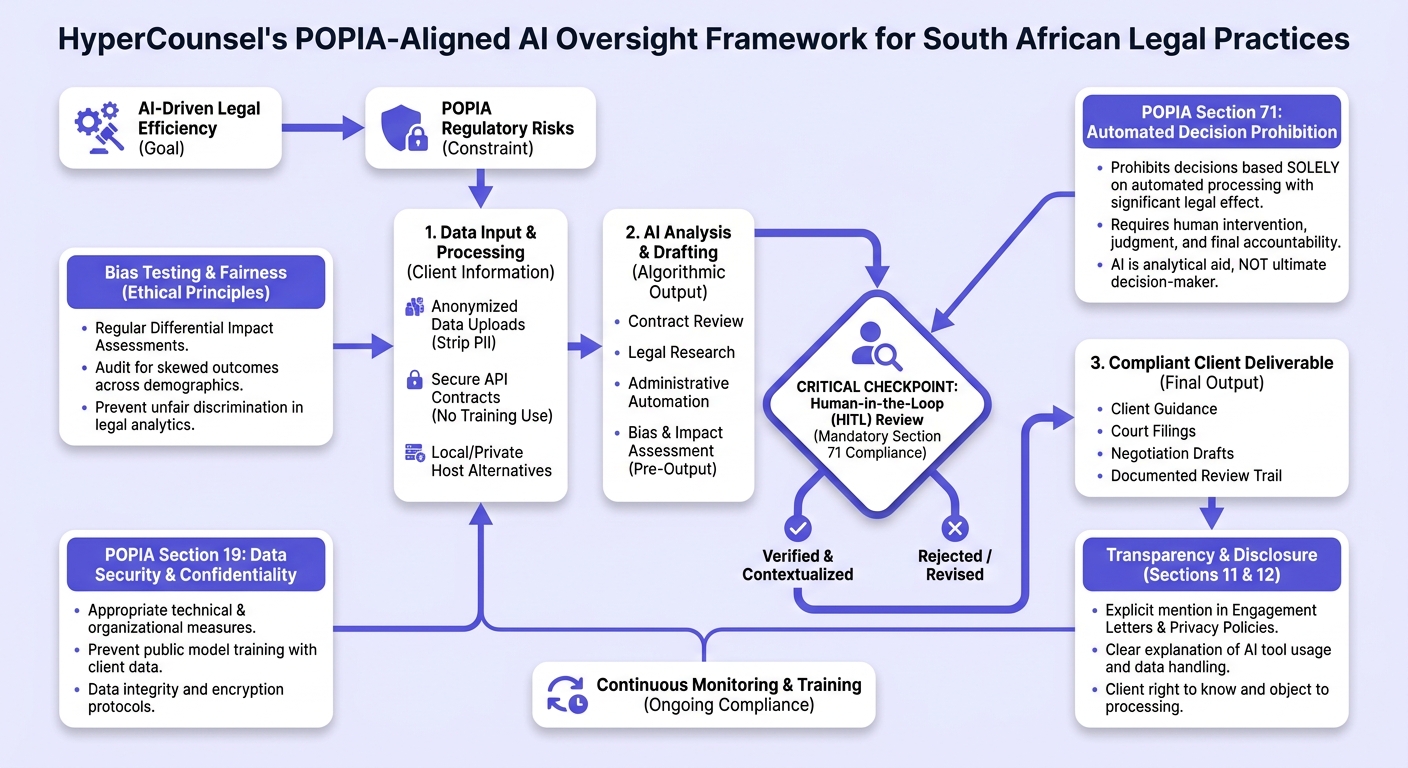
For data protection act solicitors in South Africa, Section 71 of POPIA is the primary regulatory hurdle when deploying AI tools. This section explicitly prohibits subjecting data subjects to decisions that produce legal consequences or significantly affect them, if those decisions are based solely on the automated processing of personal information.
If a law firm uses an AI tool to automatically vet employment contracts, grade potential client liability, or calculate settlement offerings without human intervention, it likely violates Section 71. The Information Regulator of South Africa monitors these automated systems closely to ensure they do not bypass human judgment.
To remain compliant, South African practices must construct workflows where AI serves strictly as an analytical aid rather than the ultimate decision-maker.
The Human-in-the-Loop Requirement
To counteract the risks identified in Section 71, law firms must establish a rigorous "human-in-the-loop" (HITL) review framework. Under South African legal practice guidelines, an AI output cannot be delivered directly to a client or filed with a court without professional vetting.

Implementing HITL means that a qualified legal professional must:
- Independently verify the statutory citations and case law references generated by AI tools.
- Evaluate the contextual relevance of AI-drafted clauses to the specific client matter.
- Document that a human review took place prior to final output transmission.
This active supervision ensures that the firm remains the primary repository of legal accountability, effectively neutralizing the risk of "hallucinated" legal precedents or incorrect statutory interpretations.
Securing Client Data in AI Systems
Section 19 of POPIA requires responsible parties to secure the integrity and confidentiality of personal information by taking appropriate, reasonable technical and organizational measures. When solicitors upload sensitive client briefs, financial disclosures, or personal identifiers into AI systems, they risk exposing that data to external servers.
Many commercial AI tools utilize user inputs to train future models, meaning public uploads could result in a severe data breach.
To maintain compliance, South African law firms must implement the following protective protocols:
- Enterprise Agreements: Secure API-level contracts with AI vendors that guarantee input data is not used for model training.
- Data Anonymization: Strip all personally identifiable information (PII) from legal briefs and agreements before uploading them to any external AI application.
- Local Host Alternatives: Favor local, self-hosted, or private cloud-based legal AI models that keep client data within the firm's sovereign security perimeter.
Bias Testing and Differential Impact Assessments
AI models are trained on historical data, which may contain systemic biases or outdated legal assumptions. Under South African non-discrimination frameworks and POPIA's ethical data principles, legal professionals must ensure their AI applications do not produce biased outputs.
This is especially critical when AI tools are deployed to assess claims, analyze historical court rulings, or evaluate candidate CVs for internal recruitment. Firms should perform regular differential impact assessments to evaluate whether an AI tool produces skewed results across different demographic or socio-economic groups. Collaborating with technology partners to perform periodic bias audits prevents regulatory issues and legal liability.
Transparency and Client Disclosures
Transparency is a foundational condition of lawful processing under POPIA. Clients have a right to know how their sensitive data is processed, analyzed, and stored. For modern law firms, this means disclosing the use of AI tools in daily operations.
To meet these transparency obligations, firms should update their onboarding materials:
- Engagement Letters: Clearly state that the firm utilizes secure, vetted AI tools to expedite administrative tasks, document drafting, and research.
- Privacy Policies: Publish details on the firm's website detailing how client information is secured, anonymized, and processed across third-party software platforms.
- Explicit Consent: Obtain formal authorization for automated processing activities that fall outside normal administrative support.
Practical POPIA AI Compliance Roadmap
Transitioning to an AI-enabled practice while staying fully compliant with POPIA requires a structured methodology. Law firms can use the structured checklist below to audit and align their current deployments.
| Step | Action Item | Target Timeline | Responsible Party |
|---|---|---|---|
| Step 1 | Inventory Current AI Use: Document all software, extensions, and engines currently used to process or analyze client data. | Week 1 - 2 | Information Officer |
| Step 2 | Update Vendor Contracts: Audit software SLAs to ensure compliance with POPIA Section 19 regarding data security. | Week 3 - 4 | Senior Partner |
| Step 3 | Draft HITL Protocols: Document and distribute standard operating procedures requiring human verification of all AI outputs. | Week 5 | Practice Manager |
| Step 4 | Client Terms Updates: Revise engagement letters and privacy policies to include mandatory AI disclosures. | Week 6 | Compliance Officer |
| Step 5 | Staff Training: Conduct workshops on data security, data anonymization, and the limits of automated processing. | Week 7 | All Legal Staff |
Take the Next Step
Setting up robust POPIA compliance frameworks for legal technology does not have to overwhelm your firm's administrative resources. Ensuring that your digital infrastructure is fully aligned with South African privacy laws can quickly become a competitive differentiator.
With HyperCounsel South Africa, legal teams gain access to structured workflows, enterprise-grade document generation systems, and compliance-ready technologies designed for modern law firms. Eliminate the risks of manual oversight and safeguard your client portfolios with transparent, reliable legal tech management.
Ready to protect your firm from compliance liabilities? Plan your technology journey by checking our competitive HyperCounsel Pricing options or Book a Demo with our legal workflow specialists today.
This article provides general information and is not legal advice.
Frequently Asked Questions
Does POPIA apply to solicitors using AI for client communication?
Yes. If an AI tool processes, drafts, or manages communications containing personal client details—such as names, addresses, ID numbers, or financial details—the interaction must fully comply with POPIA's conditions for lawful processing.
What is Section 71 of POPIA and how does it affect legal AI tools?
Section 71 prohibits making significant or legal decisions about data subjects based solely on automated processing. It prevents law firms from relying exclusively on AI tools to make definitive legal determinations, draft binding decisions, or evaluate claims without human oversight.
Can solicitors rely solely on AI outputs without human review under POPIA?
No. Relying solely on raw AI outputs violates professional conduct guidelines and conflicts with Section 71 of POPIA. Human review is mandatory to ensure context, legal accuracy, and data security before presenting advice to clients.
How must solicitors disclose AI use to clients under POPIA transparency rules?
Firms should disclose the use of AI tools within their signed client agreement letters and detailed privacy policies. This communication must clarify how information is uploaded, processed, and safeguarded.