

The Human-in-the-Loop Mandate: Why POPIA Section 71(1) is Now the Primary Guardrail for AI Legal Tech in SA Firms
Learn why POPIA Section 71(1) requires a human-in-the-loop for AI legal tech in South Africa.
Artificial intelligence is rapidly transforming the South African legal market. From automating contract reviews to predicting case outcomes, modern tools promise unprecedented efficiency. However, deploying these technologies without understanding the regulatory landscape is a high-risk gamble.
According to research on emerging technologies, over 80% of corporate compliance failures in early-stage AI adoption stem from a lack of human oversight in automated pipelines. In South Africa, this oversight is not just a operational best practice; it is a strict statutory requirement.
As South Africa lacks a standalone AI Act, the Protection of Personal Information Act (POPIA) serves as the primary regulatory framework. Specifically, POPIA Section 71(1) establishes a strict "human-in-the-loop" mandate that every law firm must navigate. By building compliant workflows with advanced platforms like HyperCounsel, South African law firms can safely leverage automated tools while fully mitigating legislative risks.
Table of Contents
- Understanding POPIA Section 71(1) and Automated Decisions
- The Automated Decision-Making Exceptions: Section 71(2)
- What Are Appropriate Measures Under Section 71(3)?
- Real-World Risks for South African Law Firms
- The Human-in-the-Loop Strategy: Your Compliance Shield
- POPIA Section 71 vs GDPR Article 22
- Step-by-Step AI Legal Tech Integration Checklist
- Let HyperCounsel Secure Your AI Workflows
- Frequently Asked Questions
- Recommended
Quick Summary
| Takeaway | Explanation |
|---|---|
| Primary Guardrail | POPIA Section 71(1) restricts fully automated decisions that carry legal or major consequences. |
| Human-in-the-Loop | To deploy AI safely, firms must maintain meaningful human review at key decision points. |
| Unique SA Gaps | POPIA lacks a proactive notification rule, meaning firms must independently build client-feedback channels. |
| Strict Penalties | Violations can result in severe administrative fines and reputational damage by the Information Regulator. |
| How to Comply | Implement structured checklists, log all AI decision rationales, and use POPIA-compliant platform pipelines. |
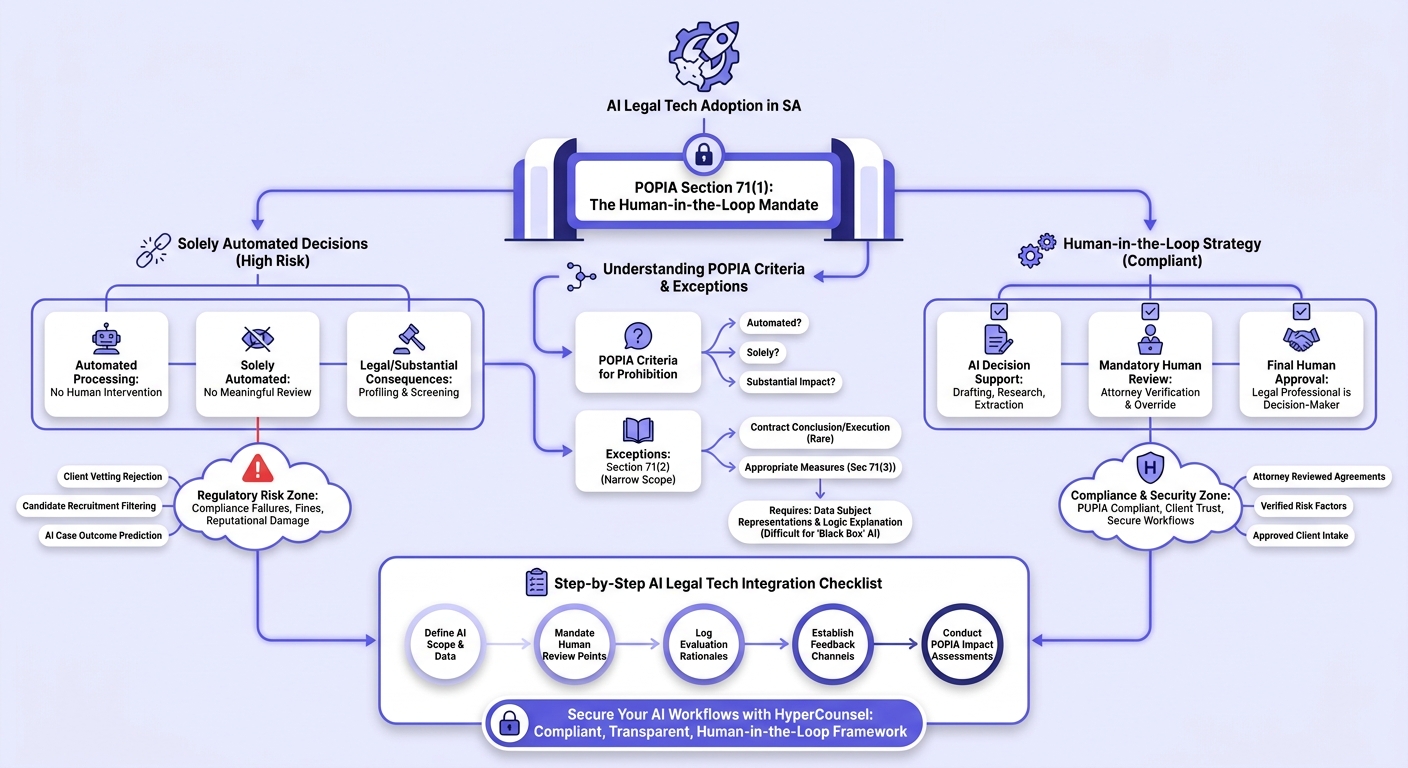
Understanding POPIA Section 71(1) and Automated Decisions
POPIA Section 71(1) prohibits decisions that result in legal consequences or substantially affect a data subject if those decisions are based solely on the automated processing of personal information. The law is designed to prevent scenarios where machines make life-altering decisions without human empathy, contextual understanding, or judicial review.
To trigger the prohibition under Section 71(1) of POPIA, a technology process must meet three specific criteria:
- Automated Processing: Personal information is analyzed, profiled, or run through an algorithm without human intervention.
- Solely Automated: There is no meaningful human review, verification, or override capability in the workflow.
- Legal or Substantial Consequences: The decision results in significant impacts, such as profiling a client’s creditworthiness, screening job candidates, or predicting case outcomes that determine whether a firm takes on a matter.
For lawyers integrating modern legal tech south africa, this means any tool that automatically generates final actions, predicts litigation success, or rates a client’s credibility must feature an explicit human gatekeeper.
The Automated Decision-Making Exceptions: Section 71(2)
Section 71(2) provides narrow exceptions where automated decision-making (ADM) is legally permissible. These exceptions apply only if the decision:
- Has been taken in connection with the conclusion or execution of a contract, and the request of the data subject has been satisfied, or
- Is supported by appropriate measures that protect the data subject’s legitimate interests.
In a legal services environment, relying on these exceptions is highly risky. Legal matters are inherently complex and dynamic. It is rare for a standard legal tech tool to fit neatly into the "execution of a contract" exception without requiring deep qualitative analysis. Therefore, firms must rely on establishing "appropriate measures" to ensure compliance.
What Are Appropriate Measures Under Section 71(3)?
If a firm attempts to utilize automated decision-making under the exceptions, Section 71(3) requires them to implement specific safeguards. These "appropriate measures" must include:
- Providing the data subject with an opportunity to make representations about the decision.
- Supplying the data subject with sufficient information regarding the underlying logic of the automated decision.
As noted by IT Law Co, explaining the "black box" logic of highly advanced AI systems is exceptionally difficult. This technological limitation makes the "human-in-the-loop" model the most reliable mechanism for compliance.

Real-World Risks for South African Law Firms
How does this play out in practice? Law firms adopting modern AI face compliance risks in several everyday operations:
- Client Vetting and Credit Profiling: Using AI to analyze a prospective client’s financial history to determine whether they can afford your retainers. If the system automatically rejects a client without an attorney reviewing the report, it violates Section 71(1) as highlighted in Webber Wentzel's analysis.
- Candidate Recruitment: Deploying automated screening tools that rank and filter legal candidates based on CV data, which constitutes profiling under POPIA vetting guidelines.
- AI Case Outcome Predictions: Generating case success probabilities that are automatically used to reject or settle claims without an attorney verifying the algorithmic assumptions first.
The Human-in-the-Loop Strategy: Your Compliance Shield
The safest way to adopt legal tech in South Africa is to avoid "solely automated" decisions entirely. By establishing a strict Human-in-the-Loop (HITL) operational workflow, your firm ensures that the legal professional remains the ultimate decision-maker.
Under an HITL framework, the AI legal tech performs the heavy lifting—such as drafting agreements, extracting key contract metadata, or identifying risk factors. However, an attorney must review, verify, and formally approve the output before it is communicated or acted upon. This step transforms the AI from an autonomous decision-maker into a powerful decision-support tool, keeping your firm firmly within POPIA compliance.
POPIA Section 71 vs GDPR Article 22
While South Africa's POPIA is heavily modeled after Europe's General Data Protection Regulation (GDPR), key differences exist regarding automated decisions.
| Comparative Aspect | POPIA Section 71 | GDPR Article 22 |
|---|---|---|
| General Prohibition | Prohibits decisions based solely on automated processing. | Prohibits decisions based solely on automated processing. |
| Duty of Notification | Highly ambiguous; lacks an explicit, proactive duty of notification. | Features a strict, proactive duty to notify individuals about automated processing. |
| Clarity of Exceptions | Broadly framed, requiring internal firmware policies. | Highly codified with specific, clear regulatory exemptions. |
Because POPIA lacks an explicit, proactive notice requirement relative to automated decisions, South African law firms must be proactive. Firms should design internal compliance policies that mandate human review, rather than waiting for regulatory disputes to arise.
Step-by-Step AI Legal Tech Integration Checklist
To safely integrate AI legal tech south africa in your firm, use this step-by-step compliance checklist:
- Define the AI's Scope: Document exactly what data the software will process and identify if any personal or special personal information is involved.
- Mandate Human Review Points: Embed mandatory manual checkpoints in your workflow software so no document or report is finalized without human validation.
- Log Evaluation Rationales: Keep a secure registry of how AI suggestions were evaluated, modified, or approved by the human attorney.
- Establish Feedback Channels: Provide clients with a clear, simple way to ask questions, request human reviews, or contest any algorithmically aided assessments.
- Conduct Impact Assessments: Run a periodic POPIA Risk Assessment on your legal tech stack to identify vulnerabilities in data transmission and storage.
Let HyperCounsel Secure Your AI Workflows
Adopting artificial intelligence should not put your firm at regulatory risk. By selecting legal tech platforms that are designed with compliance, transparency, and data security in mind, you protect both your practice and your clients.
HyperCounsel provides the reliable, structured framework South African firms need to deploy AI safely. Our platform embeds human-in-the-loop checkpoints directly into specialized legal workflows, ensuring your lawyers remain in total control of the system's outputs. Protect your practice, build trust with your clients, and achieve peace of mind with intuitive compliance tools.
Ready to see how we help South African law firms scale compliantly? Book a Demo today or view our transparent Pricing models.
This article provides general information and is not legal advice.
Take the Next Step
Ready to protect your business with expert legal support? Explore how HyperCounsel can help:
Frequently Asked Questions
Does POPIA Section 71(1) ban all AI use in South African law firms?
No. POPIA Section 71(1) only restricts decisions that are based solely on automated processing and carry legal or substantial consequences. AI tools utilized for drafting assistance, legal research, and background document analysis are fully permissible, provided a qualified legal professional reviews and signs off on the final work product.
What are the "appropriate measures" required to comply with Section 71(3) of POPIA?
Appropriate measures require that you give the data subject (your client or employee) an opportunity to make representations regarding the decision. Additionally, you must be able to explain the underlying logic of the automated system in simple, accessible terms.
Can a lawyer use AI to assess a client's creditworthiness without human review under POPIA?
No. Assessing creditworthiness is a form of profiling that directly impacts whether a client can access legal services. Using an AI tool to automatically reject clients without an attorney reviewing the decision violates the core protections of Section 71(1).
What happens if a South African law firm violates POPIA Section 71 by using fully automated legal tech?
Violating POPIA can result in administrative investigations, enforcement notices, and substantial administrative fines issued by the Information Regulator. Furthermore, firms risk severe reputational damage and potential civil claims from affected clients.