

Contract Confidentiality Under Fire: Securing Client Data in Generative AI for Lawyers
Learn how lawyers can safely use generative AI while protecting strict client confidentiality.
The legal industry is undergoing a structural paradigm shift driven by agentic artificial intelligence. While these autonomous tools promise to draft, analyze, and process massive data sets at lightning speed, they present unprecedented risks to the foundational duty of client confidentiality.
Integrating generative ai for lawyers into daily workflows requires more than just accepting a terms-of-service checkbox. Corporate and litigation practices must build strict security protocols to prevent unintentional data disclosures and privileged waivers during complex AI tasks.
According to data security studies, 68% of data breaches involve human error while using technology, and law firms face an average data breach cost of $5.08 million. When using advanced legal tech, simple errors in prompt entry or vendor setups can compromise non-disclosure agreements and damage clinical firm reputations.
Table of Contents
- Quick Summary of Secure AI Management
- The Ethics of Legal Tech: Understanding ABA Formal Opinion 512
- Practical Anonymization Techniques for Prompts
- Negotiating Generative AI Vendor Agreements
- Prohibited AI Uses and Open-Loop Vulnerabilities
- Building a Compliance Policy Under Model Rules 5.1 and 5.3
- Secure Your Firm with AI Governance
- Frequently Asked Questions
- Recommended
Quick Summary of Secure AI Management
| Takeaway | Explanation |
|---|---|
| ABA Formal Opinion 512 | Requires informed client consent when using self-learning generative AI tools with client data. |
| Anonymization Tactics | Implement masking, tokenization, and contextual substitution prior to using any prompt. |
| Enterprise-Grade Focus | Avoid public free-use models; run systems only on closed developer enterprise environments with DPAs. |
| Model Rules Compliance | Maintain diligent supervision over non-lawyer assistance under ABA Model Rules 5.1 and 5.3. |
The Ethics of Legal Tech: Understanding ABA Formal Opinion 512
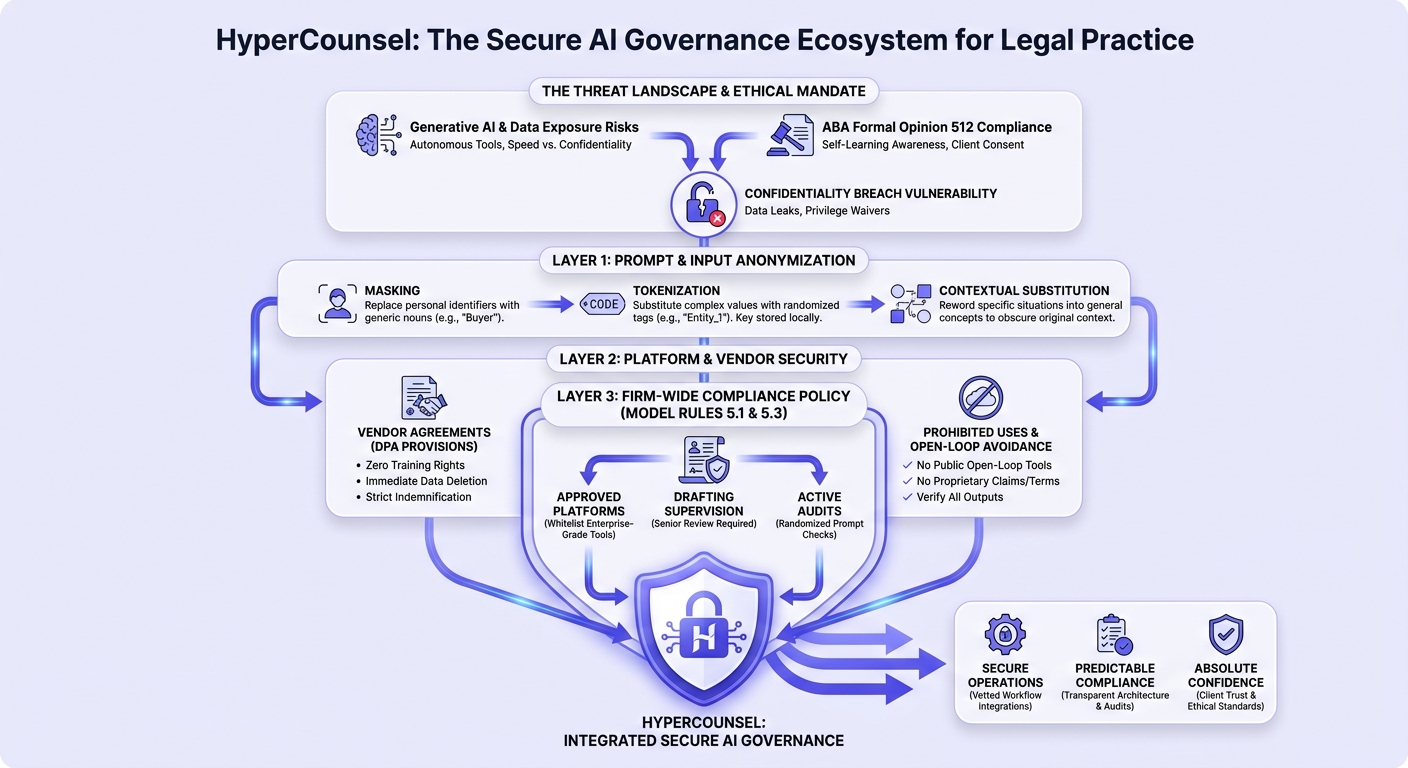
Modern attorney ethics rules make no exception for advanced technology. In the US, the American Bar Association (ABA) issued Formal Opinion 512 to explicitly address the integration of generative AI tools. This ruling mandates that lawyers must understand whether an AI system is self-learning (meaning it trains on input prompts) and ensure that raw client files are not fed into exposed algorithms.
Under these ethical guidelines, boilerplate consent clauses nested deep in client engagement letters are insufficient. Firms must secure explicit informed consent when a case requires entering highly unique proprietary information into third-party AI platforms.
Ethical outsourcing further dictates that lawyers verify where their digital tools process data. As established in academic analyses of AI ethics, failing to run rigorous security diligence on subcontractors — including technology platforms — violates a lawyer's primary fiduciary duties.
Practical Anonymization Techniques for Prompts
Attorneys must strip sensitive identifying material from any draft before running it through an external neural network. Failing to do so can immediately waive attorney-client privilege. Utilizing robust anonymization strategies prevents search crawlers and AI memory nodes from matching queries with real-world entities.
According to practical guidelines on legal AI exposure, practitioners should standardly implement three distinct data-washing steps before querying an AI model:
- Masking: Replacing direct personal identifiers (e.g., names, SSNs, corporate brands) with boilerplate placeholder nouns like "Buyer" or "Underwriter".
- Tokenization: Replacing complex values with randomized, alphanumeric tags (e.g., "Company_X" or "Property_Y") and housing the structural conversion key locally on secure firm drives.
- Contextual Substitution: Rewording distinct, hyper-specific situations into general, abstract legal concepts to completely obscure the original situation.
The table below outlines how to utilize these measures effectively:
| Anonymization Step | Objective | Example |
|---|---|---|
| Level 1: Basic Masking | Protect individual identity | Convert "John Smith of Chicago" to "Individual A of Illinois" |
| Level 2: Tokenization | Track multi-party patterns secure from exposure | Convert "Acme Corp and Apex LLC" to "Entity_1 and Entity_2" |
| Level 3: Legal Abstraction | Maintain technical utility of broad workflow | Convert exact trade secret recipe issues to "patentable chemical structures" |
Negotiating Generative AI Vendor Agreements
When a firm deploys generative ai for lawyers at an institutional scale, relying on consumer-tier software licenses is a significant liability. Lawyers must negotiate enterprise-grade licenses that ensure incoming data is strictly partitioned.
Reviewing a data processing agreement (DPA) requires demanding specific defensive provisions:
- Zero Training Rights: The vendor must contractually agree that absolutely no user data, prompts, or generated outputs will be utilized to train their underlying models.
- Immediate Data Deletion: Vendor logs must purge prompt memory banks as soon as the processing thread closes.
- Strict Indemnification: AI vendors should indemnify the firm for any platform-side security breaches that expose client files.
Always incorporate non-waiver of privilege language into your software contracts to establish that utilizing the platform's processor does not constitute a public waiver.

Evaluating your provider's backend processing setups is non-negotiable. Many firms choose to build custom APIs that route legal queries through walled cloud systems like Microsoft Azure or Amazon AWS GovCloud. Such environments offer robust end-to-end encryption and custom-tailored zero-day threat prevention.
Prohibited AI Uses and Open-Loop Vulnerabilities
To properly protect sensitive operational data, law firms must designate certain generative tools and legal practices completely out of bounds. Public AI tools function as "open loops," indexing incoming prompt terms to refine public algorithms.
Attorneys must strictly avoid inputting full patent claims, draft merger terms, or sensitive personal injury medical summaries into open platforms. As highlighted by corporate security briefings on creative IP, treating public AI portals like an advanced search engine will inadvertently index proprietary files for public search queries.
Furthermore, relying on unverified generative AI outputs for final filings is a high-risk practice. Courts nationwide are penalizing lawyers for presenting fabricated algorithmic case citations. Unchecked outputs can lead to malpractice claims and direct regulatory review.
Building a Compliance Policy Under Model Rules 5.1 and 5.3
Establishing a firm-wide AI policy is not optional. It represents a core supervisory obligation under ABA Model Rules 5.1 (Responsibility of Partners) and 5.3 (Supervision of Non-Lawyer Assistance). Partners must actively police how associates and paralegals employ tech systems within their workloads.
A baseline legal AI policy must explicitly define:
- Approved Platforms: A definitive whitelist of secured, enterprise-grade AI software systems authorized for client work.
- Drafting Supervision: Requiring senior attorney verification for every machine-generated legal citation or contract clause draft prior to execution.
- Active Audits: Performing randomized monthly audits on employee prompts to catch potential un-anonymized data inputs before they trigger a data breach.
Setting clear guardrails prevents human-error exposures. Law firms looking to modernize without incurring security debt should partner with an established, compliance-first platform like HyperCounsel to streamline their ethical transitions.
Secure Your Firm with AI Governance
Managing the complexities of generative AI compliance does not have to break your firm's operational structure. By working with dedicated specialists, you can establish clear technical safeguards and secure workflows that scale seamlessly.
HyperCounsel delivers vetted, comprehensive legal support, workflow integrations, and strategic consulting to ensure technology acts as an asset rather than a liability. Partnering with a dedicated resource ensures secure operations, predictable transparent pricing, and absolute confidence in your compliance architecture.
Take the Next Step
Ready to protect your business with expert legal support? Explore how HyperCounsel can help:
Frequently Asked Questions
What does ABA Formal Opinion 512 require lawyers to know about AI systems before using client data?
ABA Formal Opinion 512 requires lawyers to understand how an AI tool processes, stores, and uses data. Specifically, lawyers must confirm whether the generative platform trains its models on input prompts, as this risks exposing confidential client matters.
How should lawyers anonymize client data for GenAI prompts to avoid privilege waiver?
Lawyers should use masking (swapping identifying names with generic titles like "Employer"), tokenization (assigning randomized codes to specific entities), and conceptual substitution (generalizing unique scenarios) to completely sanitize the context before submitting prompts.
What contract clauses are necessary when using generative AI providers for confidential client matters?
Firms must execute a Data Processing Agreement (DPA) containing explicit clauses that prohibit training models on user data, mandate the immediate deletion of cached prompts, specify zero-retention logs, and provide indemnification for vendor-side data leaks.
Which AI uses are prohibited for law firms to protect client confidentiality?
Law firms should ban inputting un-anonymized client documents into public, open-type AI tools, using machine-generated research without checking sources, and relying on automated draft arguments for litigation without senior attorney review.