

Fake Citations, Real Sanctions: How South African Courts Are Referring AI-Hallucinated Briefs to the LPC for Malpractice Investigation
South African courts are penalizing lawyers who submit AI-hallucinated case citations in court.
The rapid adoption of generative artificial intelligence has fundamentally changed the speed of legal research and drafting. However, this technology has also introduced unprecedented professional liability for legal practitioners who rely on unverified digital tools. In South Africa, the judiciary is actively penalizing legal practitioners who submit fictitious case law generated by conversational AI models.
Recent rulings confirm that South African courts hold a strict "no tolerance" policy for fabricated citations, treating them as a serious ethical breach rather than an innocent technology misunderstanding. In one prominent local case, out of 9 case references submitted to the High Court, only 2 were legitimate while the remaining 7 were fabricated AI hallucinations. Under the Code of Judicial Conduct, judges are legally obligated to refer practitioners responsible for these ghost citations to the Legal Practice Council (LPC) for formal malpractice investigations.
To help South African practitioners protect their reputations while continuing to leverage the efficiency of modern technology, this guide outlines the regulatory risks of ai in legal practice south africa and provides clear steps to ensure compliance and citation integrity.
Table of Contents
- Quick Summary
- Understanding AI Hallucinations in the Legal Context
- The Three Key South African Cases Setting the Precedent
- The Legal Practice Council and Mandatory Judicial Referrals
- The Serious Consequences: Sanctions, Cost Orders, and Malpractice
- A Legal Practitioner Checklist for Verifying Case Citations
- How HyperCounsel Secures Your Legal Research
- Take the Next Step
- Frequently Asked Questions
- Recommended
Quick Summary
| Key Takeaway | Explanation |
|---|---|
| Zero Judicial Tolerance | South African courts treat the submission of fake AI-generated citations as a severe breach of professional ethics, regardless of whether the practitioner in question acted with good intentions. |
| Mandatory LPC Referrals | Under Article 16(1) of the Code of Judicial Conduct, South African judges must refer legal practitioners who submit fake cases to the Legal Practice Council. |
| Severe Financial Sanctions | Offending legal practitioners regularly face punitive, personal cost orders (de bonis propriis), requiring them to pay litigation costs from their own pockets. |
| Verification is Mandatory | Modern legal practitioners must utilize secure, verified legal tech solutions rather than public, general-purpose conversational LLMs. |
Understanding AI Hallucinations in the Legal Context
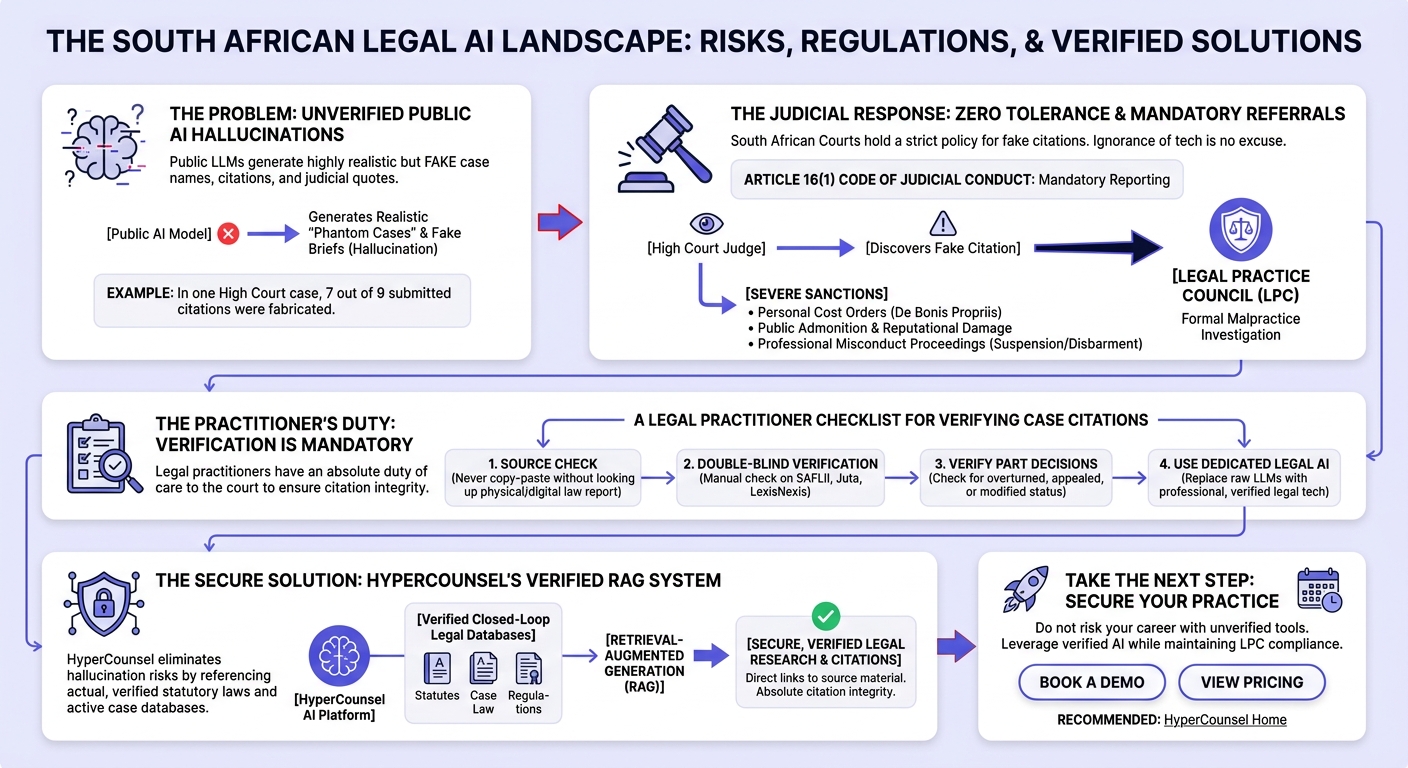
An "AI hallucination" occurs when a large language model (LLM) generates convincing but entirely fabricated information. Because general-purpose conversational AI tools are designed to predict the most statistically probable next word in a sequence—rather than verifying actual factual databases—they frequently generate highly realistic, yet entirely fake, case names, citation numbers, and judicial quotes.
[Public AI Model] ---> Generates realistic, but fake, case law (Hallucination)
[Legal Practitioner] ---> Submits unverified brief to High Court (Ethical Breach)
[High Court Judge] ---> Verifies records, discovers fake citation, and issues LPC Referral
In the context of ai in legal practice south africa, relying on unchecked tool outputs is highly dangerous. Public conversational AI platforms lack access to real-time, closed-loop legal repositories. When prompted to find a precedent supporting a specific legal argument, they often build a highly plausible "phantom case," complete with real judge names and genuine-sounding volume numbers, which does not exist in any law report.
The Three Key South African Cases Setting the Precedent
The dangers of unchecked technology adoption in South Africa are illustrated by three recent landmark rulings where legal practitioners relied on fabricated citations.

1. Parker v Forsyth
In Parker v Forsyth, the court discovered that several of the citations provided in the plaintiff's heads of argument were entirely fictitious. The presiding judge emphasized that legal practitioners have an absolute duty of care to the court. Feigning ignorance of how AI functions did not excuse the submission of fake submissions, and the practitioners were referred to the LPC.
2. Mavundla v MEC for Health, Eastern Cape
During the proceedings in Mavundla v MEC, the legal team submitted 9 case citations to support their pleadings. A review by the court revealed that only 2 were legitimate, while the remaining 7 were fabricated AI hallucinations. According to legal analyses by Cliffe Dekker Hofmeyr, the court ordered the firm to pay punitive costs out of their own pockets and referred the matter to the LPC.
3. Northbound Processing v Commissioner for SARS
In the Northbound Processing matter, Acting Judge DJ Smit issued a direct order referring the applicant's legal representatives to the LPC for a formal malpractice investigation, as documented by ITWeb. The judge ruled that submitting non-existent law is a serious misrepresentation that damages the integrity of the administration of justice.
The Legal Practice Council and Mandatory Judicial Referrals
Judges in South Africa do not have the discretion to overlook fabricated legal citations. Under Article 16(1) of the Code of Judicial Conduct, a judge who becomes aware of professional misconduct by a legal practitioner must report that behavior to the appropriate regulatory body.
Because submitting fake cases is viewed as a misrepresentation to the court, judges are legally bound to refer the offending attorney or advocate to the Legal Practice Council. Once referred, the legal professional faces a formal disciplinary inquiry that can result in suspended licenses, heavy fines, or complete striking from the roll of practitioners.
The Serious Consequences: Sanctions, Cost Orders, and Malpractice
The professional and financial consequences of submitting AI-generated hallucinations to a South African court are immediate and severe:
- Personal Cost Orders (De Bonis Propriis): Courts regularly order the offending lawyers to pay the opposing party's legal fees personally, protecting the innocent client from suffering financially because of their representative's technological negligence.
- Public Admonition: Court judgments are public records. Having a firm name linked with "fabricated citations" in a published High Court judgment causes permanent reputational damage.
- Professional Misconduct Proceedings: An LPC investigation can lead to a finding of unprofessional conduct, ending in suspension or disbarment.
A Legal Practitioner Checklist for Verifying Case Citations
To prevent AI hallucinations from compromising your legal practice, implement this verification checklist before filing any document with a South African court:
- Source Check: Never copy and paste a citation from a general conversational AI without looking up the physical or digital law report volume.
- Double-Blind Verification: Ensure a junior practitioner or colleague manually checks every cited case on a verified local legal research database (e.g., SAFLII, Juta, or LexisNexis).
- Verify Part Decisions: Ensure that the cited case has not been overturned, appealed, or modified by a higher court.
- Use Dedicated Legal AI: Replace raw general-purpose LLMs with professional legal tech platforms like HyperCounsel that execute queries over verified, closed-loop legal databases.
How HyperCounsel Secures Your Legal Research
HyperCounsel is engineered specifically to eliminate the risks of AI hallucinations in legal practice, providing South African lawyers with a secure environment to draft and research.
Our platform uses Retrieval-Augmented Generation (RAG). Instead of generating legal answers from statistical probabilities, HyperCounsel references actual, verified statutory laws and active case databases. Every citation generated shows direct links to the source material, ensuring absolute citation integrity and protecting your practice from court sanctions.
Take the Next Step
Do not allow unverified AI tools to put your legal career and professional reputation at risk. You can safely leverage the power of artificial intelligence while maintaining compliance with the Legal Practice Council.
Book a Demo with our team today to discover how our verified systems protect your practice, or explore our Pricing options to secure your legal workflow.
Frequently Asked Questions
This article provides general information and is not legal advice.
What happens if a South African lawyer submits AI-hallucinated case citations to the court?
If a lawyer submits hallucinated citations, the court will typically reject the arguments, issue a punitive personal cost order (de bonis propriis) against the lawyer, and make a mandatory referral to the Legal Practice Council (LPC) for professional misconduct.
Can a lawyer avoid sanctions if they apologize for using AI-generated fake citations?
No. South African courts have ruled that claiming ignorance of how generative AI works is not a valid defense. While an apology is necessary, it will not prevent a mandatory referral to the LPC under the Code of Judicial Conduct.
Is using AI for legal research illegal in South Africa?
No, using AI toolsets for legal research is entirely legal. However, legal practitioners remain personally responsible for the accuracy of their work. AI tools must be used as aids, and all outputs must be verified through professional legal databases.
How can lawyers verify that AI-generated case citations are legitimate before filing?
Lawyers must manually cross-reference each citation against trusted legal repositories (such as SAFLII or official law reports) or utilize specialized, verified legal AI platforms like HyperCounsel which link all outputs to verified source documents.