

The 'Chief AI Officer' Mandate: How SRA AI Guidance Reshapes UK Law Firm Governance
Learn how new SRA AI guidance impacts UK law firm governance and why human oversight is critical.
The rapid adoption of artificial intelligence in the legal sector has prompted regulatory action. In the United Kingdom, the Solicitors Regulation Authority (SRA) has made it clear that while innovation is encouraged, firms must not compromise on core professional standards. Recent sra ai guidance emphasizes that law firms cannot simply deploy AI tools and hope for the best; instead, accountability, risk assessment, and human oversight must be hardcoded into their operational models.
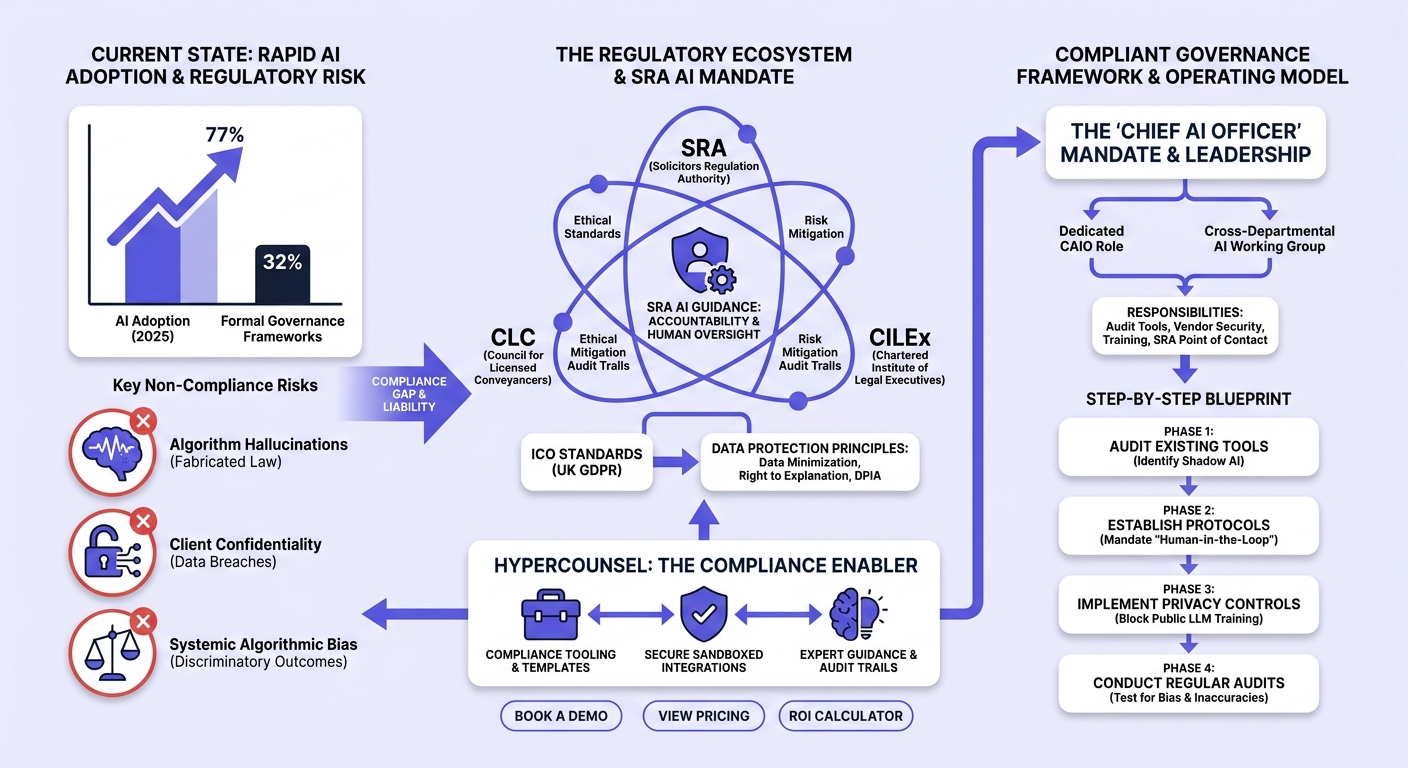
A recent study found that 77% of legal firms report increased AI tool adoption in 2025, yet only 32% have formal governance frameworks in place. This gap between technology deployment and regulatory oversight presents a massive compliance risk.
To help law firms navigate these shifting sands, HyperCounsel provides the compliance tooling, template frameworks, and expert guidance needed to align operating models with regulator expectations. Let us explore what the regulator requires and how you can establish a robust, compliant AI framework.
Table of Contents
- Understanding the Core Demands of SRA AI Guidance
- The Regulatory Landscape: Joint Oversight from SRA, CLC, and CILEx
- Key Risks of AI Non-Compliance: Hallucinations, Bias, and Data Breaches
- Step-by-Step Blueprint for Building an SRA-Compliant AI Governance Framework
- The Chief AI Officer: Necessity or Luxury for Law Firms?
- Merging SRA Rules with UK GDPR and ICO Standards
- Case Study: Successful AI Governance Implementation
- Take the Next Step
- Frequently Asked Questions
- Recommended
| Takeaway | Explanation |
|---|---|
| SRA AI Guidance Focus | Places strict accountability on humans (solicitors and managers) for all AI outputs. |
| Cohesive Regulation | SRA, CLC, and CILEx collaborate to enforce ethical AI deployment across legal practices. |
| Human-in-the-Loop | Mandates that legal experts verify AI drafts, research, and data processing. |
| Chief AI Officer (CAIO) | Emerging leadership role designed to oversee risk management and governance. |
| ICO Alignment | AI systems must align with UK GDPR data minimization and transparency rules. |
Understanding the Core Demands of SRA AI Guidance
The central premise of the latest sra ai guidance is unyielding: technology does not dilute professional responsibility. If a firm uses an AI system to draft contracts, conduct legal research, or manage client intake, the ultimate responsibility for accuracy and ethical standards lies with the humans in charge.
The SRA demands a "human-in-the-loop" approach. Under this directive, solicitors must critically evaluate and cross-reference all AI-generated outputs before they reach clients or courts. Using AI blindly is classified as a failure to deliver competent service. This breach can result in severe professional disciplinary proceedings.
To meet these requirements, firms must upgrade from simple software-use policies to comprehensive, dynamic governance systems. A modern legal AI framework should track the inputs, verify the training data where possible, and document the human review team at each step. This transparency is key to remaining compliant online and offline.
The Regulatory Landscape: Joint Oversight from SRA, CLC, and CILEx
The UK does not have a single, overarching legislative act governing AI. Instead, it relies on a decentralized, sector-led regulatory framework as outlined in the UK Government Pro-Innovation AI Strategy. For legal professionals, this means complying with overlapping guidelines from the SRA, the Council for Licensed Conveyancers (CLC), and the Chartered Institute of Legal Executives (CILEx).
All three regulatory bodies coordinate their expectations to protect clients and uphold the rule of law. A recent analysis by Legal Eye confirmed that these regulators collectively require robust governance policies. Firms must show they can mitigate risk proactively before they deploy tools.
This joint supervision forces law firms to implement rigorous auditing trails. If your firm handles diverse practice areas, your AI tools must meet various standards. SRA guidance on litigation research may differ from CLC requirements for automated land registry filings.
Key Risks of AI Non-Compliance: Hallucinations, Bias, and Data Breaches
Failing to establish a compliant governance structure introduces complex liabilities. These issues extend beyond simple regulatory checkmarks to affect your brand reputation.

The four primary risk vectors that firms must secure immediately include:
- Algorithm Hallucinations: Standard language models can invent plausible-sounding legal precedents. Citing fabricated case law to a UK court is a direct violation of professional duties.
- Client Confidentiality and Data Leakage: Feeding sensitive client documents into public external AI machines to summarize briefs breaks strict professional client-privilege bounds.
- Systemic Algorithmic Bias: Training on historic data can lead algorithms to recommend biased pricing or draft discriminatory terms, creating exposure under UK equality laws.
- Regulatory Sanctions and Fines: A demonstrated lack of oversight can result in severe SRA fines, temporary practice suspensions, and devastating brand reputational damages.
Using HyperCounsel helps firms mitigate these hazards with pre-configured templates, secure sandboxed integrations, and expert compliance guidelines.
Step-by-Step Blueprint for Building an SRA-Compliant AI Governance Framework
Law firms do not need to pause innovation to stay compliant. Designing a structured framework ensures your daily operations meet regulatory standards.
Use this four-phase schedule to align your tools with expectations:
| Phase | Action Step | Key Objective |
|---|---|---|
| Phase 1 | Audit Existing Tools | Identify all shadow AI used by staff and create an asset inventory. |
| Phase 2 | Establish Protocols | Mandate "human-in-the-loop" verification for all AI outputs. |
| Phase 3 | Implement Privacy Controls | Block public LLM training on client files. |
| Phase 4 | Conduct Regular Audits | Run testing schedules to detect bias and inaccuracies. |
First, discover what your associates are already using. Many practitioners run search queries or draft templates through free, public consumer engines without thinking of the privacy implications. Next, declare a formal policy on what programs are authorized, then record your reviews to prove your oversight to inspectors.
The Chief AI Officer: Necessity or Luxury for Law Firms?
As AI continues to change operational workflows, firms must decide who owns the resulting liability. While some firms rely on general IT managers, others are creating the role of the Chief AI Officer (CAIO) or setting up cross-departmental AI Working Groups.
A dedicated CAIO is no longer just for large corporate entities. For mid-market and boutique firms, having a designated partner or group leader manage technology procurement is a significant competitive and regulatory advantage.
The CAIO or Working Group is responsible for auditing third-party tools, verifying vendor security, updating training plans, and acting as the direct point of contact for SRA compliance queries. Having a dedicated person in this role shows regulators you take technological risk management seriously.
Merging SRA Rules with UK GDPR and ICO Standards
Your AI framework must exist in harmony with external data protection rules. In the UK, the Information Commissioner's Office (ICO) monitors compliance with the UK General Data Protection Regulation (UK GDPR).
When processing client data through machine learning, firms must respect key principles:
- Data Minimization: Avoid sending complete client databases to external models when only minor portions are needed.
- The Right to Explanation: Clients must be informed if automated systems play a role in their matter tracking, case triage, or fee structures.
- Data Protection Impact Assessments (DPIA): Before deploying any high-risk AI technology, firms should perform and document a DPIA to present to the ICO or SRA upon request.
By linking SRA AI guidance directly to ICO standards, firms prevent parallel enforcement actions from multiple regulators.
Case Study: Successful AI Governance Implementation
Consider Apex Legal UK, a mid-sized commercial law firm based in London. During their digital transition, leadership realized their teams were using unstructured chat tools for internal notes. Recognizing the compliance risk, they designed a multi-layer framework.
First, they partnered with HyperCounsel to build a compliant, secure legal workspace. Second, they mandated that all legal research draft results undergo manual cross-checking against primary sources, such as Westlaw or LexisNexis, before delivery.
Within six months, an associate identified a hallucinated citation generated by an automated drafting tool. Because of the human verification system, the fake case was caught before any client delivery. The firm not only protected its reputation but also had clear documentation to prove its security procedures during a routine SRA review.
Take the Next Step
Building a compliant governance framework is essential for modern law firms. With regulators actively auditing AI policies, waiting for an incident to occur before taking action is a significant operational risk.
HyperCounsel helps firms adopt advanced technology safely and efficiently. Our legal-AI platforms provide the security, templates, and clarity your firm needs to remain fully compliant with SRA AI guidance.
Are you ready to protect your firm, satisfy regulators, and deploy AI with confidence?
Frequently Asked Questions
What does SRA AI guidance require regarding human oversight?
The guidance demands that a qualified human review and verify all AI outputs. Legal professionals are fully responsible for any errors, hallucinations, or confidential leaks caused by their chosen software.
Do UK regulators mandate a Chief AI Officer for law firms using AI?
No, regulators do not officially require a specific "Chief AI Officer" title. However, the SRA, CLC, and CILEx require firms to have defined governance structures and named individuals who are accountable for technology risks.
What are the penalties for law firms failing to comply with SRA AI governance rules?
Penalties include formal warnings, substantial fines, and conditions placed on your practicing certificate. In severe cases of systematic neglect, firms can face closure or individual managers can be suspended.
How can small law firms implement AI governance without hiring a full-time CAIO?
Small law firms can appoint an existing partner to oversee technology or establish an AI Working Group. They can also use secure compliance platforms like HyperCounsel to manage audits on a transparent budget.