

The 48-Hour Deepfake Removal Mandate: Law Firm Guide
Learn how the federal TAKE IT DOWN Act's 48-hour deepfake removal mandate impacts your law firm.
The landscape of digital compliance is shifting rapidly under the pressure of generative AI. Under the newly enacted federal TAKE IT DOWN Act, any online platform that hosts, stores, or facilitates user-generated content faces strict timelines and severe penalties for failing to remove non-consensual AI-generated explicit material. In fact, under this strict new deepfake law united states regulations dictate that civil penalties for violations can reach up to $53,088 per violation under Federal Trade Commission (FTC) enforcement.
For law firms, legal service providers, and legal tech platforms, this law is not just an abstract policy; it is an active operational risk. If your firm hosts client portals, user-generated forums, or interactive databases that touch public or client files, you may qualify as a "covered platform" under the statute. This means you must adapt to a strict 48-hour investigation and removal window or face devastating criminal and civil liabilities.
Navigating these emerging requirements demands a proactive, ironclad compliance framework. Partnering with HyperCounsel ensures your firm remains ahead of these shifting federal guidelines with transparent, fixed-pricing legal solutions designed to mitigate modern digital risks.
Table of Contents
- Understanding the TAKE IT DOWN Act and the 48-Hour Mandate
- Are Law Firms Considered 'Covered Platforms'?
- Penalties for Non-Compliance: Civil and Criminal Risks
- Step-by-Step Compliance Guide for Law Firms
- FTC Enforcement Mechanics: Unfair and Deceptive Trade Practices
- Take Action to Secure Your Firm
- Frequently Asked Questions
- Recommended
Quick Summary Table
| Takeaway | Explanation |
|---|---|
| Strict 48-Hour Removal Mandate | Platforms must remove non-consensual deepfakes within 48 hours of notification. |
| Heavy Financial Penalties | Civil fines reach up to $53,088 per violation under FTC rules. |
| Criminal Liability | Non-compliance can lead to up to 3 years of imprisonment for responsible parties. |
| Broad Platform Definition | Applies to any system hosting user-generated or shared client content. |
| Effective Date | Complete operational compliance is mandatory by May 19, 2026. |
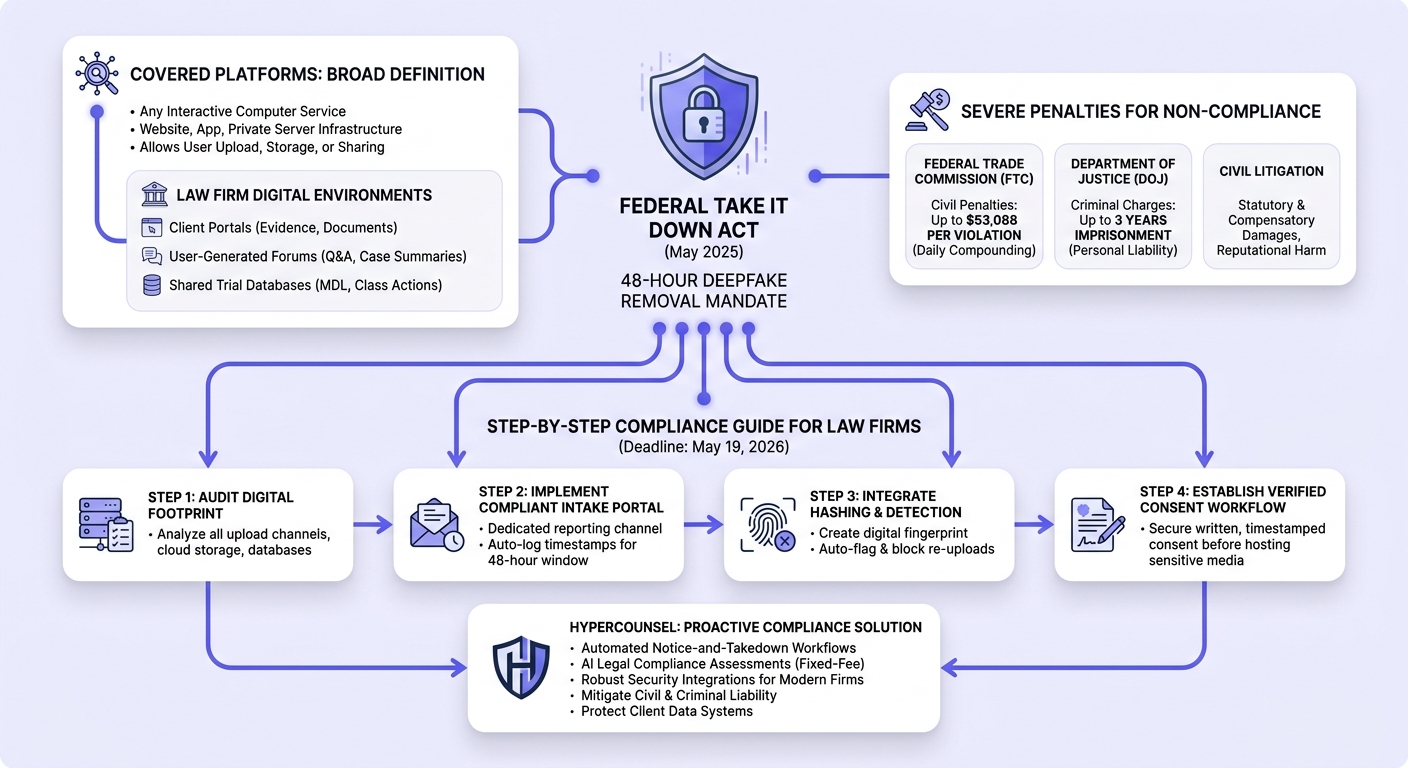
Understanding the TAKE IT DOWN Act and the 48-Hour Mandate
The Tools for Abusing Keystrokes and Explicit Imagery Non-consensually (TAKE IT DOWN) Act, signed into law in May 2025, marks the first major federal step in regulating non-consensual intimate imagery (NCII) generated by artificial intelligence. Under this comprehensive deepfake law united states rules require platforms to investigate and remove reported non-consensual intimate deepfakes within a strict 48-hour window from the moment a notice is received.
This legislative framework shifts the burden of proof and action heavily onto those hosting the content. Once a victim or their representative flags a piece of non-consensual AI-generated material, the platform must immediately begin its investigation. If the content meets the statutory definition of explicit deepfakes, it must be completely expunged from the platform's servers within 2 days.
Are Law Firms Considered 'Covered Platforms'?
Many attorneys mistakenly believe that the TAKE IT DOWN Act applies only to social media giants like Meta, TikTok, or X. However, the statutory definition of a "covered platform" under federal law is remarkably broad. It encompasses any interactive computer service, website, app, or private server infrastructure that allows users to upload, store, or share content.
Within a modern legal practice, several common digital environments fit this description:
- Client Portals: Shared digital workspaces where clients, experts, and co-counsel upload evidence, documents, and media.
- User-Generated Forums: Blogs, legal clinics, or Q&A portals operated by a firm where the public can upload inquiries, case summaries, or trial files.
- Shared Trial Databases: Collaborative litigation databases utilized during multi-district litigation (MDL) or class actions.
If a client or an unauthorized user uploads an AI-generated explicit image—even as alleged evidence—your firm could be liable under the deepfake law united states framework if a compliant notice-and-takedown channel is not established. This makes a custom risk assessment from an experienced team like HyperCounsel critical for protecting your enterprise.

Penalties for Non-Compliance: Civil and Criminal Risks
The TAKE IT DOWN Act carries some of the stiffest enforcement mechanisms seen in digital media regulation. The goal of the federal government is deterrence: forcing platforms to take immediate responsibility for hosting harmful, AI-altered media.
| Enforcement Authority | Penalty Structure | Operational Impact |
|---|---|---|
| Federal Trade Commission (FTC) | Civil penalties up to $53,088 per violation. | Fines can compound daily for unresolved takedown notices. |
| Department of Justice (DOJ) | Criminal charges leading to up to 3 years of imprisonment. | Personal criminal liability for platform administrators and firm partners who knowingly ignore notices. |
| Civil Litigation | Statutory and compensatory damages. | Significant reputational harm and loss of partner liability protections. |
According to the FTC Deepfake Mandate Guidelines, failure to react to a verified notice is treated directly as an unfair or deceptive trade practice. This means your firm cannot shield itself behind standard terms of service or user liability waivers.
Step-by-Step Compliance Guide for Law Firms
To prepare your practice for the upcoming May 19, 2026 enforcement deadline, you must systematically update your digital operations. Delaying compliance raises both your insurance premiums and litigation risks.
Step 1: Audit Your Digital Footprint
Analyze every digital channel where users, clients, or third parties can upload files. Ensure that your firm has complete visibility into its cloud storage, litigation databases, and public-facing portals.
Step 2: Implement a Compliant Intake and Investigation Portal
You must establish a dedicated, easy-to-find reporting channel specifically for non-consensual deepfake removals. This system should auto-log the timestamp of incoming requests to ensure you meet the strict 48-hour investigatory clock.
Step 3: Integrate Hashing and Detection Technologies
Removing a piece of content is only the first step. To comply with federal expectations, firms and platforms should utilize hashing technologies. Hashing creates a unique digital fingerprint of the removed image, ensuring that if someone attempts to re-upload the same deepfake, the platform automatically flags and blocks it.
Step 4: Establish a Verified Consent Workflow
If your firm manages cases involving sensitive client media, implement a verified consent workflow. Before hosting or transmitting any client visual media of an intimate or sensitive nature, secure written, timestamped, and verified consent documents. This ensures you never run afoul of the non-consensual standard.
FTC Enforcement Mechanics: Unfair and Deceptive Trade Practices
The FTC acts as the primary civil enforcer of the deepfake law united states framework. By classifying a failure to comply with the 48-hour mandate as an unfair or deceptive trade practice, the FTC bypasses many traditional legal hurdles.
The commission looks closely at several factors when investigating a covered platform:
- Responsiveness: Did the platform act immediately upon finding or being notified of the deepfake?
- Systemic Safeguards: Are there preventative measures, such as automated workflows, to keep explicit AI content off the system?
- Record-Keeping: Does the platform maintain complete logs of all takedown notices and corresponding actions taken?
For boutique law firms and large-scale partnerships alike, trying to manage this overhead internally is highly inefficient. Leveraging HyperCounsel for comprehensive compliance automation keeps your firm secure without draining valuable billable hours.
Take Action to Secure Your Firm
Protecting your legal practice from the strict penalties of the TAKE IT DOWN Act requires professional, reliable compliance architecture. You do not have to navigate these complex federal mandates alone. HyperCounsel offers fixed-fee AI legal compliance assessments, automated notice-and-takedown workflows, and robust security integrations designed specifically for modern law firms.
By securing your firm's compliance today, you protect your partners from civil liability, prevent reputational damage, and ensure your client data systems remain fully protected. Let us handle the complexities of digital risk so you can focus on winning cases.
To get started, Book a Demo with our compliance solutions team, or explore our flexible integration options by visiting our Pricing page.
Take the Next Step
Ready to protect your business with expert legal support? Explore how HyperCounsel can help:
Frequently Asked Questions
What is the 48-hour deepfake removal mandate under federal law?
The mandate, created by the TAKE IT DOWN Act of May 2025, requires all covered online platforms and digital hosts to investigate and permanently delete any reported non-consensual AI-generated explicit content within 48 hours of receiving a notification.
How does the TAKE IT DOWN Act apply to law firms hosting client content?
If a law firm utilizes private client portals, shared litigation databases, or interactive websites where clients or third parties can upload files, they qualify as a "covered platform." This means the firm is legally responsible for implementing a compliant notice-and-takedown process.
What are the criminal penalties for violating the new deepfake law in the US?
Under the deepfake law united states framework, willful non-compliance or failure to cooperate with a legitimate takedown request can result in federal criminal charges, carrying a penalty of up to 3 years of imprisonment for responsible administrators or business leaders.
What steps must platforms take to comply with the FTC's deepfake enforcement?
Platforms must establish a clear, timestamped reporting channel for takedown notices, conduct prompt investigations within 48 hours, remove non-consensual content, and implement preventive measures like hashing technology to block re-upload attempts.