

The Texas Misuse Trap: Navigating the Texas Responsible AI Governance Act for High-Impact Legal Tech Deployments
Learn how the Texas Responsible AI Governance Act impacts legal tech deployments.
As law firms and corporate legal departments race to automate complex document generation, contract analysis, and client intake, understanding the recently enacted texas responsible ai governance act (TRAIGA) is no longer optional. Signed into law to govern high-impact AI systems, this complex statutory structure sets groundbreaking parameters on how public and private entities deploy artificial intelligence across the Lone Star State.
According to data on operational trends, 68% of legal firms plan to increase AI adoption in case management by 2026, adding immense pressure to audit algorithms for regulatory compliance beforehand. Fail to adapt, and legal operators risk facing severe state enforcement actions and unprecedented reputational damage from unapproved automated processes.
Navigating these new regulatory guidelines requires clear protocols and reliable assistance. By leveraging specialized AI compliance structures, HyperCounsel enables law firms and practitioners to build robust, protective governance frameworks that keep systems safe and compliant.
Table of Contents
- Quick Summary
- Scope and Applicability of TRAIGA
- Prohibited AI Practices in Texas
- The Intent-Based Liability Standard
- Requirements for Transparency and Disclosures
- How to Build a Compliant AI Program
- Enforcement, Cure Periods, and Penalties
- Mitigate Your Legal Tech Risks with HyperCounsel
- Frequently Asked Questions
- Recommended
Quick Summary
| Takeaway | Explanation |
|---|---|
| Statutory Scope | Affects any business offering artificial intelligence systems to Texas residents. |
| Prohibited Practices | Explicitly bans deepfakes, government social scoring, and manipulative mental interfaces. |
| Enforcement Framework | Exclusive jurisdiction lies with the Texas Attorney General; zero private right of action. |
| Penalties & Relief | Fines of up to $200,000 per violation; features a mandate for a 60-day cure period. |
| Safe Harbor Strategy | Documenting alignment with the NIST AI Risk Management Framework creates a presumptive defense. |
Scope and Applicability of TRAIGA
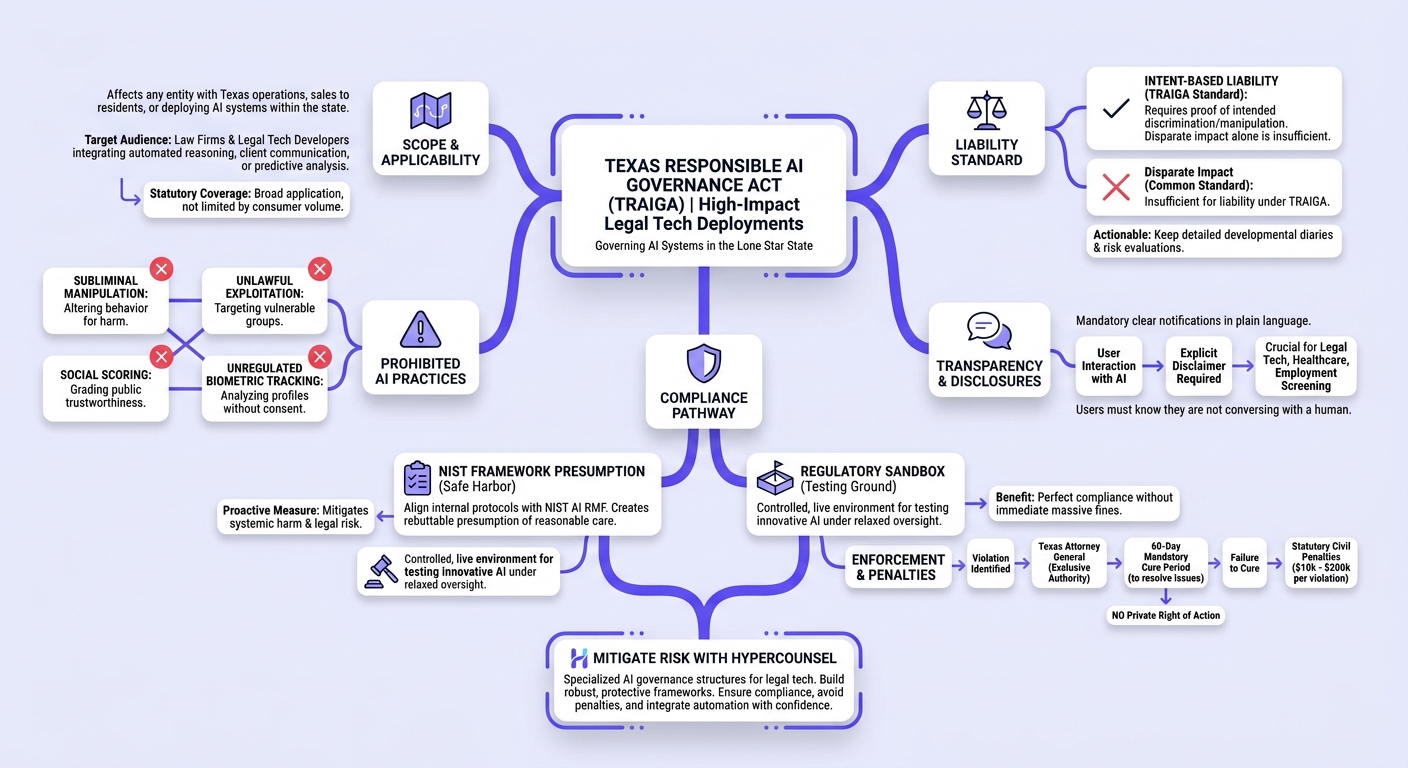
The scope of the texas responsible ai governance act is intentionally broad. Unlike some state-level frameworks that limit their compliance mandates to specific consumer volumes, the Texas statute applies to any business entity that conducts operations in Texas, sells products or services to residents within the state, or introduces artificial intelligence systems into active deployment within Texas boundaries.
If your law firm integrates software that automates legal reasoning, client communications, or predictive analysis under a Texas jurisdiction, you fall squarely under this bill's coverage. Legal tech developers offering tools to Texas attorneys are similarly bound. Neglecting your obligations under this act can render your firm or product vulnerable to deep statutory penalties.
Prohibited AI Practices in Texas
Texas legislators explicitly tailored the act to eradicate high-risk, manipulative automated systems. The law outlaws several categories of artificial intelligence practices that present direct harm to consumers.
Organized under strict legal definitions, the primary prohibited practices include:
- Subliminal Manipulation: Deploying AI systems that use subconscious techniques to alter human behavior in ways that cause physical or psychological harm.
- Unlawful Exploitation: Automatically targeted systems designed to systematically exploit vulnerable groups based on age, disability, or socio-economic standing.
- Social Scoring: Deploying classifications to grade physical individuals on public trustworthiness, leading to unfavorable treatment or denial of essential services.
- Unregulated Biometric Tracking: Analyzing live biometric profiles without explicit consent in public or commercial settings.
For law firms incorporating artificial intelligence to vet potential clients, analyze jury pools, or process consumer credit data, avoiding these classified traps is critical.
The Intent-Based Liability Standard
One of the most consequential protections drafted into the texas responsible ai governance act is its reliance on an intent-based liability standard. In many regulatory disputes, plaintiffs attempt to prove systemic bias or unlawful discrimination solely through disparate outcomes. However, the Texas legislature has drawn a firm boundary regarding algorithmic prejudice.
Under the statute, demonstrating a simple disparate impact is insufficient to hold an AI provider or developer liable for discrimination. The moving party must show that there was a distinct, intended purpose to discriminate or manipulate.
This intent requirement shields legal tech innovators from unexpected litigation resulting from anomalies in data pipelines. Nonetheless, firms using AI must still keep detailed diaries documenting their developmental decisions and risk evaluations. Legislative details can be further examined directly through the Texas Legislature Online portal to review the exact statutory definitions.
Requirements for Transparency and Disclosures
To prevent misleading consumer interactions, the act places premium emphasis on robust disclosure systems. If your organization relies on automated algorithms to converse with consumers or manage transactional updates, clear notifications must be delivered to users in plain language.
Businesses are required to furnish simple, explicit disclaimers whenever a user is directly interacting with artificial intelligence. This is especially vital in sensitive sectors such as legal tech, employment screening, and healthcare. Individuals must understand when they are not conversing with a licensed human counselor or decision-maker.

How to Build a Compliant AI Program
To insulate your legal practice or startup from structural compliance failures, you must integrate risk mitigation directly into your software development and operations pipelines.
The NIST Framework Presumption
Developing internal compliance protocols based on the National Institute of Standards and Technology (NIST) AI Risk Management Framework (RMF) is highly recommended. Under the texas responsible ai governance act, proving your systems strictly align with current NIST guidelines grants an invaluable safe harbor.
When faced with litigation or state investigations, this compliance history creates a rebuttable presumption of reasonable care. It demonstrates to regulators that your firm took proactive, standardized measures to mitigate systemic harm.
Entering the Regulatory Sandbox
For legal tech innovators testing highly experimental software, the law introduces an innovative regulatory sandbox program. Managed by official state authorities, this program allows qualified developers to test new programs in a controlled, live environment under relaxed enforcement oversight. This sandbox offers a vital pathway to perfect compliance processes without risking massive immediate fines.
Enforcement, Cure Periods, and Penalties
Understanding how State authorities enforce compliance will help you gauge your operational risk levels. Enforcement under the act is exclusive to state-level prosecution with structured periods implemented to allow rapid resolution of minor issues.
| Enforcement Element | Statutory Standard |
|---|---|
| Primary Enforcing Authority | Texas Attorney General |
| Private Right of Action | None (Private individuals cannot sue under TRAIGA) |
| Mandatory Cure Period | 60 days to resolve identified violations |
| Statutory Civil Penalties | Range from $10,000 to $200,000 per violation |
The inclusion of a 60-day cure period ensures that organizations notified of a violation have a fair window to correct algorithmic issues or update disclosures before facing financial penalties. However, failure to respond to an Attorney General inquiry within this timeframe can trigger swift litigation and crippling penalties.
Mitigate Your Legal Tech Risks with HyperCounsel
Establishing a safe, protective regulatory profile does not require complex legal bills or endless guesswork. At HyperCounsel, we provide clear, scalable AI governance evaluations tailored specifically to legal offices, corporate teams, and innovative legal tech setups.
By prioritizing fixed, clear pricing, HyperCounsel delivers rapid results, robust risk protection, and absolute transparency. This allows your team to integrate automation swiftly and confidently. Protect your firm and your clients from unexpected legal tech liability traps in Texas and beyond.
Ready to protect your systems? Reach out to our specialized partners and Book a Demo today, or explore our straightforward options on our Pricing Page.
Take the Next Step
Ready to protect your business with expert legal support? Explore how HyperCounsel can help:
Frequently Asked Questions
Does the Texas Responsible AI Governance Act apply to legal AI tools used only within Texas offices?
Yes. The act governs any entity that conducts business operations within the state or deploys artificial intelligence systems within the borders of Texas. Even if your systems are built strictly for internal law office operations, if those operations occur in Texas, compliance is required.
Can a disparate impact finding alone trigger penalties under TRAIGA's discrimination provision?
No. The texas responsible ai governance act relies on an intent-based liability standard. A prosecutor or claimant must provide evidence of intent to discriminate; showing automated disparate impact alone is not sufficient to establish a violation of the discrimination prohibition.
What is the regulatory sandbox program and who can participate in it?
The regulatory sandbox program is a structured testing pipeline established by the state. It allows AI developers to test innovative, experimental models on real-world populations under relaxed state regulatory oversight. This ensures safe prototyping prior to generalized commercial deployment.
How long is the cure period for violations before enforcement action begins?
The law provides a mandatory 60-day cure period. If the Texas Attorney General identifies a potential violation of the act, they must provide your organization with formal notice and 60 days to fix the non-compliant system before seeking statutory civil penalties.