

The Trump Executive Order Offensive: Understanding the December 2025 National AI Policy Framework and Its Challenge to State 'Algorithmic Discrimination' Bans
Discover how federal AI preemption challenges state-level algorithmic discrimination laws.
The regulatory landscape for artificial intelligence underwent a massive shift on December 11, 2025, with the signing of Executive Order 14365. This landmark ai executive order establishes a "minimally burdensome national policy framework for AI" designed to preserve American technology dominance while directly challenging the growing patchwork of state-level restrictions. For corporate attorneys and law firm operators, advising clients on AI deployment now requires a sophisticated understanding of how federal authority is being leveraged to preempt state laws.
A primary driver behind this federal intervention is blockading fragmented local compliance regimes. Over 20 states have enacted or actively considered AI-specific legislation, creating a complex, contradictory regulatory environment that the federal government now seeks to dismantle. By positioning localized bans of "algorithmic discrimination" as unconstitutional obstructions of interstate commerce, this executive order fundamentally changes how corporate clients must approach risk mitigation.
To help your firm navigate this evolving federal-state conflict, HyperCounsel offers the specialized legal support, fixed-pricing efficiency, and intake tools required to scale your compliance practice.
Table of Contents
- Quick Summary
- The Minimally Burdensome National Policy Framework
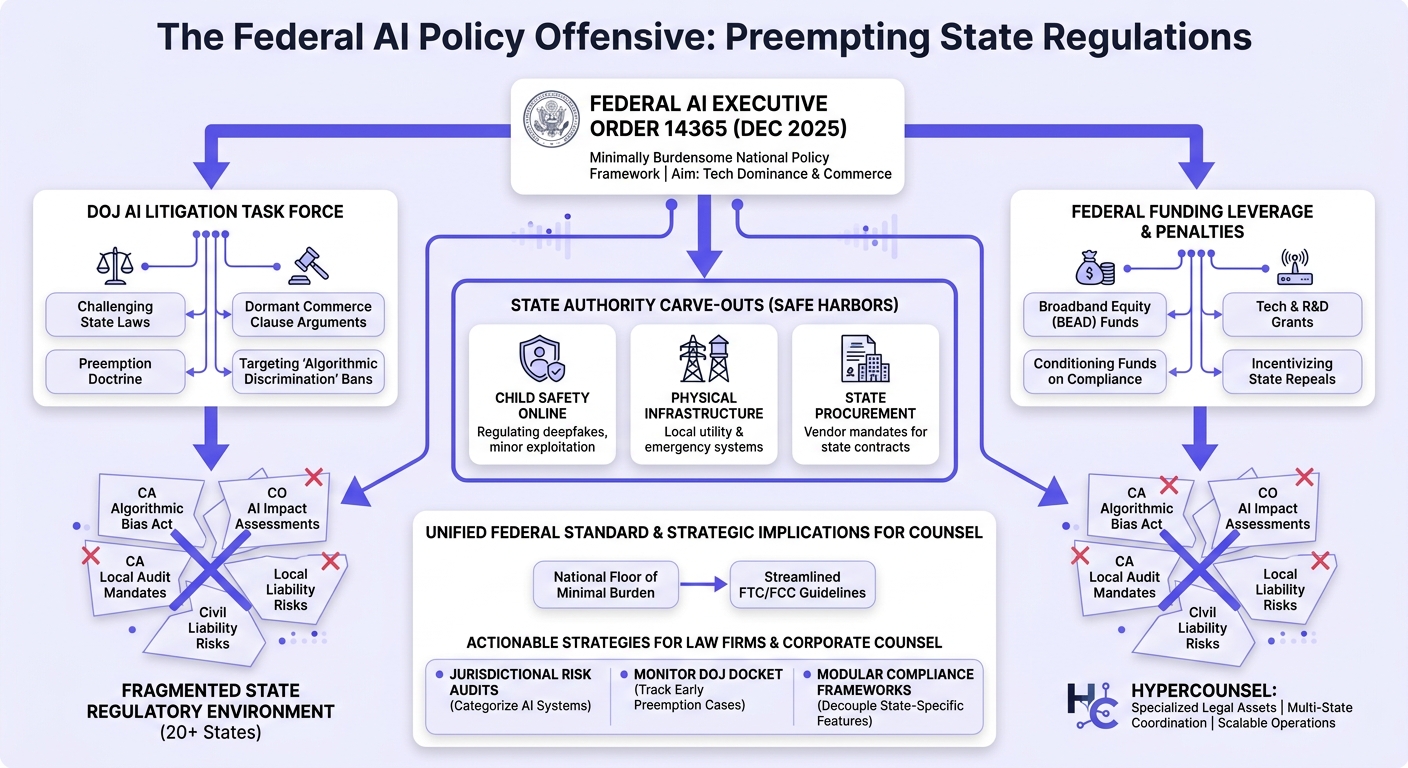
- The DOJ AI Litigation Task Force and Preemption Strategy
- Financial Leverage: Preemption via Federal Funding Penalties
- The 'As-Applied' Carve-outs: What Safe Harbors Remain for States
- Agency Directives: New FTC and FCC Mandates
- Strategic Recommendations for Law Firms and Corporate Counsel
- Take the Next Step with HyperCounsel
- Frequently Asked Questions
- Recommended
Quick Summary
| Key Takeaway | Legal & Operational Explanation |
|---|---|
| Federal Policy Shift | Establishes a "minimally burdensome" national AI policy prioritizing technological growth over precautionary regulation. |
| State Bans Targeted | Targets state-level "algorithmic discrimination" laws (like those in Colorado and California) as barriers to commerce. |
| Litigation Enforcement | Authorizes a new DOJ AI Litigation Task Force to initiate legal challenges against conflicting state-level rules. |
| Funding Lever | Threatens state access to federal grants, such as Broadband Equity Access and Deployment (BEAD) funds, for non-compliance. |
| Preserved Sectors | Leaves state authority intact regarding child safety, vital physical infrastructure, and state-level procurement. |
The Minimally Burdensome National Policy Framework
Executive Order 14365 officially establishes the strategic blueprint known as "America's AI Action Plan" via AI.gov. Rather than introducing new federal restrictions, the policy creates a permissive legal environment. The declared policy of the federal government is to sustain global technological dominance by ensuring AI development is not slowed by localized legal hurdles.
This federal policy stance places the administration in direct opposition to state legislatures that have spent years crafting laws targeting "algorithmic bias" or requiring extensive impact assessments. By setting a national floor of "minimal burden," the executive branch aims to establish that any state law imposing stricter, more complex compliance duties inherently conflicts with national economic and security interests.
The DOJ AI Litigation Task Force and Preemption Strategy
To back this policy with enforcement power, the ai executive order establishes a dedicated AI Litigation Task Force within the Department of Justice (DOJ). This task force is instructed to identify and legally challenge state laws, regulations, or localized enforcement actions that conflict with the federal open-market objective.

The primary legal weapon of the task force is the Dormant Commerce Clause and federal preemption doctrine. By framing state-level "algorithmic discrimination" bans as prohibited extraterritorial regulations on global software systems, the DOJ plans to systematically dismantle state regulatory frameworks. Attorneys advising enterprise clients should expect immediate federal challenges to state laws that mandate independent algorithmic audits or make developers civilly liable for unintended model outputs.
Financial Leverage: Preemption via Federal Funding Penalties
Litigation is not the only tool used to force state alignment. The executive order instructs federal agencies to audit state eligibility for lucrative federal infrastructure and technology grants.
| Federal Program Impacted | Leverage Mechanism | Expected State Response |
|---|---|---|
| Broadband Equity Access and Deployment (BEAD) | Conditioning grant distributions on the removal of restrictive localized digital policies. | States must choose between retaining strict AI rules or losing billions in broadband infrastructure funding. |
| Federal Technology Grants | Restricting administrative state grants if local laws impose non-standardized AI registries. | Likely rollback of secondary compliance registries to preserve state budget allocations. |
| Research Partnerships | Withholding federal-state collaborative R&D funding for state academic institutions. | Academic and local state agencies will lobby legislatures to align with federal standards. |
By tying critical infrastructure funds to AI policy alignment, the executive branch creates a strong financial incentive for state assemblies to repeal or delay the enforcement of strict AI compliance laws.
The 'As-Applied' Carve-outs: What Safe Harbors Remain for States
While the ai executive order takes an aggressive stance against commerce-restricting rules, it does not strip states of all regulatory powers. The order utilizes an "as-applied" approach, maintaining state authority in specific carve-outs:
- Child Safety online: States retain the power to regulate deepfakes, minor exploitation, and algorithmic targeting directed specifically at children.
- Physical Infrastructure: Local rules governing AI integrations within local power grids, water treatment services, and emergency physical systems remain protected.
- State Procurement: States may still dictate strict compliance and audit terms for software vendors bidding on state agency contracts.
Understanding these boundaries is crucial for legal practitioners advising software developers. Enterprise software built for general commercial use will enjoy federal protection, whereas applications built for public infrastructure or child-centric platforms must still satisfy state-level regulations.
Agency Directives: New FTC and FCC Mandates
Beyond the DOJ and funding programs, the executive order directs the Federal Trade Commission (FTC) and the Federal Communications Commission (FCC) to release unified federal policy statements.
Rather than allowing these independent agencies to develop their own strict compliance standards, the order directs them to establish streamlined, predictable guidelines. The FCC is tasked with investigating telecommunication sector standards that encourage AI deployment, while the FTC is urged to focus on actual, proven consumer fraud rather than preemptive bans on algorithmic models. This coordinated federal push aims to block state-level agencies from using local consumer protection laws to bypass the federal framework.
Strategic Recommendations for Law Firms and Corporate Counsel
As the division between federal and state AI governance widens, corporate counsel must adapt their compliance advice.
- Conduct Jurisdictional Risk Audits: Advise clients to categorize their AI systems. General-use business software is highly likely to be protected by federal preemption, while municipal tools may remain subject to local compliance laws.
- Monitor the DOJ Task Force Docket: Keep close track of early DOJ challenges to state laws. The outcomes of these initial lawsuits will set the boundaries of federal preemption for the next decade.
- Draft Modular Compliance Frameworks: Instead of building a single compliance program based on the strictest state rules (e.g., Colorado's AI Act), design modular programs. This allows clients to quickly decouple expensive compliance features if federal litigation invalidates those state regulations.
Using automated workflows can streamline this complex process. Legal practitioners can leverage HyperCounsel to access specialized legal assets, coordinate multi-state compliance assessments, and scale operations efficiently.
Take the Next Step with HyperCounsel
Navigating the shifting tides of federal AI preemption requires agility, clear strategic insights, and predictable overhead. HyperCounsel provides law firms, solo practitioners, and corporate legal departments with the transparently priced legal talent and modern operational tools needed to thrive during times of regulatory transition.
Protect your clients from conflicting regulatory authorities and streamline your firm's compliance operations today.
- Book a Demo to see how our platform elevates your practice.
- Explore our fixed-price legal support solutions.
This article provides general information and is not legal advice.
Frequently Asked Questions
What is the primary goal of President Trump's December 2025 Executive Order on AI?
The primary goal is to establish a unified, "minimally burdensome" national AI policy framework. By doing so, the federal government aims to foster technological innovation and assert federal preemption over state-level regulations that restrict interstate commerce.
How does the AI Litigation Task Force impact state 'algorithmic discrimination' bans?
The DOJ's AI Litigation Task Force is directed to legally challenge state rules that conflict with the federal open-market framework. These lawsuits will likely target state-level algorithmic discrimination laws, arguing they interfere with interstate commerce and are preempted by federal authority.
Which state AI laws are exempt from the Executive Order's challenge mechanism?
The executive order preserves state regulatory powers over narrow, non-commercial interests, including child safety protection, physical critical infrastructure (like utility grids), and state-level public procurement standards.
Can states still regulate AI for child safety or data center infrastructure under the new framework?
Yes. The order utilizes an "as-applied" methodology that leaves state power intact where there is a compelling local interest, such as preventing child exploitation online or ensuring the physical safety of localized data centers and utility infrastructure.