

Preparing for the UK’s 9-Month AI Copyright Report Deadline
Prepare your law firm for the UK's upcoming AI copyright report and regulatory compliance.
Keeping pace with artificial intelligence regulations in the United Kingdom can feel like tracking daily meteorological shifts. Just as professional firms check bbcweather to prepare for volatile conditions, legal operators must actively monitor incoming statutory shifts to protect their operations. The regulatory climate is moving fast, and firms can no longer afford to use AI tools without analyzing the underlying intellectual property structures.
The urgency is driven by a strict statutory timeline initiated under the Data Use and Access Bill (DUAB). According to recent findings by the UK Government, 50% of employers surveyed were unsure what AI training is relevant to their operations, illustrating a massive compliance gap as the country transitions toward strict copyright enforcement. Law firms must act quickly to audit their technology stacks before the government's highly anticipated 9-month report reshapes UK market access for AI developers.
Table of Contents
- Quick Summary
- Understanding the 9-Month Clock and DUAB Passage
- Abandoning the Text and Data Mining Exception
- Statutory Transparency and Market Access Obligations
- Step-by-Step AI Vendor Compliance Audit for Law Firms
- The Emerging Commercial AI Licensing Market
- Secure Your Practice Against AI Licensing Liability
- Frequently Asked Questions
- Recommended
Quick Summary
| Takeaway | Explanation |
|---|---|
| Statutory Deadline | The UK Government must publish an AI copyright report and economic impact assessment within 9 months of DUAB passage. |
| Licensing is Mandatory | Voluntary exceptions are out; AI training on UK copyrighted works requires explicit holder licenses. |
| Global Realignment | Tech companies training models overseas cannot escape UK oversight if they market to UK law firms. |
| Firm Liabilities | Lawyers must audit AI vendors to ensure compliance and avoid copyright infringement liability under UK law. |
Understanding the 9-Month Clock and DUAB Passage
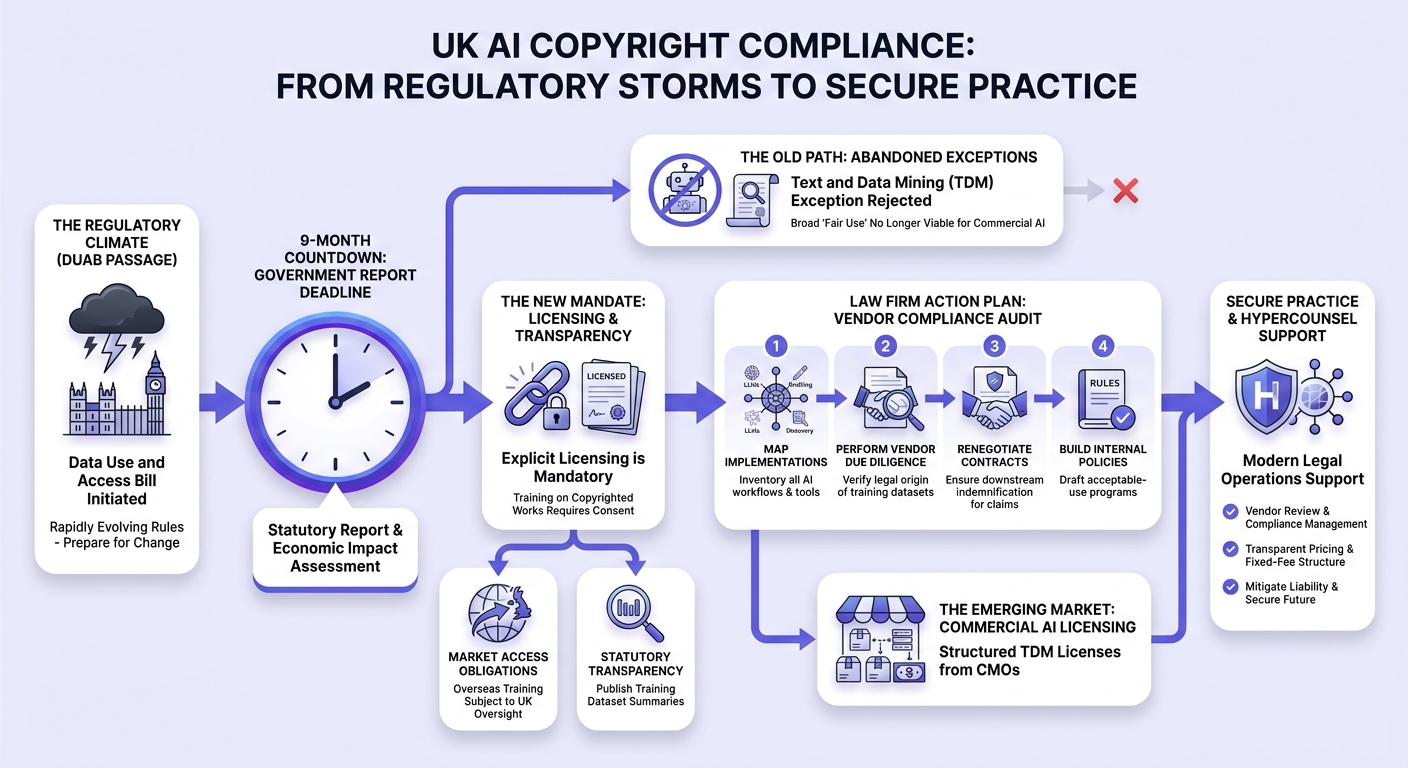
The passage of the UK Data Use and Access Bill (DUAB) has introduced a definitive regulatory timeline for AI integration. Within 9 months of the bill's legislative activation, the UK Government must produce a comprehensive report detailing copyright rules, licensing structures, and a formal economic impact assessment of AI training.
According to legal analyses from Pinsent Masons, this timeline places immediate pressure on both developers and institutional users. The report is designed to iron out ambiguities that have plagued the domestic software market since early generative models emerged. Law firms utilizing automated drafting, discovery, and matter analysis systems must realize that the compliance grace period is coming to an end.
Abandoning the Text and Data Mining Exception
In a decisive shift that separates the UK from more permissive jurisdictions globally, the government has formally backed away from a broad text and data mining (TDM) exception. Early policy drafts considered letting AI developers catalog and train on domestic data sets passing under "fair use" style exclusions. Instead, officials confirmed that copyright protections take precedence over commercial AI development.
As noted in an assessment by Simmons & Simmons, licensing is now the definitive path forward. This means training AI models using public or proprietary data without explicit legal consent constitutes copyright infringement. Law firms must verify that the proprietary legal tech platforms they lease have secured appropriate licenses for their base datasets, protecting themselves from downstream intellectual property claims.
Statutory Transparency and Market Access Obligations
The forthcoming UK framework introduces stringent statutory transparency obligations. Under these rules, domestic market access will depend on a developer's willingness to publish precise summaries of their training datasets.
To level the playing field, the UK applies these strict guidelines to models trained outside its borders but commercialized inside the country. This policy prevents tech companies from utilizing regulatory arbitrage—such as relying on loose copyright exceptions in overseas jurisdictions—to bypass UK protections. If a tool is deployed within a UK firm, its base training history must survive domestic scrutiny, making third-party audits essential.
Step-by-Step AI Vendor Compliance Audit for Law Firms
Law firm operators should not wait for the government's report to inventory their tech stack. Protecting your firm requires an immediate operational audit.

Firms should follow a structured approach to evaluate their prospective exposure:
| Step Number | Audit Action | Required Outcomes |
|---|---|---|
| Step 1 | Map AI Implementations | Inventory all workflows utilizing Large Language Models (LLMs) or automated reasoning. |
| Step 2 | Perform Vendor Due Diligence | Request formal representations confirming the legal origin of all training datasets. |
| Step 3 | Renegotiate LLM Contracts | Ensure indemnification clauses explicitly cover downstream third-party copyright claims. |
| Step 4 | Build Internal Policies | Draft internal acceptable-use programs detailing which data tools are authorized. |
The Emerging Commercial AI Licensing Market
As the UK regulatory apparatus solidifies its licensing-first mandate, several collective management organizations (CMOs) are introducing structured, commercial TDM licenses. These bodies will allow developers to purchase legal licenses for large-scale data ingestion, reducing litigation risk for downstream end-users like corporate law firms.
For law offices, managing this transformation requires robust legal operations tools. Working with HyperCounsel allows legal operators to modernize their vendor contracting procedures, manage compliance tasks, and transition to fixed-fee legal technology assistance. This structured operational support shields practices from unpredictable industry changes and escalating compliance labor costs.
Secure Your Practice Against AI Licensing Liability
Protecting your legal practice from emerging regulatory liabilities requires a proactive legal operations strategy. Unlicensed software solutions can disrupt client transactions, generate significant liability, and harm your firm's professional reputation. Partnering with a specialized advisory service is the fastest way to verify that your digital infrastructure is fully compliant with upcoming UK legislations.
Discover how HyperCounsel supports managing partner compliance, vendor reviews, and transparent pricing strategies. Speak with our experts to secure clear compliance pathways before regulatory enforcement begins.
This article provides general information and is not legal advice.
Take the Next Step
Ready to protect your business with expert legal support? Explore how HyperCounsel can help:
Frequently Asked Questions
What is the 9-month deadline for the UK Government's AI copyright report?
Following the passage of the Data Use and Access Bill (DUAB), the UK Government must deliver a detailed statutory report and economic impact assessment on AI training copyright within nine months. This report will establish clear rules for training transparency and marketplace standards.
Does the UK Government still support a text and data mining exception for AI training?
No, the UK Government has officially moved away from establishing a broad commercial text and data mining (TDM) exception. Current regulatory policies reinforce that AI developers must secure explicit permission or commercially license copyrighted works to train generative software.
What transparency obligations will AI developers face under the new UK framework?
Developers must provide comprehensive dataset disclosures detailing the source of training records, jurisdictions, and legal status of materials used to build their AI models. These disclosures are a prerequisite for maintaining market access inside the UK.
How does UK copyright law apply to AI models trained overseas but marketed in the UK?
The UK applies its strict compliance standards to any model distributed, licensed, or utilized within the domestic market. Developers cannot escape UK copyright liability by training their platforms overseas in more permissive legal environments.
How should law firms audit their current generative AI vendors?
Firms should catalog all active machine learning integrations, draft strict data collection playbooks, adjust terms of service to shift commercial risk to developers, and seek indemnification guarantees for proprietary workflows.