

Principle 5 Redress: Navigating UK AI Regulation to Contest Harmful Automated Decisions
How lawyers can challenge algorithmic bias and automated decisions under UK AI regulations.
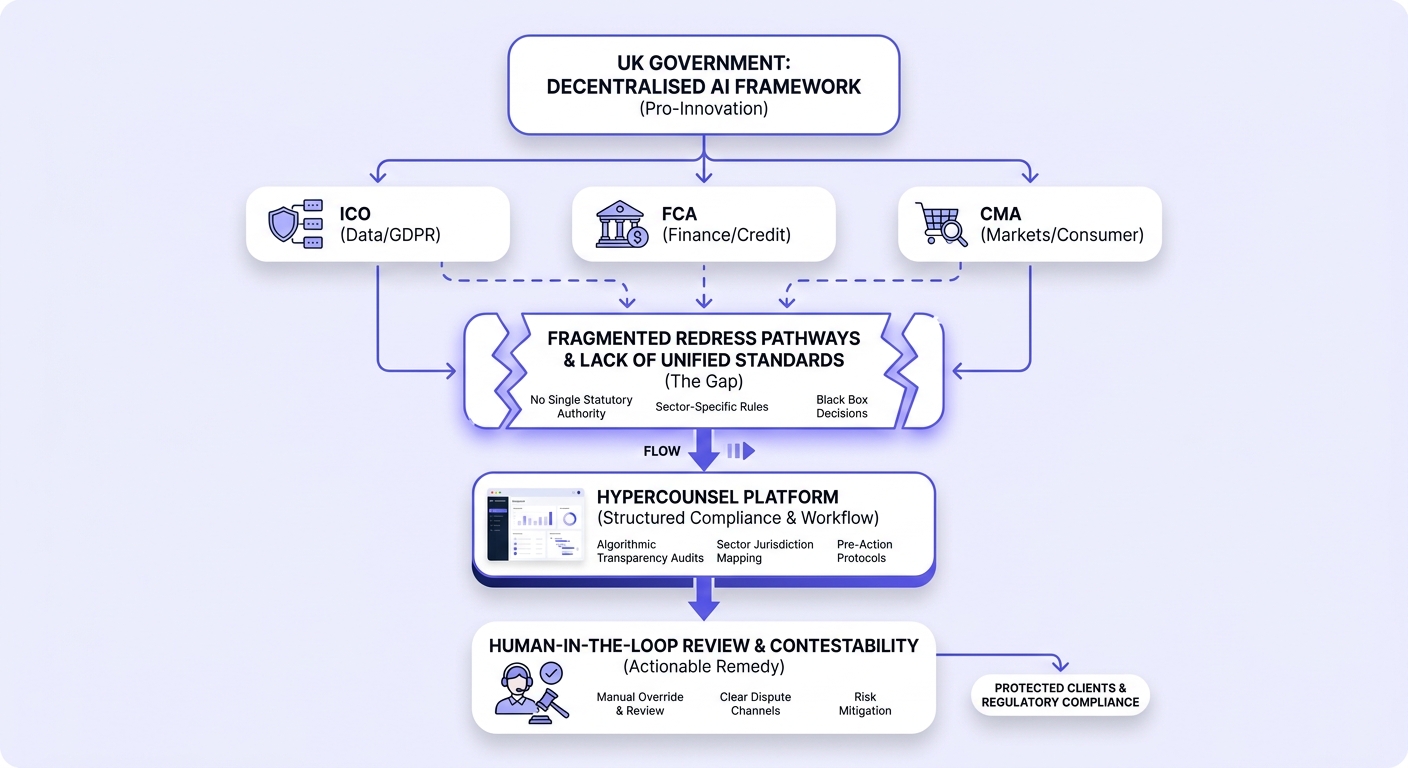
As artificial intelligence integrates deeper into legal, financial, and administrative systems, practitioners in the United Kingdom face a major challenge: protecting clients from algorithmic bias and system errors. Under the current landscape of uk ai regulation, the Government relies on a decentralized, pro-innovation framework. Within this structure, ensuring individuals can challenge unfair automated decisions has quickly become the most pressing operational hurdle.
Recent legal analyses highlight the scale of this governance challenge: 67% of legal professionals cite contestability as the most critical gap in the UK AI regulation framework. Because the UK lacks a single central statutory authority for automated decision-making, lawyers must build specialized, manual procedures to dispute decisions made by insurers, banks, and high-impact automated screeners.
To navigate this highly fragmented environment, forward-thinking law firms are partnering with platform systems like HyperCounsel to transform compliance workloads into structured, high-value representation. This guide breaks down the core tenets of the UK framework, with a specific focus on Principle 5 (Contestability and Redress), giving your firm an actionable roadmap to protect clients from automated harm.
Table of Contents
- What is Principle 5 under UK AI Regulation?
- The Redress Gap: Why Principle 5 is Underdeveloped
- Step-by-Step Guide: Implementing Contestability Routes
- Comparing the UK Voluntary Framework vs. the EU AI Act
- Risk Mitigation: Avoiding Client Harm and Redress Claims
- Take Control of Your AI Compliance Today
- Frequently Asked Questions
- Recommended
| Key Takeaway | Legal Impact and Action |
|---|---|
| Principle 5 Definition | Focuses on contestability and redress, giving individuals the right to challenge outcomes generated by automated systems and obtain actionable remedies. |
| The Redress Gap | Lacks unified technical standards, leaving consumer protections highly segmented depending on the specific sector. |
| Regulatory Framework | Sectoral watchdogs enforce compliance under existing statutory rules rather than a single unified AI statute. |
| Active Risk Mitigation | Deployers must build manual human-in-the-loop overrides to protect against costly civil liability. |
What is Principle 5 under UK AI Regulation?
The Department for Science, Innovation and Technology (DSIT) established five cross-sectoral principles to guide UK regulators. Chief among these is Principle 5: Contestability and Redress. This principle demands that where automated systems make or support high-impact decisions, individuals must have clear pathways to dispute those decisions and seek remediation.
Unlike codified administrative frameworks, this principle is non-statutory. According to the government's initial guidance for regulators, responsibility for implementing these principles falls to existing watchdogs. These sector-specific authorities include:
- The Information Commissioner's Office (ICO): Enforces data protection rights, algorithmic bias, and automated profiling under UK GDPR Article 22.
- The Financial Conduct Authority (FCA): Regulates credit scoring, automated commercial underwriting, and algorithm-driven market trading.
- The Competition and Markets Authority (CMA): Investigates market transparency issues, price-fixing algorithms, and algorithmic consumer harms.
Without dedicated statutory backing, these regulators must rely on their existing powers to enforce the rules, which means contestability requirements vary significantly depending on the sector.
The Redress Gap: Why Principle 5 is Underdeveloped
While technical guidelines (such as ISO/IEC standards) exist for cybersecurity, safety, and data lineage, standard guidelines for contestability are largely missing. This keeps contestability as the least developed zone of UK compliance.
As highlighted by the Ada Lovelace Institute's analysis on UK AI governance, a decentralized framework dilutes recourse. Without standard rules across the board, consumers suffer from fragmented dispute pathways. This makes it incredibly difficult for individuals to challenge automated outcomes in vital areas like credit scoring or immigration processing.
Furthermore, because these systems function as "black boxes," individuals rarely understand why a specific automated decision was reached. Without transparency, establishing a solid basis for an appeal is nearly impossible.
Step-by-Step Guide: Implementing Contestability Routes
Lawyers and deployers must collaborate to build reliable, structured mechanisms for disputing automated decisions.
- Step 1: Conduct Algorithmic Transparency Audits: Ensure systemic inputs, weights, and logic metrics are transparently logged.
- Step 2: Map Sector-Specific Jurisdiction: Identify whether a dispute falls under the jurisdiction of the ICO (via UK GDPR), the FCA, or common-law administrative standards.
- Step 3: Define Human-in-the-Loop Escalation Rules: Ensure clear internal procedures permit rapid transition from automated output to physical human review when challenged.
- Step 4: Draft Clear Pre-Action Protocols: Build standardized demand letters that focus on the lack of contestability as a failure of common-law equity.

Checklist for Law Firms and Deployers
The checklist below outlines a typical timeline and deliverables for setting up an internal contestability and redress pathway:
| Phase | Milestone | Setup Timeline | Key Deliverable |
|---|---|---|---|
| Phase 1 | Transparency Audit | 2-3 Weeks | Full system map and data-trace logs |
| Phase 2 | Redress Pathway Design | 1-2 Weeks | Automated intake system for internal claims |
| Phase 3 | Compliance Alignment | 1-2 Weeks | Integration with UK GDPR Article 22 rules |
| Phase 4 | Pilot Escalation Testing | Ongoing | Mock challenges to verify human override speed |
Comparing the UK Voluntary Framework vs. the EU AI Act
For international operations, contrasting jurisdictions is vital. The UK aims to foster business growth by avoiding rigid rules, relying instead on high-level principles that can adapt to changing technology. This approach lets regulators tailor rules to their specific sectors.
By contrast, the European Union's AI Act relies on strict statutory mandates. It categorizes systems by risk levels and imposes heavy fines for missing compliance records. It also provides explicit citizen rights to seek judicial redress and demand clear explanations for decisions made by high-risk systems.
Because the UK approach is decentralized, using a unified platform like HyperCounsel helps firms keep their internal compliance mechanisms structured without having to build costly, bespoke systems for every sector-specific change.
Risk Mitigation: Avoiding Client Harm and Redress Claims
To avoid expensive common-law claims and regulatory scrutiny, companies deploying AI must take a proactive stance on liability:
- Impact Assessments: Review your AI systems regularly to check for bias and errors before they cause harm.
- Human Safeguards: Require a person to approve critical, high-impact automated outcomes before they are finalized.
- Accessible Dispute Portals: Put self-service portals in place to allow quick resolutions, minimizing legal costs.
By putting these safeguards in place, businesses can resolve disputes early on and protect themselves from more serious legal actions down the line.
Take Control of Your AI Compliance Today
Navigating the changing landscape of UK regulations requires modern legal technology to stay both compliant and competitive. Law firms and legal departments must streamline their policy workflows, automate contract reviews, and build robust risk management systems.

With HyperCounsel, you get instant access to an enterprise-grade AI engine with predictable pricing and secure, legal-specific workflows. Avoid complex setup processes and start managing your compliance workflows with ease.
Discover how our advanced legal platform can protect your firm and streamline your administrative operations.
Take the Next Step
Ready to protect your business with expert legal support? Explore how HyperCounsel can help:
Frequently Asked Questions
What is Principle 5 (Contestability and Redress) in UK AI regulation?
Principle 5 is a core pillar of the UK's AI White Paper framework. It states that individuals should have clear, accessible pathways to dispute decisions made by automated systems and seek remedy if those decisions cause harm or significantly affect them.
How can UK lawyers help clients contest harmful AI decisions?
Lawyers can challenge unfair automated systems by using UK GDPR Article 22, which protects individuals from purely automated decisions. They can also file complaints with sector regulators like the FCA or bring common-law claims for unfairness and bias.
Why is redress the most underdeveloped principle in UK AI guidance?
Unlike cybersecurity and data protection, contestability lacks standardized technical benchmarks. This leaves individual sector watchdogs to build their own dispute systems without a unified, nationwide plan.
Does the UK have mandatory AI redress laws like the EU AI Act?
No, the UK currently relies on a non-statutory, pro-innovation framework led by existing regulators. It does not enforce a single, unified law with strict penalties like the EU AI Act.