

87% of UK Lawyers Predict AI Disruption: Why Individual AI Fluency is Your Top Differentiator
Learn why individual AI fluency is the ultimate competitive advantage for UK lawyers today.
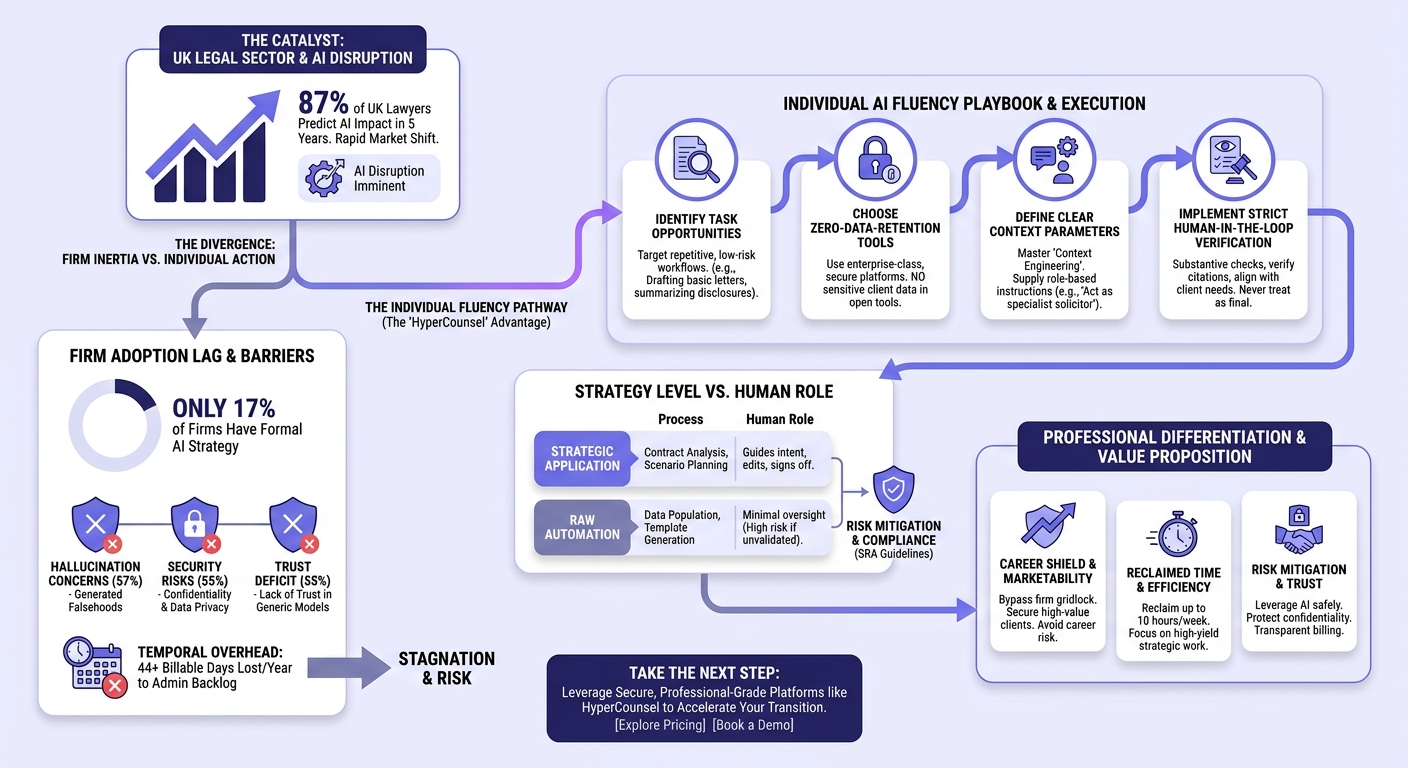
As artificial intelligence reshapes the legal sector, professionals across the United Kingdom are facing a critical turning point. According to recent industry research, 87% of UK legal professionals predict AI will significantly impact the profession within five years, showcasing a rapid shift in mindset that outpaces many global counterparts. This transformation is positioning individual AI mastery not merely as an optional skill, but as the premier asset in the fast-evolving landscape of legal tech uk.
While firms slowly debate organizational adoption strategies, forward-thinking practitioners are taking matters into their own hands. Developing personal competency in artificial intelligence has emerged as the definitive career differentiator, helping individual lawyers deliver faster outcomes, manage risks, and secure high-value clients.
To stay ahead of this paradigm shift, many practitioners are leveraging advanced tooling from HyperCounsel to streamline their workflows and master AI capabilities directly.
Table of Contents
- The Landscape of Legal Tech UK
- Why Individual Fluency is the New Standard
- Barriers to Firm Adoption and the Individual Solution
- Step-by-Step Playbook for Building Individual AI Fluency
- Mitigating Risks, Compliance, and Trust
- Costs and Timelines for Building Fluency
- Take the Next Step
- Frequently Asked Questions
- Recommended
Quick Summary
| Takeaway | Explanation |
|---|---|
| AI Disruption is Imminent | Over 87% of UK legal professionals anticipate deep AI integration within five years, prioritizing proactive skill development. |
| Fluency Gap is Growing | While 61% of lawyers use AI tools monthly, only 17% of firms have a formal strategy, leaving a wide differentiation gap for individuals. |
| Bypass Firm Inertia | Individual legal AI fluency acts as a low-risk, high-return personal career shield against slow corporate IT rollouts. |
| Mitigate Technical Risks | Understanding how to avoid hallucinations allows lawyers to leverage AI safely while protecting client confidentiality. |
The Landscape of Legal Tech UK
The professional environment in the United Kingdom is witnessing an unprecedented influx of automation resources. According to the UK Government AI Adoption Plan, the professional and business services sector saw rapid adoption indicators by late 2025. This massive wave is supported by venture backing: the UK legal technology landscape secured a record £188.8 million in funding, turning general interest into serious capital deployment.
This high level of capitalization puts the United Kingdom third globally for private AI investment, as highlighted by TechUK's AI Adoption Report. As a consequence, the domestic market is incredibly receptive to automated tools. However, individual lawyers are adopting modern workflows much faster than their employers can establish compliance policies, creating a notable execution gap.
Why Individual Fluency is the New Standard
The disparity between personal usage and corporate implementation defines the modern legal career. While 61% of lawyers report utilizing AI tools on a monthly basis, only 17% are employed at firms where AI is fully embedded in the official enterprise strategy. This creates an environment of "shadow fluency," where skilled lawyers use individual tools to complete work in hours that used to take days.
Individual AI fluency has evolved from a technical skill to an emotional and career defense mechanism. Research shows that 18% of UK lawyers would consider leaving their current firms if management fails to invest in modern tooling. Attorneys who understand how to guide and prompt AI systems naturally secure higher job satisfaction, alleviate repetitive burnout, and position themselves as invaluable assets to tech-forward clients.
Barriers to Firm Adoption and the Individual Solution

While the demand for technological scaling is obvious, institutional adoption within conservative firms faces immense friction. These barriers create a slow-moving environment where waiting for a firm-wide rollout can actively harm a lawyer's market value.
- Hallucination Concerns: Around 57% of lawyers express deep worry over algorithmic "hallucinations" (generated falsehoods), stalling firm-wide software deployment.
- Security Risks: Confidentiality worries stop 55% of firm partners from approving generic AI interfaces that may train public models on proprietary client data.
- Trust Deficit: Another 55% of practitioners cite a general lack of trustworthiness in generic, non-specialized large language models.
- Temporal Overhead: High-performing lawyers routinely lose over 44 billable days per year to administrative backlog and secondary administrative tasks, leaving them with little bandwidth to test unauthorized systems.
By building individual fluency, the independent practitioner bypasses institutional gridlock. Becoming AI-fluent means learning how to safely run sandboxed queries, use zero-retention professional platforms like HyperCounsel, and verify system outputs manually. This strategy protects the integrity of the work product while giving the fluent lawyer a multi-day head start over competitors.
Step-by-Step Playbook for Building Individual AI Fluency
Achieving professional fluency is a manageable, systematic process. Rather than learning to code, lawyers must master "context engineering"—the art of structuring instructions so that AI models output highly accurate, jurisdictionally correct legal materials.
- Step 1: Identify Task Opportunities: Target repetitive, low-risk administrative workflows first, such as drafting basic client update letters, summarizing lengthy standard disclosures, or structuring contract outlines.
- Step 2: Choose Zero-Data-Retention Tools: Never paste sensitive client data into open, free, consumer-grade AI chat tools. Use enterprise-class tools that guarantee data is not utilized for model training.
- Step 3: Define Clear Context Parameters: Always supply the model with role-based instructions (e.g., "Act as a specialist corporate solicitor in England and Wales under SRA guidelines").
- Step 4: Implement Strict Human-in-the-Loop Verification: Never treat generic AI outputs as a final draft. Use your professional judgment to perform substantive checks, verify case citations, and align the final text with precise client needs.
| Strategy Level | Process | Human Role |
|---|---|---|
| Strategic Application | Analyzing contract patterns, draft restructuring, scenario planning | Human guides intent, edits outputs, signs off |
| Raw Automation | Mass data population, template generation, basic transcriptions | Minimal human oversight needed (high-risk if unvalidated) |
Mitigating Risks, Compliance, and Trust
Operating safely within the legal tech uk framework means aligning with regulatory standards set forward by the Solicitors Regulation Authority (SRA). The SRA places a high premium on professional competence and absolute client confidentiality.
- Confidentiality Checks: Ensure contract data, client names, and proprietary firm secrets are completely redacted or run through encrypted, secure nodes.
- Citation Protection: Be aware that generic AI is prone to referencing nonexistent case law. Every case citation must be verified against actual UK court registers.
- Billing Transparency: Be open with clients about your use of AI tools to increase efficiency. True fluency means showing clients how tech-forward practices lower their overall cost while delivering superior, speedier results.
Costs and Timelines for Building Fluency
Building a personal competitive advantage does not require massive financial investments or years of study.
- The Learning Curve: Most individual lawyers achieve comfortable workspace fluency within 2 to 4 weeks of daily, targeted use of dedicated legal tools.
- Financial Investment: Standard professional platforms cost roughly equivalent to a basic software subscription, representing a negligible expense compared to the massive value of reclaimed billable hours.
- The Payoff: Practitioners who achieve high fluency frequently reclaim up to 10 hours per week, allowing them to focus entirely on high-yield strategic work and direct business development.
Take the Next Step
Building personal AI fluency does not require complex IT overhauls or expensive corporate training. By leveraging secure, professional-grade platforms, you can instantly upgrade your productivity and safely integrate advanced AI workflows into your daily practice.
Ready to elevate your legal career and claim your competitive edge in the UK legal market? Check our flexible Pricing plans or Book a Demo today to see how HyperCounsel can accelerate your transition into a highly efficient, AI-fluent legal practitioner.
Frequently Asked Questions
What is individual AI fluency and why is it becoming a professional differentiator?
Individual AI fluency refers to a lawyer’s personal ability to understand, prompt, and successfully integrate AI systems safely into their everyday legal work. It differentiates practitioners in the UK market by allowing them to work faster, lower client costs, and avoid the technological lag of slow-moving firms.
How do UK lawyers' AI adoption rates compare to US and Canadian counterparts?
UK lawyers are adopting AI tools at a significantly accelerated pace, with 87% predicting major industry disruption within five years. While individual monthly usage rates are high globally, UK professionals are leading the push toward utilizing specialized legal technologies to manage challenging administrative overhead.
What are the main barriers preventing UK law firms from fully embedding AI?
The main barriers include deep concerns over AI hallucinations (57%), general security and data privacy concerns (55%), and an overall trust deficit in generic platforms (55%). These concerns make individual, controlled sandboxed fluency the safest point of entry for modern practitioners.
Can individual AI fluency help lawyers avoid career risks like leaving firms that don't invest in AI?
Yes. Developing personal AI fluency ensures your skills remain highly marketable and independent of any single firm’s IT infrastructure. It also relieves daily burnout by automating administrative tasks, allowing you to sustain long-term job satisfaction.