

Webber Wentzel Fusion and the Law-Firm AI Subsidiary Model in South Africa
Learn how law firm AI subsidiaries like Webber Wentzel Fusion are transforming legal services.
The launch of Webber Wentzel Fusion marks a pivotal turning point in how South African legal practices approach artificial intelligence, legal technology, and practice transformation. Rather than keeping technology initiatives locked inside traditional partnership structures, top-tier firms are establishing standalone legal operations and technology subsidiaries to commercialize AI tools, scale advisory services, and meet rising client expectations.
According to research from the World Economic Forum, 39% of core professional skills are expected to change by 2030, putting immense pressure on corporate legal departments and law firms to re-engineer their daily operations. For law firm managing partners, innovation heads, and general counsel across South Africa, the emergence of Webber Wentzel Fusion signals that AI adoption has shifted from experimental pilots to core business strategy.
Understanding how law-firm AI subsidiaries operate—and how your practice can deploy governed, enterprise-grade AI through platforms like HyperCounsel—is essential for staying competitive in an increasingly tech-enabled legal market.
Table of Contents
- Quick Summary
- Understanding Webber Wentzel Fusion and the Spin-Out Model
- Why Law Firms Are Launching Dedicated AI Subsidiaries
- Regulatory and Governance Realities Under South African Law
- Core Capabilities: What an AI-Enabled Legal Operations Unit Delivers
- Build vs. Buy vs. Partner: Structuring Your Firm's AI Roadmap
- Commercialization, Pricing, and Productization Strategies
- Accelerate Your Legal AI Strategy with HyperCounsel
- Frequently Asked Questions
- Recommended
Quick Summary
| Takeaway | Explanation |
|---|---|
| Strategic Shift | Webber Wentzel Fusion demonstrates the transition from internal R&D to dedicated, client-facing technology subsidiaries. |
| Operational Flexibility | Separate business entities allow firms to recruit technical talent, productize digital workflows, and offer alternative billing models. |
| Governance & POPIA | Deploying legal AI in South Africa requires strict adherence to privacy rules overseen by the Information Regulator and LPC ethics. |
| Speed to Value | Mid-market firms do not need massive spin-out budgets to compete; turnkey, governed platforms provide instant AI capabilities. |
| Commercial Packaging | Modern legal delivery combines prompt engineering, digital playbooks, and automated document review into fixed-fee solutions. |
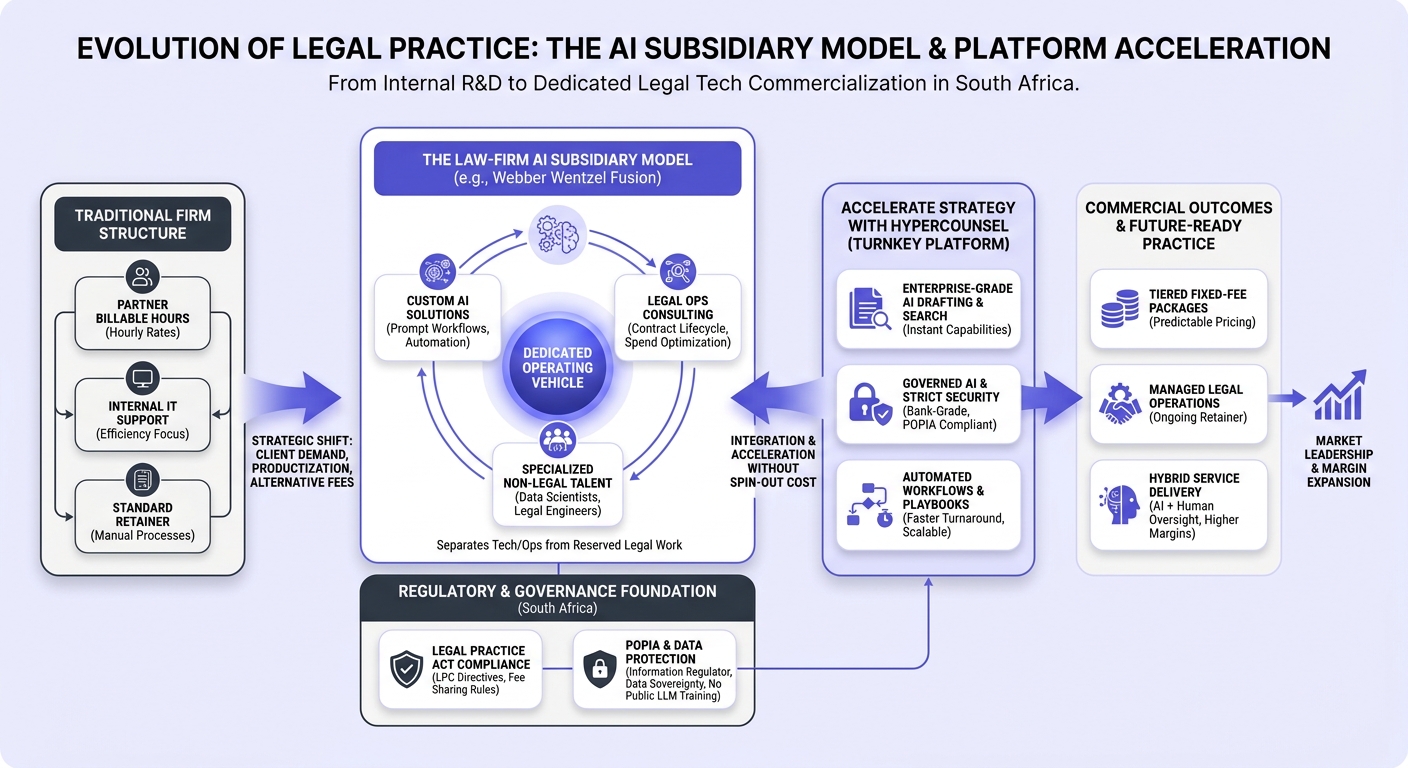
Understanding Webber Wentzel Fusion and the Spin-Out Model
Webber Wentzel Fusion represents a structural evolution in the South African legal market. Traditionally, law firms managed technology and process automation through internal innovation committees or IT departments. While effective for internal efficiency, internal teams often face constraints related to partnership billing models, non-lawyer equity rules, and capital allocation.
By establishing a standalone subsidiary, a law firm creates a distinct operating vehicle dedicated to:
- Developing and deploying custom AI solutions: Engineering tailored prompt workflows, matter-management automation, and bespoke client portals.
- Providing direct legal operations consulting: Helping corporate legal departments modernize contract lifecycles, triage matters, and optimize outside counsel spend.
- Recruiting specialized non-legal talent: Attracting data scientists, legal engineers, and solution architects outside standard attorney compensation structures.
This model allows the primary law practice to focus on complex legal advisory while the technology arm scales repeatable, software-driven legal services.
Why Law Firms Are Launching Dedicated AI Subsidiaries
The decision to launch an independent technology unit is driven by commercial and operational realities in South Africa and global legal markets.
Traditional Firm Structure                 AI Subsidiary Model
┌─────────────────────────┐               ┌─────────────────────────┐
│ Partner Billable Hours  │               │ Fixed-Fee Tech Services │
│ Internal IT Support     │  ──────────►  │ Dedicated Legal Ops Eng │
│ Standard Hourly Retainer│               │ Managed AI Workflows    │
└─────────────────────────┘               └─────────────────────────┘
- Client Demand for Value: Corporate clients increasingly reject paying premium hourly rates for routine contract drafting, due diligence, and legal research.
- Productization of Legal Knowledge: Standardized compliance checklists, regulatory trackers, and lease review templates can be packaged into scalable digital assets.
- Alternative Fee Structures: A subsidiary can charge fixed subscription fees, implementation costs, or software-as-a-service (SaaS) rates without complicating partnership accounting.
- De-risking Core Practice: Technical experimentation and third-party software integration can be managed within a dedicated corporate structure.
Regulatory and Governance Realities Under South African Law
Operating an AI-enabled legal subsidiary in South Africa requires careful alignment with local statutory frameworks and professional conduct guidelines.

1. Legal Practice Act Compliance
Under the Legal Practice Act 28 of 2014, only admitted legal practitioners may render reserved legal services or share fees from reserved legal work with non-practitioners. Technology subsidiaries must cleanly separate technology consulting, software delivery, and legal operations support from reserved legal advice to remain fully compliant with Legal Practice Council (LPC) directives.
2. Data Protection and POPIA
The Protection of Personal Information Act (POPIA), enforced by the Information Regulator South Africa, mandates strict safeguards when processing client and employee data. Legal AI implementations must ensure:
- Client documents are not used to train public Large Language Models (LLMs).
- Cross-border data transfers comply with Section 72 of POPIA.
- Data subject rights and access controls are enforced at every workflow layer.
Core Capabilities: What an AI-Enabled Legal Operations Unit Delivers
Law firms leveraging dedicated technology vehicles focus on high-impact, repeatable legal operations workflows.
- Automated Contract Analysis: Rapid extraction of change-of-control, liability, and indemnity clauses during M&A due diligence.
- Digital Playbooks: Codifying institutional firm knowledge into dynamic prompt workflows that junior associates and in-house teams can run safely.
- Regulatory Tracking: Continuous monitoring of legislative updates across South African government gazettes, sector regulators, and court judgments.
- Matter Intake and Triage: Automated classification of incoming legal requests to route work to the appropriate specialist or self-service template.
Build vs. Buy vs. Partner: Structuring Your Firm's AI Roadmap
Not every law firm has the balance sheet or scale to spin out a standalone entity like Webber Wentzel Fusion. For most practices, a hybrid or platform-led approach delivers faster time to value without massive capital expenditure.
| Deployment Model | Capital Required | Time to Launch | Maintenance Overhead | Best For |
|---|---|---|---|---|
| Standalone Spin-Out | High ($500k+) | 9–18 months | High (dedicated engineering & sales teams) | Top-tier firms with large corporate client bases |
| Internal Custom Build | Medium–High | 6–12 months | Medium (ongoing IT & security updates) | Mid-market firms with in-house developer talent |
| Turnkey AI Platform | Low (Predictable fixed SaaS) | 1–2 weeks | Minimal (managed infrastructure & compliance) | Solo practitioners, mid-market firms, and agile legal teams |
Firms utilizing governed platforms such as HyperCounsel can access enterprise-grade prompt engineering, strict data confidentiality, and automated drafting tools without the operational risk of running a software development company.
Commercialization, Pricing, and Productization Strategies
Transforming legal know-how into commercial software or tech-enabled services requires a shift in pricing strategy:
- Tiered Fixed-Fee Packages: Offering defined-scope document reviews or compliance audits at predictable price points.
- Managed Legal Operations: Providing in-house legal teams with ongoing operational tooling, prompt optimization, and workflow monitoring on a monthly retainer.
- Hybrid Service Delivery: Combining AI-generated first drafts with human attorney oversight to deliver work in hours instead of days at higher gross margins.
Accelerate Your Legal AI Strategy with HyperCounsel
You do not need to build a multi-million rand technology subsidiary to deliver modern, AI-powered legal services. HyperCounsel empowers law firms, solo practitioners, and corporate legal departments across South Africa with enterprise-grade AI drafting, intelligent document search, and bank-grade data security.
Whether you want to productize your firm's workflows, cut document turnaround times by up to 70%, or establish strict POPIA-compliant AI governance, HyperCounsel provides the tools your team needs to lead the market.
- Book a Demo to see customized South African legal workflows in action.
- Calculate Your ROI to evaluate billable time savings and margin expansion.
- Review Enterprise Security to see how your client data remains isolated and protected.
Take the Next Step
Ready to protect your business with expert legal support? Explore how HyperCounsel can help:
Frequently Asked Questions
What is Webber Wentzel Fusion and why was it spun out?
Webber Wentzel Fusion is a dedicated technology, artificial intelligence, and legal operations subsidiary established by Webber Wentzel. It was created to provide standalone legal technology consulting, custom workflow automation, and digital solutions to corporate clients under a specialized business model.
How does a law-firm AI subsidiary differ from an internal innovation team?
An internal innovation team primarily supports the firm's own lawyers to increase internal efficiency. A standalone AI subsidiary can hire specialized technical talent, productize software tools, and contract directly with corporate legal departments under alternative, fixed-fee pricing models.
What governance issues matter when commercializing AI services in South Africa?
Firms must comply with the Legal Practice Act regarding reserved legal work, maintain strict client confidentiality, adhere to POPIA rules enforced by the Information Regulator, and ensure client data is never used to train public foundational AI models.
Can smaller South African law firms compete with firm-backed AI subsidiaries?
Yes. Smaller and mid-sized practices can deploy turnkey platforms like HyperCounsel to achieve the same efficiency gains, document automation, and client turnaround speeds without incurring high software development or maintenance costs.