

Why Dedicated Legal AI Platforms Outpace General Chatbots for Research, Drafting, and Document Review
Learn why specialized legal AI platforms outpace general chatbots for research and drafting.
According to the Small Business Administration, small businesses make up 99.9% of all U.S. firms, demonstrating that boutique operations and solo practices represent the vast majority of professional service providers in the country. For law firms in this competitive landscape, maintaining an operational edge requires adopting modern efficiency tools while strictly managing risk. This pressure has led many practitioners to evaluate how incorporating generative tools can optimize daily billable tasks.
However, using a basic consumer-grade chatbot for sensitive files presents substantial compliance hazards. To maintain client trust and professional standards, law firms are shifting away from open-ended models in favor of purpose-built legal ai solutions. These enterprise-grade platforms combine the speed of generative language processing with strict data security, verified references, and legal-specific workflow tools.
This guide outlines why specialized legal ai is outpacing general-purpose chatbots across research, drafting, and document review, and provides a framework for selecting the right technology for your firm.
Table of Contents
- Quick Summary
- The Core Difference: General Chatbots vs. Dedicated Legal AI
- Comparing Core Use Cases
- Ethical Compliance and Managed Risks
- Key Performance Indicators and Security Checklist
- Take the Next Step
- Frequently Asked Questions
- Recommended
Quick Summary
| Takeaway | Explanation |
|---|---|
| Data Confidentiality | General chatbots train models on user inputs. Dedicated legal ai platforms prevent consumer data training and employ secure, zero-retention parameters. |
| Reference Verification | Open chatbots frequently formulate inaccurate citations. Legal platforms check drafts against active case law and statute databases to certify authority. |
| Integrated Workspaces | Purpose-built utilities organize work by client matter, comparing drafts directly against organizational playbooks. |
| Professional Ethics Compliance | Dedicated compliance tools ensure attorneys adhere to court mandates regarding generative software usage and confidentiality. |
The Core Difference: General Chatbots vs. Dedicated Legal AI
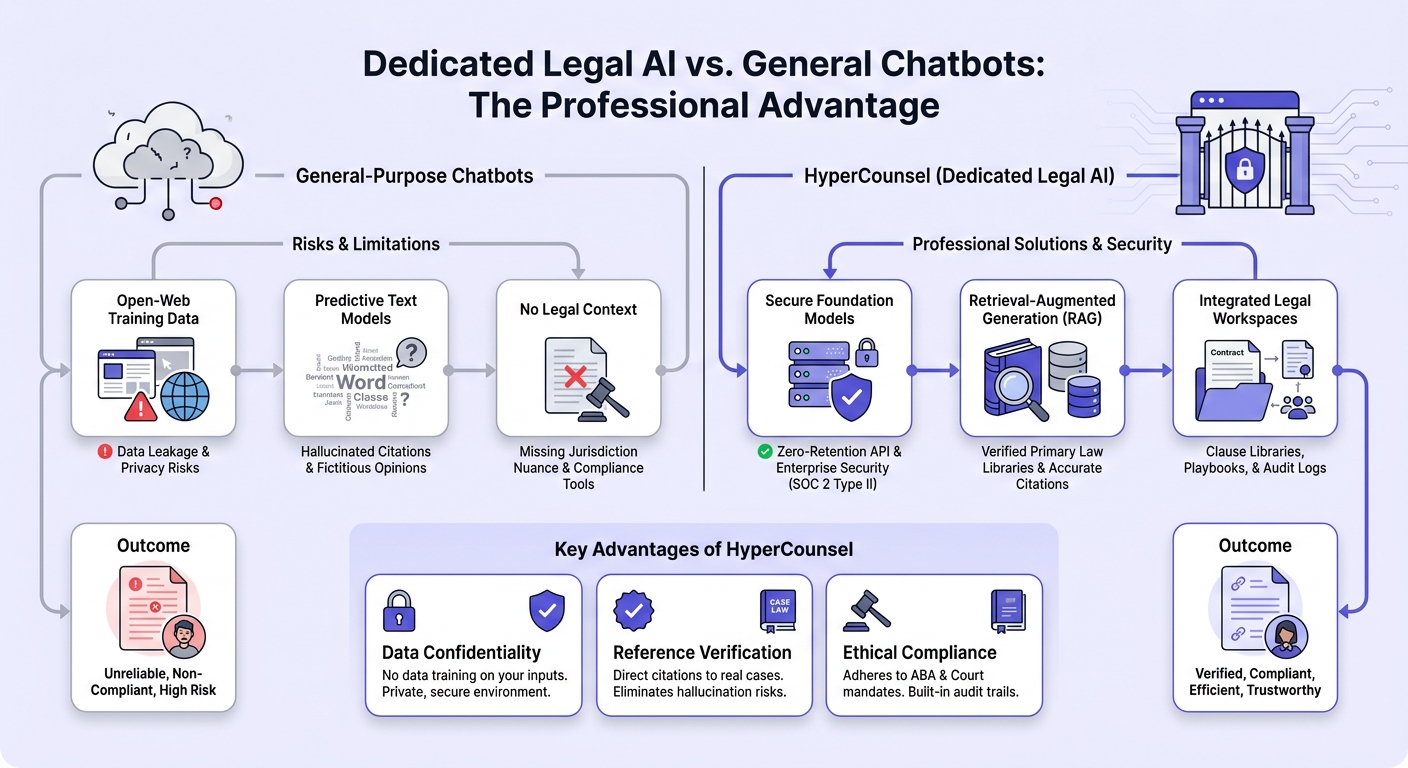
General-purpose chatbots are designed to produce plausible-sounding language across an unlimited spectrum of topics. These systems operate as predictive text models, choosing the next most probable word based on patterns in their open-web training data. They lack the specialized structural architecture to verify legal accuracy, parse jurisdictional nuances, or enforce strict file confidentiality.
In contrast, dedicated legal ai platforms are built on top of secure foundation models integrated with closed, verified primary law libraries. Through a design pattern called Retrieval-Augmented Generation (RAG), the system first queries verified statutes, rules, and case law, then uses the language model exclusively to summarize the retrieved sources.
Further, data privacy provisions differ significantly between platforms. As noted by the Federal Trade Commission in their guidelines on AI data privacy and security, commercial operators frequently modify privacy agreements to claim rights over uploaded user inputs for training. Highly secure legal ai vendors guarantee your firm's data remains private and is never used to train foreign models.
Comparing Core Use Cases
Choosing the right approach depends on understanding how general-purpose systems and specialized legal software perform across daily tasks.
Legal Research and Source Verification
When general chatbots are asked to identify precedent, they often hallucinate fictitious opinions and insert non-existent legal citations. This can lead to severe professional consequences. Under a Federal Courts Order on Generative AI, numerous jurisdictions now require formal certifications that all filings have been checked for AI-generated hallucinations.
Dedicated legal systems utilize closed databases of primary law to cite directly to real cases, code sections, and regulations. They provide clickable links directly to the source text, so you can verify each citation before it goes into a brief.
Contract Drafting and Clause Library Integration
Drafting a commercial contract with a general chatbot often produces vague boilerplate that lacks context-specific protections, like indemnification or standard governing law clauses.
Professional platforms allow teams to save custom clause libraries, upload playbooks, and draft documents using their firm's preferred language. This ensures that every generated draft remains consistent with your firm's standards.
Precision Document Review
Uploading a comprehensive lease or merger agreement into an open-web chatbot presents massive confidentiality concerns. Additionally, basic systems cannot compare thousands of pages against institutional parameters simultaneously.

Specialized workspaces offer secure bulk analysis. Attorneys can import an entire folder of contracts, extract specific key clauses, identify deviating terms, and generate side-by-side transaction comparisons without exposing data to the public.
Ethical Compliance and Managed Risks
Under ABA Model Rules Rule 1.1 Comment on Competence, legal practitioners must maintain technological competence, which includes understanding the benefits and risks associated with relevant technologies.
Using generative platforms introduces specific compliance considerations:
- The Duty of Confidentiality: Uploading client disclosures or proprietary contracts into consumer programs may waive attorney-client privilege.
- The Duty of Supervision: Partners must monitor the technological tools used by junior associates to prevent unverified briefs from reaching the judge's desk.
- The Duty of Candor: Federal and local court rules increasingly mandate disclosing the use of artificial intelligence in document draft work.
Specialized platforms address these challenges using enterprise-level security measures, precise user access levels, and comprehensive audit logs that track every system query and action.
Key Performance Indicators and Security Checklist
When comparing vendors, assess how their service levels, data protections, and operational features align with your firm's core operational needs.
| Operational Indicator | General-Purpose Chatbots | Secure Legal AI Platforms |
|---|---|---|
| Zero-Retention API | Typically unavailable on basic consumer tiers | Standard; guarantees data is deleted after session processing |
| Jurisdictional Nuance | Limited; blends general legal concepts together | High; filtered by state, federal, or specialty court jurisdictions |
| Precedent Validation | Prone to citation fabrication and outdated references | Real-time cross-checking with active case databases |
| Colleague Collaboration | Lacks secure matter-based folders or shared logs | Integrated shared workspaces with distinct permission controls |
Use this checklist to evaluate prospective vendors:
- SOC 2 Type II Certification: Confirms the provider maintains verified, audited data control procedures.
- Integration with Document Systems: Integrates directly with your existing document management systems (DMS) for smooth file transfers.
- No-Train Clauses: Contractually guarantees that your uploaded work product will not be used to train future language models.
- Predictable Billing: Offers flat-rate or per-user monthly rates rather than opaque, usage-based consumption pricing.
Take the Next Step
Law firms must balance client advocacy with strict operational compliance. Sticking with open-web consumer tools risks compromising client confidentiality, violating court rules, and introducing document errors.
Adopting a secure, specialized platform lets your firm streamline its research, drafting, and document analysis workflows while maintaining institutional-grade security.
HyperCounsel helps firms operate more efficiently through structured legal workspaces, secure document analysis, and predictable, transparent pricing model plans.
To see how specialized legal technology can safely optimize your billable productivity and speed up draft lifecycles, Book a Demo with the team today or explore our clear Pricing models to find the right tier for your firm.
This article provides general information and is not legal advice.
Frequently Asked Questions
What is the difference between legal AI and a general chatbot?
A general chatbot relies on predictive text patterns trained on the public internet, which can lead to made-up citations and privacy concerns. A specialized legal platform uses closed, verified databases of primary law to ground its answers, ensuring accurate citations while maintaining strict confidentiality boundaries.
Can lawyers rely on AI-generated legal research without checking sources?
No. Attorneys are ultimately responsible for the accuracy of their filings under ethical rules and court orders. While a specialized legal platform makes checking sources much easier by linking directly to actual cases, attorneys must verify each source before relying on it in court documents.
What should a firm look for in an AI vendor's privacy and security terms?
Firms should look for a SOC 2 Type II certification, a contractual commitment to zero-data retention, and a clear "no-train" guarantee ensuring uploaded firm data is never used to train future generative systems.
How can legal AI help with drafting and document review without replacing attorney judgment?
The system serves as an advanced assistant that handles time-consunming first drafts, summarizes massive contracts, and flags missing clauses. This lets attorneys focus their time on strategic analysis, final editing, and high-level client advocacy.