

AI Contract Review for Tech Law Firms in Nigeria: Speeding Due Diligence Without Losing Legal Judgment
Learn how Nigerian tech law firms use secure AI to speed up contract review and due diligence.
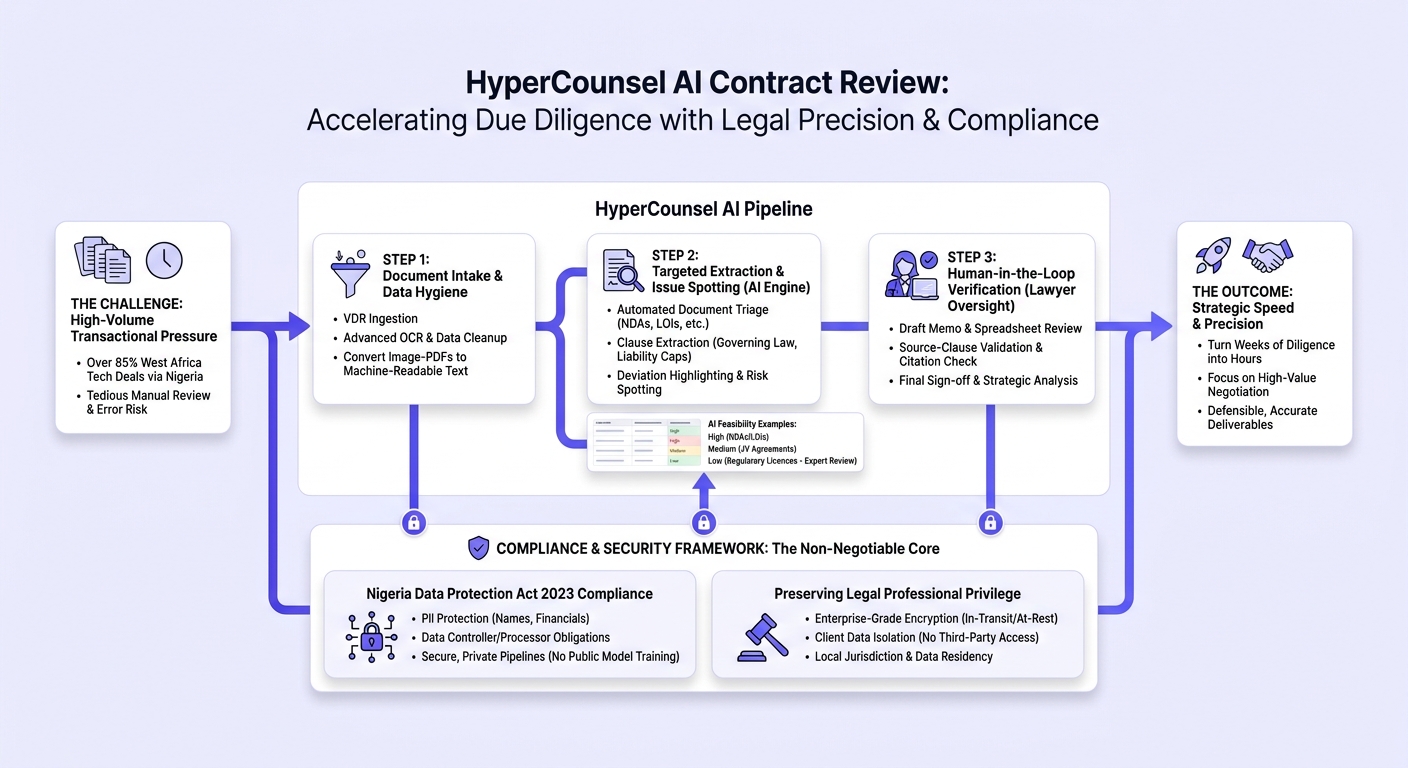
As digital economic activity sweeps across Sub-Saharan Africa, tech law firms in nigeria are facing unprecedented deal volumes. Over 85% of early-stage tech investments in West Africa flow through Nigeria, putting immense pressure on corporate lawyers to run rapid, error-free due diligence on complex, cross-border corporate records.
While transaction teams must move at venture-backed speeds, they cannot afford to sacrifice accuracy, client privilege, or risk control. This is where AI-assisted contract review steps in—not to replace the lawyer, but to accelerate first-pass issue spotting and data extraction.
By pairing advanced technology with human oversight, forward-thinking teams using HyperCounsel are transforming how high-volume legal reviews are executed, turning weeks of tedious diligence into a matter of hours.
Table of Contents
- Quick Summary
- Where AI Contract Review Fits in Nigerian Deal Workflows
- The Core Compliance Landscape: Data Protection and Privilege
- Step-by-Step AI Contract Review Workflow
- Key Evaluation Criteria for Law Firms Selecting Legal AI Tools
- Accelerate Your Deal Workflows Today
- Frequently Asked Questions
- Recommended
Quick Summary
| Takeaway | Explanation |
|---|---|
| Strategic Efficiency | AI accelerates transactional due diligence by automating document triage and clause extraction, saving time for senior analysis. |
| Strict Compliance | Secure operations require compliance with the Nigeria Data Protection Act 2023 and professional privilege standards. |
| Quality Safeguards | A "human-in-the-loop" model ensures all AI-generated contract tags are validated by a qualified attorney. |
| High-Value Contracts | Tech transactions are optimized by targeting NDAs, employment agreements, IP assignments, and financing records. |
Where AI Contract Review Fits in Nigerian Deal Workflows
In high-stakes corporate transactions, transaction teams are frequently inundated with hundreds of pages of disclosures. Navigating the expectations of institutions like the Securities and Exchange Commission Nigeria or the Central Bank of Nigeria leaves zero margin for error.
Traditionally, junior associates spend days manually scanning contracts for standard key markers. AI changes this paradigm by acting as an intelligent first-pass system. Instead of replacing the lawyer, AI tools handle:
- Document Triage: Grouping incoming files by contract type (e.g., employment agreements, non-disclosure agreements, loan terms) automatically.
- Clause Extraction: Identifying key clauses such as governing law, liability caps, and change-of-control provisions in seconds.
- Issue Spotting: Highlighting deviation from standard firm parameters or missing critical clauses, allowing the deal team to focus solely on high-risk issues.
By delegating these repetitive diagnostic steps to an AI pipeline, senior lawyers preserve their energy for high-value risk analysis and negotiation strategy.
The Core Compliance Landscape: Data Protection and Privilege
Deploying artificial intelligence tools in Nigerian transactional practices introduces specific obligations regarding both data protection rules and client confidentiality.
Nigeria Data Protection Act 2023 Compliance
Client documents inevitably contain personal identifiable information (PII)—including employee name lists, corporate director details, and financial account numbers. Under the Nigeria Data Protection Act 2023, legal teams are treated as data controllers or processors. This classification requires technical and organizational checks to protect data from unauthorized access or leakage.
Furthermore, the Nigeria Data Protection Act General Application and Implementation Directive 2024 emphasizes rigorous administrative safeguards. Tech law firms in Nigeria cannot simply paste sensitive client NDAs or cap tables into public consumer AI engines that might use the data for model training. Secure, private pipelines are mandatory.
Preserving Legal Professional Privilege
Maintaining professional privilege is a foundational ethical standard for Nigerian lawyers, as detailed by The Principles of Legal Professional Privilege Under Nigerian Law.
Firms must evaluate legal tech tools carefully to ensure that:
- Vendor servers operate with enterprise-grade encryption (both in transit and at rest).
- Client communications and work products are not visible to third-party developers or generic AI model providers.
- Local jurisdiction and data residency expectations are maintained during complex cross-border due diligence tasks.

Step-by-Step AI Contract Review Workflow
Successfully adopting AI contract review requires a structured, step-by-step workflow to minimize slip-ups and maximize speed.
Step 1: Document Intake and Data Hygiene
Begin by gathering the files provided in the client's virtual data room (VDR). Often, legacy agreements are low-resolution, scanned PDFs with unsearchable text.
Using structured legal infrastructure platforms like HyperCounsel, firms run advanced Optical Character Recognition (OCR) and data cleanup. This converts image-only PDFs into clean, searchable, and machine-readable text files.
Step 2: Targeted Extraction and Issue Spotting
Once the data is structured, the software analyzes the files based on specific corporate criteria. Users select the target covenants and risks depending on the contract type.
| Document Type | AI Feasibility | Recommended Action |
|---|---|---|
| NDAs & LOIs | High | Fully automate extraction and clause tag matching |
| IP Assignment Agreements | High | Scan for transfer terms and local registration issues |
| Complex JV Agreements | Medium | AI-assisted extraction; heavy partner scrutiny required |
| Regulatory Licences (CBN/SEC) | Low | Expert legal interpretation for operational compliance |
Step 3: Human-in-the-Loop Verification
No AI tool should hold final sign-off authority. Experienced lawyers must review and verify every draft memo, structured spreadsheet, and annotated clause.
Attorneys use the generated pointers and reference citations to double-check exact locations in original documents. This process prevents hallucinations and guarantees that final client deliverables are defensible.
Key Evaluation Criteria for Law Firms Selecting Legal AI Tools
Before adopting any legal AI vendor, tech law firms in Nigeria should ask the following core enterprise questions:
- Data Privacy & Training Policy: Does the software vendor partition your client data? Confirm that client documents are never used to train foreign model foundations.
- Integration Profile: Can the application sync with your existing document management systems (DMS) such as OneDrive, Google Workspace, or NetDocuments?
- User Interface and Speed: Is the tool designed for immediate usability by deal teams without requiring complex prompt engineering scripts?
- Transparent and Fixed Pricing: Avoid unpredictable pay-per-api usage bills by prioritizing predictable, fixed SaaS fee frameworks.
By maintaining high vendor-evaluation standards, firms can scale their corporate transaction teams securely without exceeding operational budgets.
Accelerate Your Deal Workflows Today
To scale operations, modern firms must merge speed and precision. Securely automating early-stage contract review and organization saves days of manual triage, giving your deal team the margin to focus on strategic negotiation.
Platforms like HyperCounsel empower corporate legal teams with predictable, fixed pricing models, secure frameworks, and streamlined legal tech interfaces that respect the Nigeria Data Protection Act 2023.
If your team is ready to accelerate due diligence workflows while maintaining elite advisory standards, Book a Demo or view our View Pricing Plans to find the ideal fit for your firm.
This article provides general information and is not legal advice.
Take the Next Step
Ready to protect your business with expert legal support? Explore how HyperCounsel can help:
Frequently Asked Questions
Can AI review contracts for Nigerian transactions without replacing a lawyer's judgment?
Yes. AI handles the highly repetitive, structural aspects of contract review—such as extracting clauses, identifying missing terms, and sorting files. This leaves the strategic, customized, and client-facing legal advisory tasks completely to the professional lawyer's judgment.
What kinds of deal documents are safest to start with when using AI in a Nigerian law firm?
Non-disclosure agreements (NDAs), standard employment contracts, software service agreements, and IP assignment templates are the safest avenues to begin with. These documents are generally standardized, making them highly receptive to automated categorization and clause matching.
How do Nigerian data protection rules affect uploading contracts into AI tools?
Under the Nigeria Data Protection Act 2023, law firms must ensure client data, including any personal information found in contracts, is not exposed to unauthorized third parties. Firms must only use secure, private AI applications that strictly prohibit the use of client files for model-training purposes.
What controls should a law firm put in place before using AI for due diligence?
Firms should implement a strict human-in-the-loop review policy, use access-controlled permission levels, perform rigorous source-clause validation on all outputs, and obtain formal partner-level approval before sharing due diligence findings with clients.