

Preparing for Tech Law Firms in Nigeria: Why We Must Integrate AI Literacy into Legal Education by 2026
Nigerian law schools must integrate AI and tech literacy into their curricula by 2026.
The Nigerian legal landscape is experiencing a massive technological transformation. As venture capital, fintech platforms, and complex digital commerce ecosystems continue to scale across West Africa, the demand for specialized legal counsel has skyrocketed. However, a significant gap is widening between what classrooms teach and what the marketplace demands, particularly within tech law firms in nigeria.
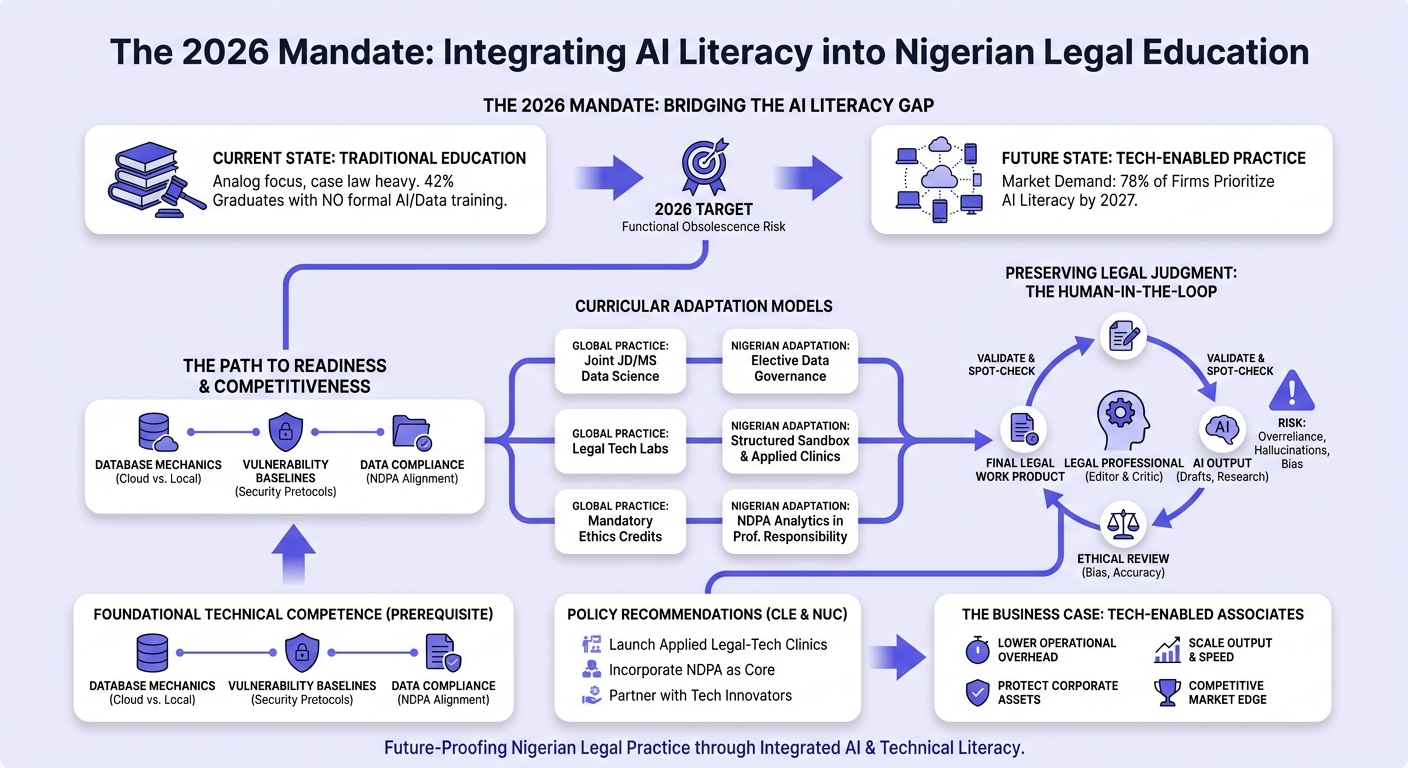
Recent market data shows that 78% of tech law firms in Nigeria plan to prioritize hiring law graduates with proven AI literacy by 2027. Despite this high demand, contemporary regional training programs remain anchored in traditional methodologies. If Nigerian law schools do not aggressively integrate AI literacy, technical competence, and data ethics into their curricula by 2026, our next generation of practitioners risks entering the market functionally obsolete.
This article outlines why reforming our educational curriculum is no longer optional. For modern firms, adopting modern law firm automation software like HyperCounsel bridges this immediate knowledge gap, proving that technical and AI literacy is essential for modern competitiveness.
Table of Contents
- The Current Gap: AI Literacy in Nigerian Legal Education
- Foundational Technical Competence Must Precede AI Literacy
- Global Curricular Models for AI Ethics and Data Governance
- The Risks of Overreliance: Preserving Legal Judgment
- Policy Recommendations for Regulators and Law Schools by 2026
- The Business Case: Why Nigerian Firms Need Tech-Enabled Associates
- Ready to Future-Proof Your Legal Practice?
- Frequently Asked Questions
- Recommended
Summary Table
| Takeaway | Explanation |
|---|---|
| Immediate Skills Gap | Many Nigerian law graduates lack the hands-on AI and data experience required by modern firms. |
| Core Competence First | Basic digital and security literacy must precede AI tool deployment to maintain ethical standards. |
| The 2026 Mandate | Regulators must integrate legal tech curricula to maintain international competitiveness. |
| AI as an Assistant | Overreliance on AI can erode critical thinking; human-in-the-loop validation remains vital. |
| Competitive Edge | Lawyers trained in both law and data science command premium positions in the digital economy. |
The Current Gap: AI Literacy in Nigerian Legal Education
The mismatch between academic preparation and practical execution in modern advocacy is growing. While global operations automate document sorting, review, and contract pipelines, local programs remain heavily focused on case law and analog systems of litigation. Research shows 42% of Nigerian law graduates report no formal training in AI or data ethics before entering practice, leaving them underprepared for the rigors of modern legal practices.
This educational gap is not merely a technical limitation; it is an economic barrier. When freshly minted lawyers join tech law firms, partners must spend corporate resources teaching basic modern file structures, digital discovery techniques, and software collaboration dashboards.
Historically, legal clinics underprioritized technology diffusion. Correcting this ensures that when associates take on active files, they can confidently parse software architecture, smart contract functionality, and regulatory mechanics.
Foundational Technical Competence Must Precede AI Literacy
Before any lawyer can safely deploy machine learning tools, they must master baseline computer and network concepts. It is impossible to evaluate whether an AI platform is executing safely if you do not understand where client records are archived, how they are encrypted, and what vectors could trigger a breach.
As highlighted in technical briefings on AI Literacy for Lawyers, basic digital competence must serve as a prerequisite to deploying AI systems in professional practices.

In practice, a lawyer representing a digital fintech company must be familiar with:
- Database Mechanics: Knowing the difference between local servers and secure cloud systems.
- Vulnerability Baselines: Understanding how file sharing across unsecured Wi-Fi compromises client privileges.
- Data Compliance: Evaluating systems for alignment with the Nigeria Data Protection Act (NDPA).
Without these core skills, using AI shortcuts can lead to catastrophic ethical violations and massive regulatory fines.
Global Curricular Models for AI Ethics and Data Governance
Jurisdictions globally are already creating pathways to solve this. Some international institutions embed technology governance and software evaluation directly into mandatory professional responsibility tracks, rather than leaving technology as an elective. Academic initiatives are actively urging universities to redesign outdated law curricula to address global modernization developments, as highlighted in the Call for Papers on Redefining Legal Education in the AI Age.
We can summarize a viable curriculum adaptation strategy for Nigerian law schools as follows:
| Global Practice | Nigerian Adaption Step | Expected Outcome |
|---|---|---|
| Joint JD/MS in Data Science | Elective coursework in data governance | Interdisciplinary legal talent |
| Legal Tech Labs | Structured sandbox environments in Law School | Practical legal-engineering skills |
| Mandatory Ethics Credits | Integration of NDPA analytics in professional responsibility exams | Regulatory-compliant graduates |
The Risks of Overreliance: Preserving Legal Judgment
While cognitive automation platforms dramatically speed up preliminary document sweeps, overreliance poses serious risks. Legal judgment cannot be outsourced to a machine learning engine. As noted in insights on honing modern legal judgment, over-indexing on automation without contextual testing is highly dangerous.
If a lawyers fails to double-check their resources, algorithmic bias, outdated precedents, and outright hallucinations will slowly compromise work quality. Students must learn to act as editors and critics of AI outputs, utilizing platforms defensively rather than letting software drive analytical conclusions unsupervised.
Policy Recommendations for Regulators and Law Schools by 2026
To achieve full readiness by 2026, the Council of Legal Education (CLE) and the National Universities Commission (NUC) should outline practical mandates:
- Launch Applied Legal-Tech Clinics: Transition traditional moot courts into simulated digital clinics where students file automated mock documents, interact with billing software, and audit contract risk.
- Incorporate Data Privacy: Elevate the Nigeria Data Protection Act (NDPA) to a core course requirement, moving beyond basic administrative reviews.
- Partner with Tech Innovators: Collaborate with tech engineering brands like HyperCounsel to offer student licenses, enabling hands-on practice before graduation.
The Business Case: Why Nigerian Firms Need Tech-Enabled Associates
For corporate organizations, partnering with a law firm that relies on hand-cranked legal research is no longer viable. Technology-fluent lawyers allow modern organizations to lower operational overhead, protect corporate assets, and scale output.
By managing modern digital platforms, tech-enabled firms operate faster and prevent systemic bottlenecks. Graduates who join these firms with baseline AI and workflow-automation knowledge immediately add value, bypassing months of administrative training and giving their firms an immediate competitive edge in the market.
Ready to Future-Proof Your Legal Practice?
To thrive in the Nigerian legal market, firms must equip their teams with fast, secure, and modern automation tools. This is where HyperCounsel becomes invaluable. By unifying workflow collaboration, advanced intake systems, and research modules, we help your firm scale seamlessly.
Enjoy clean operations, transparent pricing, and rapid file deliveries. Book a Demo with us today or view our transparent Pricing plans online to transform your legal practice.
This article provides general information and is not legal advice.
Take the Next Step
Ready to protect your business with expert legal support? Explore how HyperCounsel can help:
Frequently Asked Questions
Why is AI literacy more important than policy rules for Nigerian law students?
While policy rules declare the "ought," AI literacy provides the practical "how." Understanding how AI engines generate responses is critical for spot-checking hallucinations, auditing data leaks, and executing legal duties efficiently.
What foundational technical skills must Nigerian law graduates master before learning AI?
Graduates must first understand data systems, information architecture, cloud databases, and information security protocols. Without these fundamentals, they cannot properly assess a legal tech provider's security compliance.
How can Nigerian law schools integrate data ethics without overwhelming existing curricula?
Schools can embed data ethics modules into existing courses like Professional Conduct and Jurisprudence rather than designing entire new programs. This minimizes systemic strain while updating pedagogical values.
Will AI-trained lawyers outperform those from traditional law programs in tech law firms in Nigeria?
Yes. AI-trained associates work faster, handle a higher volume of transaction workflows, and possess the analytical literacy needed to draft compliance rules for modern digital startups.