

The 98% Adoption Gap: AI Integration in Australian Law Firms
How Australian law firms can safely transition from ad-hoc AI use to firm-wide integration.
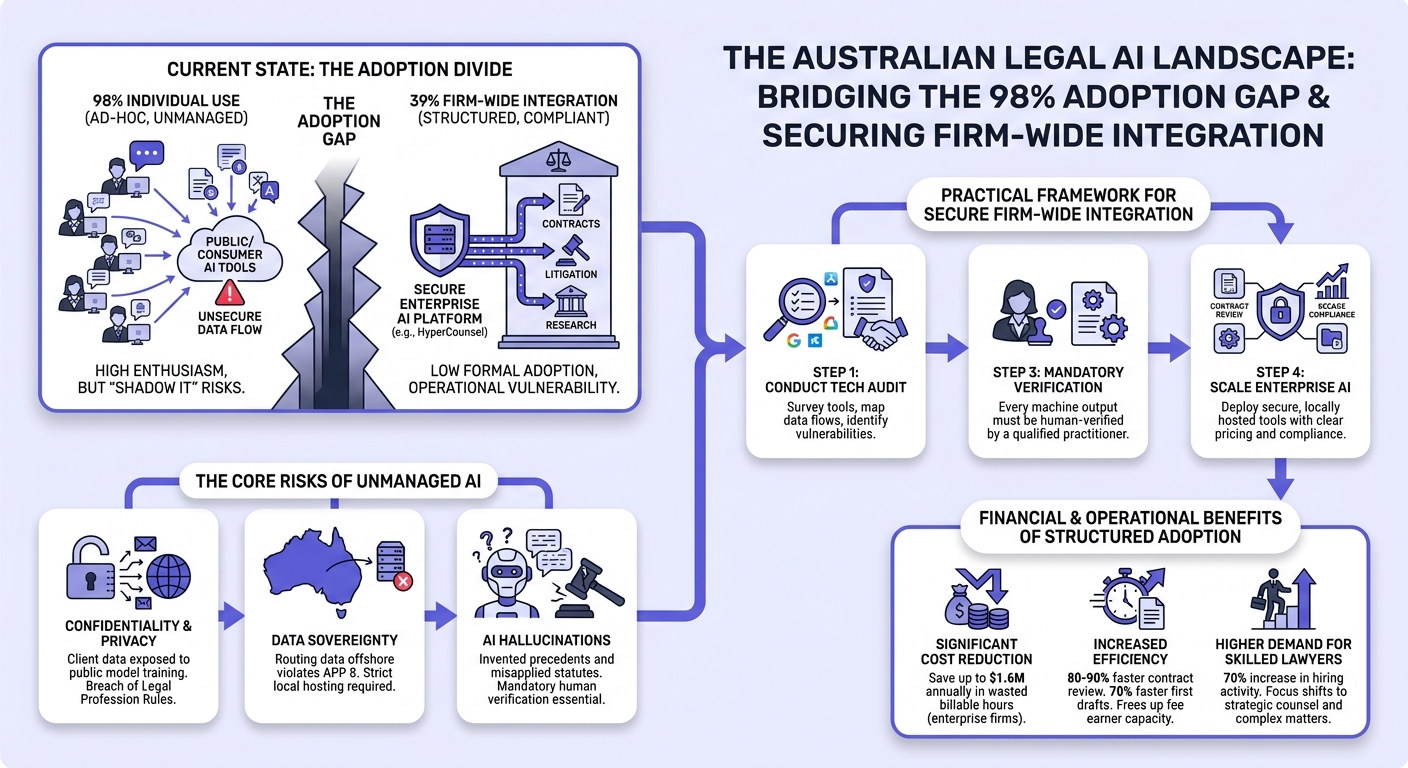
Australian law firms are at a tipping point. According to data from Clio’s 2025 Legal Trends Report, 98% of Australian legal professionals now use AI in some capacity within their practices, making Australia one of the most AI-mature legal markets globally. Yet, there remains a massive divide: only 39% of firms have actually integrated these advanced technical systems into their daily, firm-wide operations.
This gap between casual, ad-hoc experimentation and firm-level integration exposes practices to serious compliance, structural, and financial vulnerabilities. When individual lawyers use public tools on their own initiative, they risk leaking client data, violating Australian ethical regulations, and generating inaccurate legal material.
To thrive in this quickly changing market, firm operators must pivot from uncoordinated tool testing to structured, firm-wide deployments of secure, professional legal ai tools. This guide walks you through bridging that 98% adoption gap while maintaining compliance, safeguarding client data, and boosting operational margins.
Table of Contents
- Quick Summary: Bridging the Legal AI Integration Gap
- The Reality of the Australian Legal Tech Landscape
- Understanding the Core Risks: Confidentiality, Privacy, and Data Sovereignty
- Practical Step-by-Step Framework for Firm-Wide Integration
- The Financial and Operational Benefits of Structured AI Adoption
- Elevate and Secure Your Firm with HyperCounsel
- Frequently Asked Questions
- Recommended
Quick Summary: Bridging the Legal AI Integration Gap
| Takeaway | Explanation |
|---|---|
| High Usage, Low Integration | Although 98% of Australian practitioners utilize AI, only 39% do so within a coordinated, firm-sanctioned framework. |
| Confidentiality & Privacy Concerns | Open consumer AI models store and train on entered data. Enterprise-grade legal ai tools are required to safeguard commercial secrets. |
| In-Country Data Sovereignty | Federal and state laws demand strict data hosting parameters. Ensure your vendors use servers located physically within Australia. |
| The Oversight Requirement | Machine outputs are prompts, not final advice. Senior lawyer verification is mandatory to prevent court-facing errors and ethical liability. |
| Substantial Cost Reductions | Proper firm-wide integration saves mid-tier firms up to $1.6 million annually while freeing fee earner capacity. |
The Reality of the Australian Legal Tech Landscape
The statistic that 98% of Australian legal professionals are utilizing artificial intelligence highlights immense industry enthusiasm. However, the drop-off to 39% firm integration reveals a roadblock in trust, clarity, and security.
Individual lawyers are using these tools to draft emails, summarize long cases, or cross-reference documents. Yet, because firms lack formal contracts with secure vendors, this usage happens beneath the surface. This ad-hoc approach creates a "Shadow IT" issue, leaving firm partners unaware of what client information is being input into external servers.
To address this challenge, progressive firms are shifting their strategy. By partnering with HyperCounsel to deploy centralized, secure legal ai tools, operators can safely harness the productivity gains of AI while eliminating compliance risks.
Understanding the Core Risks: Confidentiality, Privacy, and Data Sovereignty
Before integrating any digital workflow tools, firm operators must understand the compliance landscape governing Australian legal practitioners. The law societies of New South Wales, Victoria, and Western Australia have all issued strict warnings regarding the unmanaged use of artificial intelligence.
The most critical concerns include:
- Client Confidentiality: Standard, public-facing AI tools often use your input text to train their primary machine models. Entering private client details or sensitive commercial terms directly compromises your legal obligations under Rule 9 of the Legal Profession Uniform Conduct (Solicitors) Rules 2015.
- Data Privacy and Sovereignty: The Office of the Australian Information Commissioner (OAIC) enforces the Australian Privacy Principles (APPs). If your AI platform routes client data outside of Australia, your firm may be in breach of APP 8 (Cross-border disclosure of personal information).
- The Threat of Hallucinations: Standard language processors do not have a built-in understanding of legal updates or context, frequently leading to invented precedents or misapplied statutes.
Research from Embroker shows that 41% of professional firms point to data privacy as their single greatest hurdle to AI adoption. To address this fear, firms must use dedicated, closed-loop systems where data is processed securely and is never stored or used to train third-party platforms.

Practical Step-by-Step Framework for Firm-Wide Integration
Transitioning from casual experimentation to formal, compliant operational integration requires a structured pathway. Here is how your firm can execute a secure rollout.
Step 1: Conduct a Firm-Wide Tech Audit
Survey your practitioners to identify which public and private tools are currently being used across different teams. Determine what documents are being processed, which platforms are accessed, and where your data security vulnerabilities lie.
Step 2: Establish an Internal AI Usage Policy
Draft a firm-wide policy detailing authorized systems, banned sites, acceptable use cases, and strict data input protocols. Your policy should outright ban the copy-pasting of identifying client names, internal financial structures, or patented technologies into non-vetted public software.
Step 3: Implement Mandatory Verification Protocols
Establish a rule within your practice management guidelines: every single document, letter, contract, or submission influenced by machine intelligence must undergo strict manual verification by a qualified Australian legal practitioner. This step protects your practice from ethical liability and maintains high-quality outputs.
Step 4: Scale with Enterprise-Grade Legal AI Tools
Retire uncoordinated consumer software and deploy enterprise-level legal ai tools that offer security, local hosting, and customized practice parameters. Work with providers like HyperCounsel that operate under clear, predictable pricing models with built-in data compliance.
The Financial and Operational Benefits of Structured AI Adoption
While managing risk is crucial, the financial and operational rewards of integrating compliant technology are substantial. Clio’s reports show that 66% of law firms using integrated AI models saw an immediate, positive impact on key operational revenue metrics.
Additionally, complete system integration can save enterprise-level legal practices up to $1.6 million annually in wasted billable hours.
Contrary to the belief that technology will reduce hiring, integrating AI actually increases the demand for skilled lawyers. An Australian Financial Review market survey showed a 70% increase in hiring activity for firms that successfully integrated AI systems. This trend occurs because automation frees up senior staff to take on more matters, requiring skilled lawyers to run client relationships, apply human oversight, and steer complex litigation.
Consider how an integrated platform optimizes traditional workflows:
| Workflow Area | Traditional Process | Integrated AI Process | Expected Time Saving |
|---|---|---|---|
| Contract Review | 4 to 6 hours per contract | 15 to 30 minutes via secure document screening | 80% to 90% |
| Compliance Flagging | Manual referencing across past precedents | Automated flags mapped to custom firm playbooks | 60% |
| First Draft Generation | Drafting from scratch or outdated templates | Prompt-based drafting using secure, internal libraries | 70% |
| Pre-Submission QC | Entirely manual secondary review | AI pre-screening followed by target human verification | 30% |
Elevate and Secure Your Firm with HyperCounsel
Bridging the gap between casual software experimentation and compliant, firm-wide integration can feel overwhelming. However, your practice does not have to face these structural transitions alone.
At HyperCounsel, we partner with progressive Australian law firms to deploy secure, enterprise-grade AI frameworks designed for daily practice. Our solutions protect client confidentiality, optimize complex workflows, and deliver measurable operational value—all backed by simple, upfront fixed pricing.
By choosing our specialized platform, you can secure your firm's data, reduce non-billable overhead, and give your practitioners the tools they need to operate at their highest level.
Take the next step in future-proofing your legal practice. Book a Demo today or explore our options on our Pricing Page.
Take the Next Step
Ready to protect your business with expert legal support? Explore how HyperCounsel can help:
Frequently Asked Questions
This article provides general information and is not legal advice.
Why do 98% of Australian lawyers use AI but only 39% integrate it into firm operations?
While individual lawyers are eager to save time on routine tasks, law firms often delay formal integration due to concerns about data privacy, changing regulations, and security protocols. This creates a gap where staff use unauthorized public tools, inadvertently putting firm compliance at risk.
What are the main confidentiality and data privacy concerns with legal ai tools for Australian law firms?
Public models often store user data and use it for training purposes, which violates the strict confidentiality rules in Australia. Additionally, routing sensitive local client data through overseas servers can violate Australian Privacy Principle (APP) 8, making regional data hosting essential.
How do mandatory verification requirements for AI-generated content affect court submissions in Australia?
State supreme courts and regional bar associations require ultimate human accountability for all submitted court documents. Lawyers must manually check every AI-generated argument, reference, and citation, as submitting incorrect or automated errors can lead to contempt penalties and professional misconduct claims.
Can legal ai tools reduce lawyer headcount or do they increase demand for skilled oversight?
Rather than replacing lawyers, advanced technology shifts human effort from low-value manual tasks to high-value strategic counsel. By speeding up drafts and research, firms can handle larger case volumes, leading to increased demand for skilled lawyers to manage client strategy and review automated outputs.