

Applying the Australian Privacy Principles: How Law Firms Can Avoid the $3.3M AI Compliance Trap
Discover how Australian law firms can navigate the APPs and avoid costly AI compliance traps.
Law practices across Australia are rapidly adopting generative artificial intelligence to draft complex contracts, evaluate evidentiary documents, and streamline communications with clients. Yet, this high-speed digital expansion is colliding directly with the australian privacy principles (APPs). Under the Office of the Australian Information Commissioner (OAIC) dual-guidelines framework, law firms face unprecedented standards of oversight when utilizing these systems.
Failing to manage these digital workflows carries massive financial and operational exposure. Under the current Privacy Act, non-serious interferences with individual privacy can incur civil penalties up to AUD $3.3 million, while serious or systemic breaches can rocket up to AUD $50 million. To maintain client trust and regulatory compliance, legal operators must immediately audit how they input, manage, and verify client data.
By partnering with HyperCounsel, Australian law firms can quickly optimize their technologies to meet these rigorous data obligations, ensuring all workflows remain secure and fully legal.
Table of Contents
- Quick Summary
- Defining Personal Information in the Age of AI
- Mandatory Disclosures under APP 1 and APP 5
- Lawful Collection and Primary Purpose under APP 3 and APP 6
- Ensuring Data Accuracy and Quality under APP 10
- The Cost of Non-Compliance: Civil Penalty Tiers
- Actionable Steps for Law Firm Compliance
- Mitigating Risk with Pre-Vetted Legal AI
- Take the Next Step
- Frequently Asked Questions
- Recommended
Quick Summary
| Takeaway | Explanation |
|---|---|
| Statutory Penalties | Serious interferences yield up to AUD $50 million in fines; non-serious violations cap at AUD $3.3 million. |
| Broadened Data Scope | AI-generated "hallucinations" and inferred profiles fall under private data rules when an individual is identifiable. |
| Transparency Obligations | APP 1 and APP 5 mandate that firms explicitly disclose AI processing policies in their standard terms. |
| Processing Boundaries | Subjecting client records to commercial, public-model databases directly violates APP 6 use limits. |
| Verification Requirements | Under APP 10, legal operators must actively audit AI outputs to ensure client files are clean and accurate. |
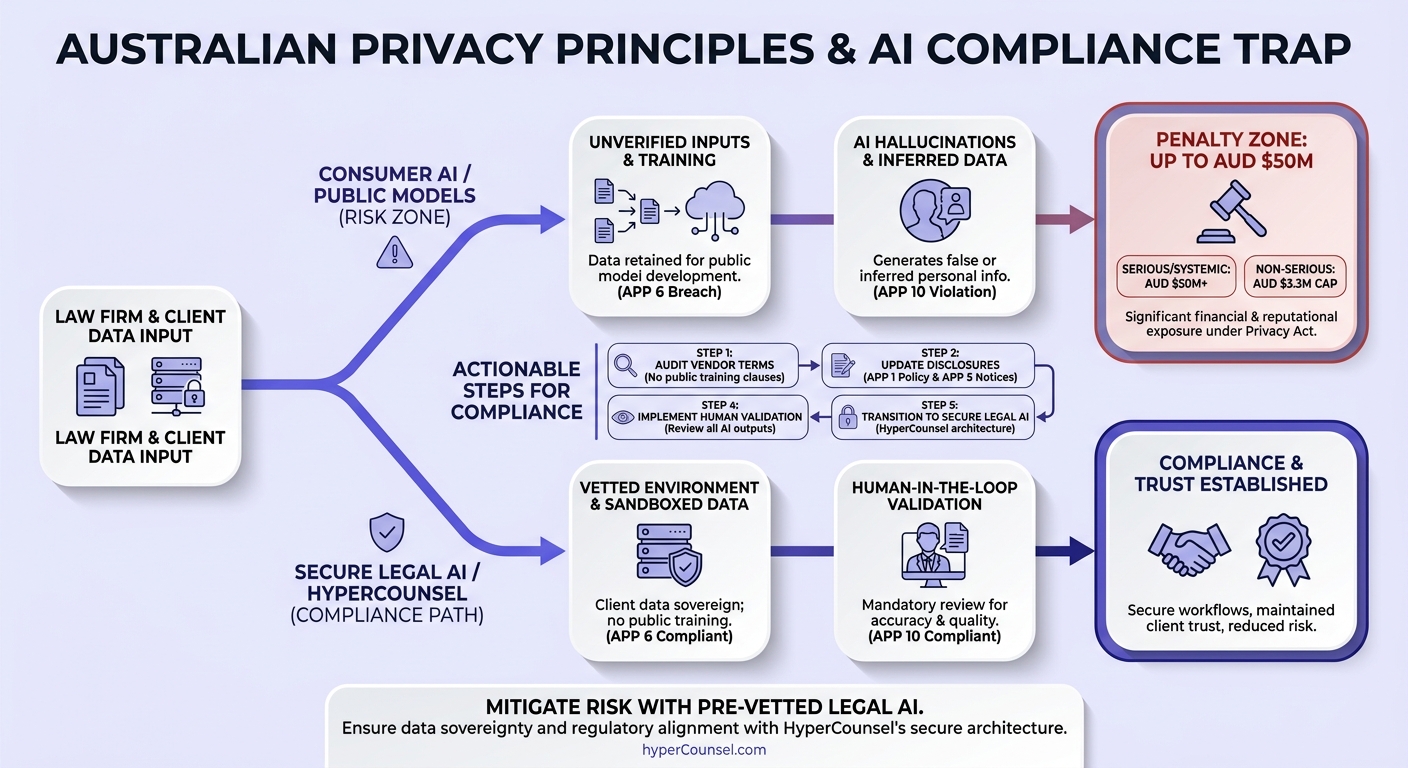
Defining Personal Information in the Age of AI
Under the central framework of the australian privacy principles, personal information encompasses any data or opinion related to an identified—or reasonably identifiable—individual. The OAIC’s latest guidelines establish that AI engines process personal information in several unexpected ways:
- Inferred Personal Information: When an AI platform synthesizes bulk documents to produce predictive scoring, personality profiles, or litigation risk metrics about an individual, those outputs are classified as newly created personal information.
- AI Hallucinations: Standard generative AI systems occasionally suffer from "hallucinations," producing fictitious and inaccurate accounts about real individuals. Under Australian law, false information generated about a person is still considered personal information and must be handled under compliance protocols.
For law firms, this means every deposition transcript, background brief, and employment file passed to an automated platform triggers compliance requirements under the APPs.
Mandatory Disclosures under APP 1 and APP 5
You cannot deploy generative tools behind closed doors. Under current transparency mandates, legal practitioners must keep clients aware of how their data is handled.
- APP 1 (Open and transparent management of personal information): Law firms are required to maintain a clear, up-to-date privacy policy detailing whether personal information is fed into AI assets, used to train models, or handled via automated decision-making engines.
- APP 5 (Notification of the collection of personal information): You must take reasonable steps to inform clients before, or at the exact time of, collecting their data for AI deployment. Broad, generic clauses hidden in long retainers are no longer sufficient to meet these rigorous standards.

Lawful Collection and Primary Purpose under APP 3 and APP 6
When inputting case histories and personal profiles into an AI platform, law firms must distinguish between "internal use" and "disclosure."
- APP 3 (Collection of solicited personal information): Law practices can only collect information reasonably necessary for their legal functions. Collecting sensitive background data through generative scrapers without deliberate client consent constitutes a direct violation.
- APP 6 (Use or disclosure of personal information): According to the OAIC's guidance on commercial AI tools, entering client records into third-party AI interfaces counts as a disclosure if the technology vendor retains the rights to use those inputs for training its public models. Without explicit consent, this action constitutes a serious regulatory breach.
Ensuring Data Accuracy and Quality under APP 10
Relying on computer-generated legal material without checking it thoroughly can easily lead to regulatory violations and issues with your professional indemnity insurance.
- APP 10 (Quality of personal information): Organizations must take reasonable steps to ensure that the personal information they utilize or disclose is accurate, up-to-date, complete, and relevant.
- Because generative AI algorithms are inherently prone to inventing facts, any inferred background information or research reports must undergo a rigorous, human-in-the-loop review. Relying blindly on an AI output that inaccurately portrays an individual violates APP 10.
The Cost of Non-Compliance: Civil Penalty Tiers
The updated Privacy Act drastically increased penalties to hold digital operators accountable. Firms utilizing non-compliant consumer-grade AI face devastating financial consequences:
| Penalty Classification | Statutory Maximum | Practical Trigger in Law Practices |
|---|---|---|
| Non-Serious Interferences | AUD $3.3 million | Neglecting to update privacy policies, using vague collection notices, or failing to audit basic software vendors. |
| Serious or Systemic Interferences | AUD $50 million (or 3x benefit obtained) | Uploading highly confidential client records to public-model training sets or experiencing a major breach due to poor oversight. |
Actionable Steps for Law Firm Compliance
To align daily operations with the australian privacy principles, your practice should implement this standardized compliance workflow:
- Step 1: Audit Vendor Terms: Review every software tool used by your firm. Ensure no client-related inputs are retained for public model development, checking that vendor agreements specify that your data remains private and sandboxed.
- Step 2: Update Transparency Disclosures: Revise your public-facing APP 1 privacy policies to explicitly details if and how automated decision-making and text-generation programs are active in your workflow.
- Step 3: Revise Client Agreements: Incorporate precise collection notices under APP 5 within your standard engagement letters, obtaining clear permission prior to processing case data with AI.
- Step 4: Implement Human-in-the-Loop Validation: Establish a formal internal policy requiring lawyers to verify all AI outputs for accuracy (APP 10) before submitting them to courts, clients, or third parties.
- Step 5: Transition to Legal-Specific Environments: Shift operations to vetted legal platforms like HyperCounsel that safeguard client data sovereignty and block unauthorized third-party model training.
Mitigating Risk with Pre-Vetted Legal AI
You do not need to choose between modern efficiency and regulatory safety. Standard consumer tools leave your client data exposed to commercial retraining databases, but HyperCounsel is custom-engineered to meet the strict security requirements of the Australian legal market.
Our secure architecture guarantees that your firm’s inputs are never used to train public engines, keeping client identities, case matters, and work products fully confidential and within your control.
Take the Next Step
Maintaining APP compliance while adopting advanced digital tools does not have to be difficult or slow down your practice. By integrating secure, pre-validated systems designed for high-stakes legal work, your firm can automate tedious tasks and protect client data.
Protect your practice from regulatory fines and ensure your workflows are secure. Reach out to our legal technology experts today to optimize your document automation and data management with fixed, transparent pricing.
Frequently Asked Questions
Does AI-generated hallucination qualify as personal information under Australian Privacy Principles?
Yes. Under the australian privacy principles, if an AI tool generates incorrect, distorted, or completely fabricated information about an identifiable individual, that output is still classified as "personal information." Law firms must actively audit these outputs to manage incorrect data under APP 10.
What specific disclosures must law firms include in their privacy policy when using AI for training or client services?
Firms must explicitly state in their privacy policy whether customer information is used to train AI models, how automated processing supports client services, and whether client data is disclosed to third-party technology providers.
Is inputting client data into a commercial AI tool considered a "disclosure" under APP 6?
Yes. If a commercial AI service provider retains the rights to store, analyze, or use your inputs for their own model training, entering client data constitutes a disclosure under APP 6. Unless you have obtained explicit consent from the client beforehand, this is a serious breach of confidentiality.
How do APP 10 accuracy requirements apply to AI-inferred or generated personal information?
APP 10 requires firms to take reasonable steps to ensure the personal information they use or disclose is accurate and complete. Since generative AI can produce incorrect data, you must have a qualified lawyer verify AI-generated profiles and assessments before relying on them.