

Generative AI in Court: Navigating Federal Court Practice Note GPN-AI
Learn how the Federal Court's GPN-AI guidelines impact your firm's AI drafting strategy.
The landscape of Australian litigation changed dramatically with the introduction of the Federal Court’s gpn ai (Generative Artificial Intelligence Practice Note). Released on April 16, 2026, this landmark directive establishes strict boundaries on how legal practitioners can integrate artificial intelligence into their court preparation and drafting workflows.
A recent survey of the Australian legal market showed that 78% of litigation firms currently use or plan to use generative AI for legal research and drafting, making immediate compliance with the Court's expectations highly critical. If your firm relies on AI without a clear validation strategy, you risk severe court sanctions under these new rules.
While the Court recognizes the efficiency gains that technology brings, the gpn ai practice note makes one crucial concept clear: technology does not dilute your fundamental ethical obligations. Lawyers remain personally responsible for every word they file. Partnering with a professional team like HyperCounsel to implement secure AI-enablement tools ensures your firm navigates these changes while keeping your drafting workflows fully compliant.
Table of Contents
- Understanding GPN-AI and Its Core Mandate
- Key Restrictions on AI Legal Drafting
- The Human Verification Mandate
- Mandatory Transparency and Disclosure Rules
- Confidentiality and Security Under GPN-AI
- Consequences of Non-Compliance
- Federal Court vs NSW Supreme Court: Major Differences
- How to Comply with GPN-AI Guidelines
- Take the Next Step
- Frequently Asked Questions
- Recommended
| Takeaway | Explanation |
|---|---|
| Professional Responsibility | Existing professional duties apply fully to all AI-generated content. |
| Mandatory Human Verification | Practitioners must personally verify all facts, citations, and authorities. |
| Disclosure Requirements | Active use of generative AI must be disclosed in certain filings and evidence. |
| Security and Privilege | Ring-fenced tools must still protect client confidentiality and data. |
| Sanction Risks | Non-compliance can lead to adverse cost orders and professional discipline. |
Understanding GPN-AI and Its Core Mandate
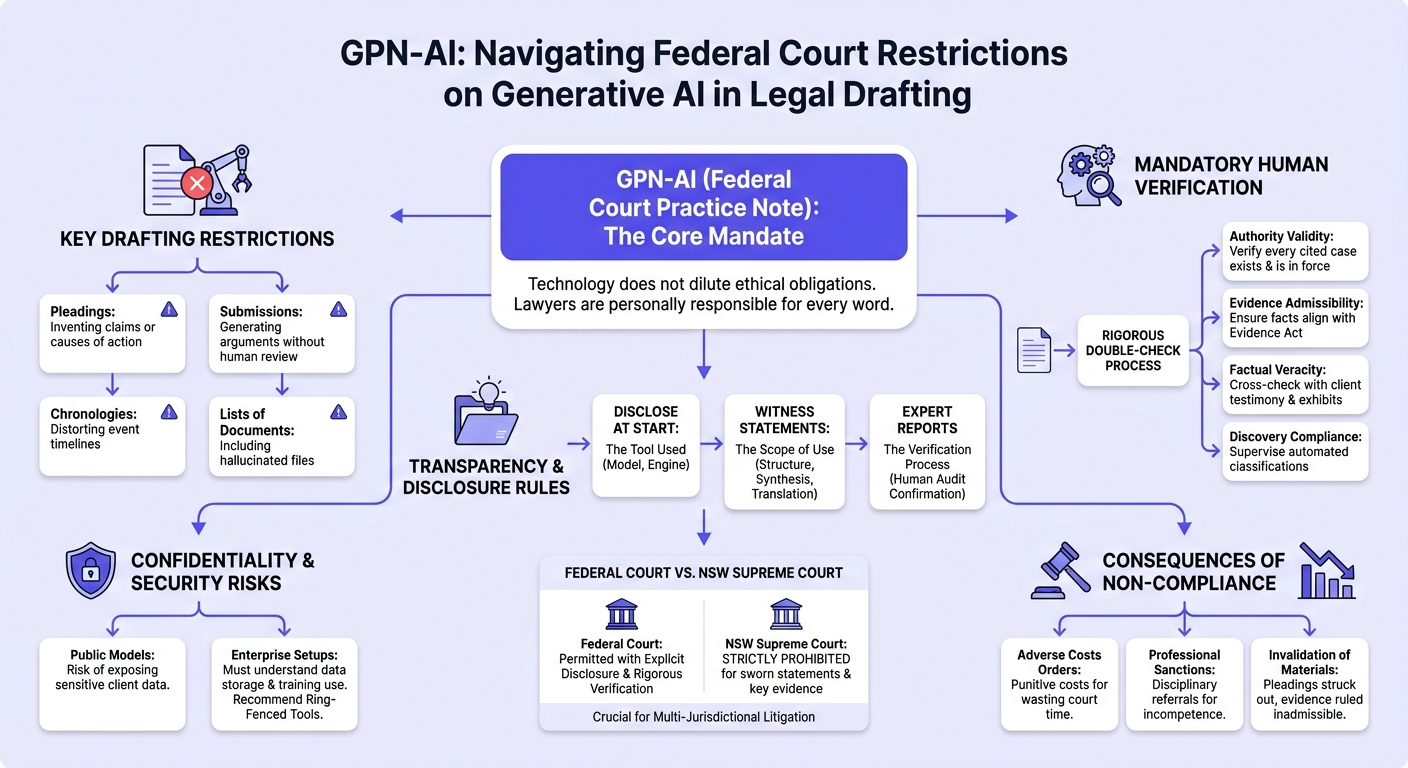
According to the official Federal Court GPN-AI guidelines, the Practice Note applies broadly to all litigation teams, corporate legal departments, and self-represented litigants. The core mandate states that existing professional obligations apply with equal force to AI-generated content.
The Court does not discourage the use of technology; in fact, it acknowledges that generative AI can facilitate the just and efficient resolution of disputes. However, the note establishes direct expectations for legal practitioners to exercise independent forensic judgment. AI may assist in synthesizing information, but technological literacy is now considered an essential component of professional competence in Australian litigation.
Key Restrictions on AI Legal Drafting
Under the gpn ai directive, the drafting of primary documents cannot be completely automated. The Court places strict boundaries on using AI tools for the following foundational filings:
- Pleadings: Generative AI cannot be used to invent claims or form causes of action without meticulous human assessment of the material layout.
- Submissions: Arguments generated by algorithms must be thoroughly reviewed to ensure they are logically sound and aligned with Australian case law.
- Chronologies: Generative frameworks often distort the timeline of events; hence, chronological facts must be cross-checked manually against primary evidence.
- Lists of Documents: Discovery inventories must not contain AI-hallucinated correspondence or non-existent files.

While legal practitioners can safely use advanced assistants to organize and structure their early thoughts, every single line of a final document must reflect the human author's independent judgment.
The Human Verification Mandate
The human verification mandate represents the core of the Court's regulatory framework. AI-generated legal text must be subjected to a rigorous "double-check" process. This requirement directly addresses the risk of "hallucinations," where generative AI tools fabricate realistic-sounding cases, judicial decisions, statutory provisions, or direct quotes.
Your litigation team must manually verify the following:
- Authority Validity: Every case cited must exist, be in force, and stand for the legal proposition associated with it.
- Evidence Admissibility: Generative tools do not understand the complex laws of evidence. Lawyers must verify that the facts embedded in AI-drafted text are admissible under the Evidence Act.
- Factual Veracity: Statements of fact must be personally scrutinized by the practitioner to ensure they align directly with actual client testimony, certified contracts, or physical exhibits.
- Compliance with Discovery Rules: Automated classifications within document review or lists must be supervised to avoid missing essential disclosures or inadvertently exposing privileged metadata.
Mandatory Transparency and Disclosure Rules
The Federal Court does not require disclosure for simple grammatical editing, but it mandates active transparency when generative AI plays a central role in producing affidavits, witness statements, expert reports, and initial evidence filings.
The disclosure must occur at the start of these documents and clearly convey:
- The tool used: Identifying the specific system, model name, and engine.
- The scope of use: Detailing whether the tool helped structure the text, synthesize historical witness notes, or translate materials.
- The verification process: Briefly confirming that a human practitioner independently audited the technical outputs for accuracy.
This ongoing disclosure requirement ensures that the judiciary, opposing counsel, and the jury are fully aware of any non-human assistance in generating the evidentiary record.
Confidentiality and Security Under GPN-AI
Legal professional privilege and client confidentiality remain paramount. The gpn ai note warns practitioners about the severe risks of entering sensitive client data, proprietary strategy, or suppressed court information into public artificial intelligence models.
Even when relying on commercial, private, or ring-fenced enterprise setups, litigation teams must understand exactly where their data is stored, processed, and whether it is being used to train subsequent foundation models. Firms must align their internal systems with strict standards, such as those outlined in HyperCounsel's Security Guidelines, to avoid exposing client records to external breaches or public repositories.
Consequences of Non-Compliance
Using unverified AI tools in the Federal Court of Australia carries heavy structural risks. The Court has broad powers to penalize behavior that compromises the administration of justice.
The consequences of failing to comply with gpn ai include:
- Adverse Costs Orders: Litigation teams or their clients may face punitive costs orders for wasting court time with fabricated citations or inaccurate filings.
- Professional Sanctions: The Court may refer negligent practitioners to relevant state legal boards (such as the Legal Practice Board) for disciplinary action, citing a lack of technological and professional competence.
- Invalidation of Materials: The Court can strike out pleadings, discard expert reports, or rule witness statements inadmissible if they are found to be produced without human oversight or appropriate disclosure.
Federal Court vs NSW Supreme Court: Major Differences
Australian law firms must navigate subtle differences across state and federal jurisdictions. While the Federal Court of Australia takes a flexible, disclosure-centric approach, other jurisdictions have enacted distinct boundaries.
For example, compare the positions of the Federal Court and the New South Wales (NSW) Supreme Court regarding affidavits:
- Federal Court of Australia: Permitted, provided there is explicit, transparent disclosure at the beginning of the affidavit or witness statement, combined with rigorous factual verification.
- NSW Supreme Court: Strictly prohibits the use of generative AI in drafting sworn statements, affidavits, and key evidence, viewing the practice as a direct violation of the mandatory human-input requirement of witness testifying. See the NSW Law Society Court Protocols for comparative updates on state-level actions.
Failing to adapt to these interstate variations can leave multi-jurisdictional litigators open to swift compliance failures.
How to Comply with GPN-AI Guidelines
To ensure your litigation practices remain fully aligned with Federal Court rules, corporate legal departments and law firms should implement a structured compliance framework.
| Step | Checklist Action | Frequency |
|---|---|---|
| 1. Source Verification | Manually cross-check every AI-drafted citation against official databases like AustLII. | Every Draft |
| 2. Maintain a Disclosure Log | Log every instance where AI-assisted drafting generates public filings or court-facing materials. | Per Case File |
| 3. Establish Secure Gateways | Use only enterprise-grade, ring-fenced generative models that guarantee absolute confidentiality. | Immediate |
| 4. Align Internal Protocols | Draft clean standard operating procedures detailing how junior lawyers verify and disclose AI outputs. | Quarterly |
Take the Next Step
Deploying advanced generative tools in court requires a structured approach to compliance. With HyperCounsel, Australian litigation firms gain access to tailored, enterprise-grade workflows designed to respect strict court protocols. Protect your firm from regulatory risk while unlocking superior drafting speeds over traditional manual processes.
Ready to implement safe, transparent, and court-compliant workflows? Book a Demo today to see our secure drafting environments in action, or check our straightforward Pricing models designed to scale alongside your litigation caseload.
This article provides general information and is not legal advice.
Frequently Asked Questions
Does GPN-AI ban the use of Generative AI in Federal Court documents?
No. The Federal Court of Australia does not ban generative AI. Instead, it permits its use provided that legal practitioners follow strict disclosure and verification protocols, ensuring human oversight is maintained.
When must I disclose my use of Generative AI in a legal filing?
You must disclose the use of generative AI when the technology has been used in a substantive capacity to draft or prepare evidence, expert reports, affidavits, and witness statements. Simple grammar and spelling checkers do not require disclosure.
Can I use AI to draft affidavits or expert reports in the Federal Court?
Yes, but you must include a transparent disclosure at the beginning of the document outlining the specific tool used and how you verified its output. Additionally, you must contrast this with the stricter rules in state courts, such as the NSW Supreme Court, which prohibits this practice.
What happens if I submit AI-generated material that contains false information?
Submitting fabricated cases or incorrect facts may lead to severe consequences, including adverse costs orders against your firm, the invalidation of filed documents, and disciplinary referrals for professional misconduct.