

Why Every Australian Practice Needs a Law Firm AI Policy: Governance, Supervision, and Risk Management
Learn how Australian law firms can build an effective AI policy to manage risk and compliance.
Artificial intelligence has rapidly transitioned from an experimental novelty to an indispensable tool in modern legal practice. Across Australian jurisdictions, law firms leverage generative models to draft correspondence, summarize complex discovery documents, and conduct preliminary research. However, the speed of technology adoption has outpaced formal internal controls, leaving many firms exposed to acute regulatory, ethical, and operational liabilities.
Without a comprehensive law firm ai policy, individual practitioners often rely on consumer-grade tools without realizing the risks to client confidentiality, legal professional privilege, and statutory privacy compliance. Recent industry findings indicate that 98% of Australian legal professionals use AI, but only 39% have embedded it into daily workflows backed by structured governance frameworks.
Bridging this governance gap is no longer optional. State regulators and law societies across New South Wales, Victoria, and Queensland have made it clear that existing ethical standards apply directly to artificial intelligence. Law firms must establish clear rules regarding permitted tools, human supervision, data security, and auditability to protect their clients and defend their practice reputation.
Table of Contents
- Quick Summary
- The AI Governance Gap in Australian Legal Practice
- Core Pillars of a Comprehensive Law Firm AI Policy
- Supervision Duties and Professional Conduct Obligations
- Data Privacy, Confidentiality, and External Models
- Audit Trails, Recordkeeping, and Billing Transparency
- Step-by-Step Implementation Framework
- Upgrade Your Firm's AI Governance Today
- Frequently Asked Questions
- Recommended
Quick Summary
| Takeaway | Explanation |
|---|---|
| Governance Imperative | Ad hoc AI usage introduces regulatory breaches; formal policies establish mandatory standards for daily practice. |
| Non-Delegable Duties | Solicitors retain non-delegable duties to review, verify, and validate all machine-generated content prior to delivery. |
| Privacy & Privilege | Unvetted AI tools can expose confidential information and trigger non-compliance with Australian Privacy Principles. |
| Audit Trails | Defensible practice requires maintaining detailed records of prompts, model outputs, and human verification steps. |
| Billing Integrity | Firms must ensure time billing accurately reflects human labor and transparently bill automated workflows. |
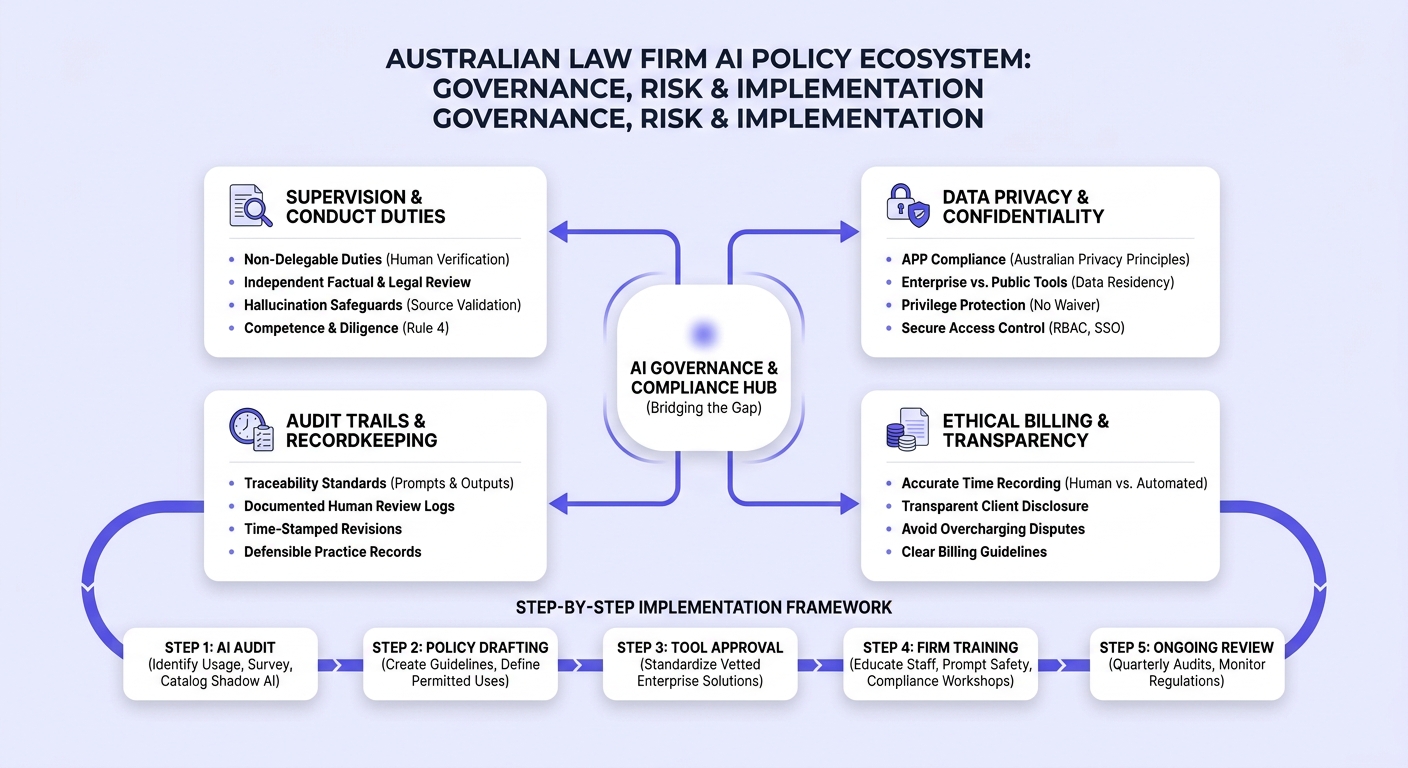
The AI Governance Gap in Australian Legal Practice
The primary risk confronting law firms today is unmanaged, informal AI usage—often termed "shadow AI." When associates and support staff use unauthorized public models to summarize client affidavits or draft commercial agreements, they expose sensitive material to external model training pipelines.
State regulatory bodies, including the Legal Services Board + Commissioner Victoria, have emphasized that the Legal Profession Uniform Law applies fully to generative tools. Solicitors cannot outsource professional judgment to algorithms, nor can they plead technical ignorance when an automated tool generates inaccurate citations or leaks confidential client data.
Implementing an enterprise-grade platform like HyperCounsel allows law practices to replace unsanctioned consumer tools with dedicated, secure environments that align directly with Australian professional conduct rules.
Core Pillars of a Comprehensive Law Firm AI Policy
A robust internal AI governance policy must balance practical productivity gains with rigorous risk mitigation. Rather than imposing an outright ban that drives usage underground, forward-thinking firms implement clear operational categories.

Permitted vs. Prohibited Use Cases
Your policy should explicitly define which legal tasks are suitable for automation and which require manual handling:
- Permitted Uses: First-pass legal research synthesis, initial drafting of standard correspondence, automated document comparison, internal workflow brainstorming, and non-sensitive administrative indexing.
- Restricted/Prohibited Uses: Uploading unredacted client identifying data to unapproved public tools, generating final submissions for court filings without verification, analyzing restricted evidentiary material, and automated decision-making on complex litigious strategy.
Escalation and Approval Workflows
Every practice group should have a designated AI lead or compliance partner. When a practitioner identifies a new use case or seeks to test a new automated platform, the policy must outline a straightforward approval process that reviews vendor security, data residency, and confidentiality safeguards.
Supervision Duties and Professional Conduct Obligations
Under Australian legal ethics, partners and supervising solicitors are strictly accountable for all work product delivered to clients or submitted to courts. AI tools must be treated with the same supervisory rigor as a newly qualified junior paralegal.
- Independent Verification: Every statutory reference, cited precedent, and factual statement generated by an AI tool must be independently confirmed against authoritative primary sources.
- Hallucination Safeguards: Generative systems can produce plausible yet entirely fabricated case law. A standard operating procedure must mandate source validation prior to filing.
- Competence and Diligence: Rule 4 of the Legal Profession Uniform Law Australian Solicitors' Conduct Rules requires practitioners to deliver legal services competently and diligently. Relying blindly on unverified machine outputs breaches these core duties.
Data Privacy, Confidentiality, and External Models
Protecting client confidentiality is central to the solicitor-client relationship. Uploading client details into consumer generative tools can waive legal professional privilege and violate statutory data privacy requirements under the Privacy Act 1988 (Cth).
Practitioners must understand how their chosen tools handle information in accordance with the Australian Privacy Principles.
| Risk Factor | Unmanaged Public AI Tools | Enterprise Governed Systems |
|---|---|---|
| Data Training | User inputs may be stored and used to train future public models. | Customer inputs and outputs are isolated and never used for foundation model training. |
| Data Residency | Data is frequently transferred across international cloud servers without domestic controls. | Firm data is encrypted at rest and in transit, respecting local regulatory standards. |
| Privilege Protection | Uploading details to third-party public platforms risks waiving legal professional privilege. | Enterprise contractual terms preserve client confidentiality and professional privilege. |
| Access Control | Open access accounts with no firm-wide role permissions. | Role-based access control (RBAC) and single sign-on (SSO) enforce internal confidentiality rings. |
Audit Trails, Recordkeeping, and Billing Transparency
A defensible legal AI workflow requires complete traceability. If a client or court questions how a particular document or advice was prepared, the firm must produce clear documentation of the process.
Traceability Standards
Firms should mandate that practitioners preserve:
- The exact prompts and source materials supplied to the tool.
- The raw output generated by the AI platform.
- The identity of the reviewing lawyer who validated the facts and law.
- Time-stamped logs of all human revisions before client delivery.
Ethical Billing Practices
Automated systems drastically reduce the time required to complete high-volume drafting and analysis tasks. When billing by time, firms must never bill automated processing time as manual lawyer hours. A well-constructed policy clarifies how automated tasks are recorded and billed, protecting the firm against overcharging disputes and regulatory scrutiny.
Step-by-Step Implementation Framework
Rolling out an effective AI policy across your firm requires structured execution, team education, and periodic auditing.
| Step | Objective | Primary Actions | Timeline |
|---|---|---|---|
| Step 1: AI Audit | Identify current usage | Survey fee earners, audit installed browser plugins, and catalog shadow AI tools. | Week 1–2 |
| Step 2: Policy Drafting | Create clear guidelines | Draft permitted use lists, supervision rules, and client disclosure requirements. | Week 3 |
| Step 3: Tool Approval | Standardize technology | Implement vetted enterprise AI solutions with enterprise-grade data security. | Week 4 |
| Step 4: Firm Training | Educate all staff | Conduct mandatory workshops on prompt safety, citation verification, and compliance. | Week 5 |
| Step 5: Ongoing Review | Maintain compliance | Audit prompt logs quarterly and review emerging state and federal court guidelines. | Ongoing |
By deploying reliable infrastructure through HyperCounsel, Australian law practices can confidently navigate compliance while providing faster, higher-margin client services.
Upgrade Your Firm's AI Governance Today
Navigating artificial intelligence in modern legal practice requires balancing high-speed efficiency with rock-solid compliance, risk management, and client confidentiality. Leaving AI usage unmanaged exposes your firm to severe ethical liabilities, regulatory scrutiny, and lost client trust.
HyperCounsel provides Australian law firms with a purpose-built, secure legal AI platform equipped with enterprise data privacy controls, complete auditability, and practical workflow templates. Protect your practice and empower your legal teams to deliver exceptional client outcomes.
Take control of your firm's AI strategy today by scheduling a consultation with our legal technology specialists:
- Book a Demo to see secure legal workflows in action.
- View Transparent Pricing designed for modern Australian law practices.
Take the Next Step
Ready to protect your business with expert legal support? Explore how HyperCounsel can help:
Frequently Asked Questions
Do Australian law firms need a formal AI policy before using generative AI?
Yes. Having a formal policy ensures all fee earners understand approved tools, data handling protocols, and verification standards. Regulators expect firms to maintain structured risk management controls whenever adopting new legal technologies.
What should a law firm AI policy cover in Australia?
An effective policy should define permitted and prohibited use cases, mandatory human supervision standards, client data redaction rules, external vendor vetting criteria, audit trail requirements, and clear billing guidelines.
How do supervision and human review obligations apply when lawyers use AI?
Under Australian professional conduct rules, solicitors maintain a non-delegable duty of competence. AI outputs must be treated like draft work from an unadmitted clerk: every citation, factual summary, and legal argument must be independently verified by a qualified lawyer.
What risks arise if a firm uses AI without audit trails or client disclosure controls?
Operating without audit trails leaves firms unable to defend against malpractice claims, verify citation integrity, or prove compliance during regulatory audits. It also increases the risk of inadvertent privilege waivers and inaccurate client billing.