

Legal-Specific AI vs General Copilots: How Tech Law Firms in Nigeria Should Choose the Right Research Stack
Learn how Nigerian tech law firms choose between general AI copilots and legal-specific tools.
The business landscape in West Africa is undergoing a rapid, digital-first transformation. To scale with this growth, pioneering tech law firms in nigeria are deploying artificial intelligence tools to handle complex transactions, manage massive document loads, and cut turnaround times.
A recent study indicates that 62% of legal industry leaders are currently piloting or integrating generative AI tools to streamline litigation prep, corporate filing, and research. However, Nigerian law practitioners face a critical crossroad: should they adopt generic AI tools like ChatGPT, or commit to dedicated, legal-specific platforms designed explicitly for case law and compliance?
Making the wrong decision can lead to serious compliance breaches, privacy violations, and costly inaccuracies. This guide provides a detailed roadmap to help your firm evaluate options, protect sensitive corporate data, and build an efficient, secure legal research stack.
Table of Contents
- The Core Evaluation: Legal-Specific AI vs. General Copilots
- Key Use Cases for Tech Law Firms in Nigeria
- Compliance, Data Privacy, and Professional Risks
- A Practical Framework for Selecting Your AI Stack
- How to Safely Pilot AI in Your Firm
- Accelerate Your Firm's Workflows Today
- Frequently Asked Questions
- Recommended
Quick Summary
| Takeaway | Explanation |
|---|---|
| General Copilots | Best for administrative drafting, brainstorming case outlines, and email summarizing, but prone to legal hallucinations. |
| Legal-Specific AI | Necessary for locating real case law precedents, drafting precision pleadings, and securing corporate data. |
| Data Protection Mandates | Firms must comply with the Nigeria Data Protection Commission rules by using enterprise-grade AI tools. |
| Verification Priority | General AI tools hallucinate fake cases, making verification against authoritative sources like the Supreme Court of Nigeria critical. |
| Optimal Setup | Combine low-cost general copilots for admin tasks with a premium dedicated platform like HyperCounsel for research and analysis. |
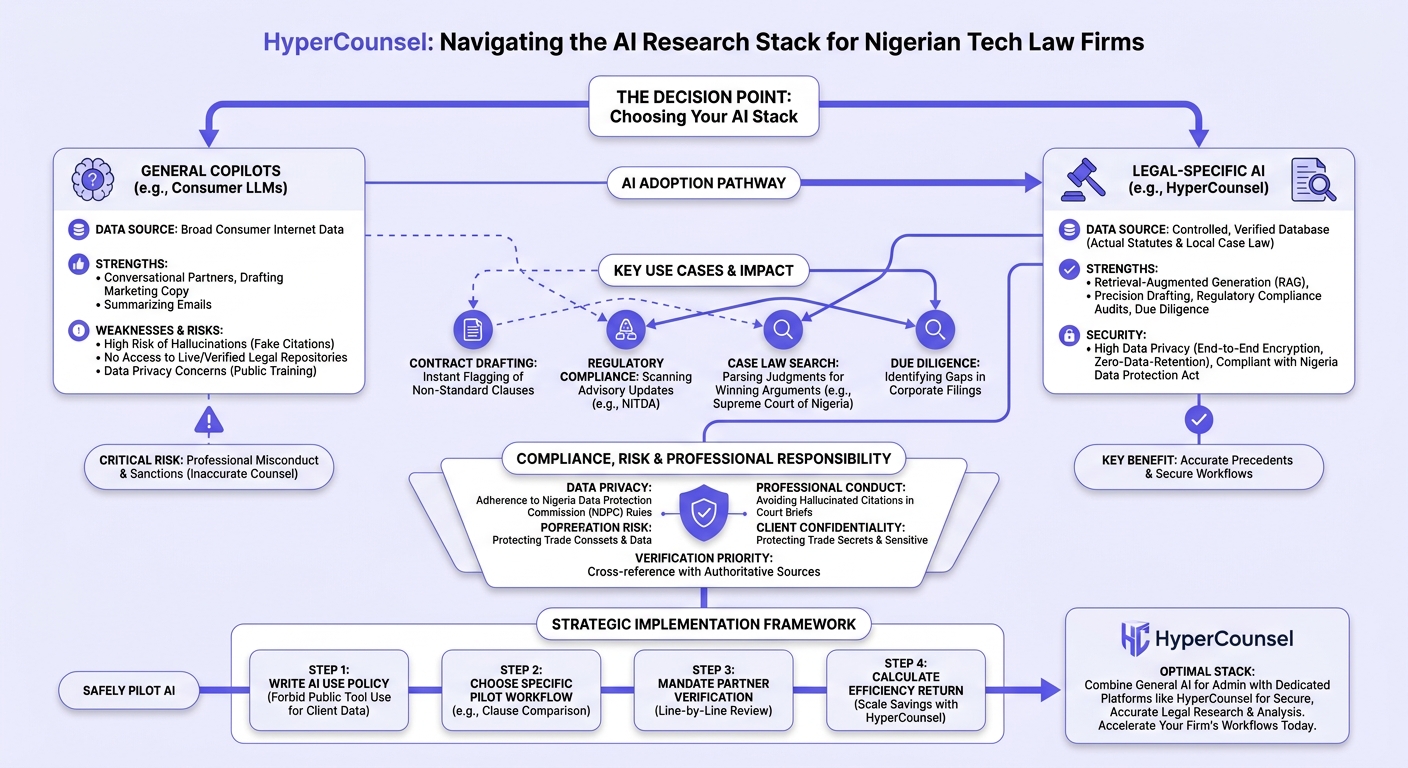
The Core Evaluation: Legal-Specific AI vs. General Copilots
To build a high-performing legal tech stack, partners and IT leaders must understand the fundamental engineering differences between general large language models (LLMs) and tools purpose-built for the law.
General Copilots
General copilots, including popular platforms like ChatGPT, Claude, and Gemini, are trained on broad consumer internet data. They act as exceptional conversational partners and copywriter. They excel at writing marketing copy, structure outlines for legal blog posts, and summarizing generic business emails.
However, they suffer from "hallucinations"—fabricating realistic-looking court citations and statutes out of thin air. They do not possess a live, structured repository of local regulations, making them dangerous for primary legal research.
Legal-Specific AI Platforms
Specialized platforms, such as HyperCounsel, leverage Retrieval-Augmented Generation (RAG). Instead of guessing the next word based on public consumer data, they first query a controlled, verified database of actual legal statues and local case law before generating an answer.
For a firm advising a high-growth startup, utilizing a legal-specific framework ensures that citations refer to real precedents. This workflow eliminates the need to manually double-check every single line of text against printed gazettes.
Key Use Cases for Tech Law Firms in Nigeria
Understanding exactly where AI fits into daily workflows allows law firms to realize immediate returns on investment.
- Contract Drafting and Review: Modern commercial practice requires drafting terms of service, software license agreements, and employment contracts. Legal AI platforms analyze standard templates and instantly flag non-standard indemnity clauses or unfavorable IP ownership rules.
- Regulatory Compliance Audits: Nigerian fintech and e-commerce companies operate under strict rules. Legal-specific search tools scan long advisory updates from regulatory bodies like the National Information Technology Development Agency and summarize changes that impact client operations.
- Case Law Search and Litigation Strategy: When preparing briefs for the Lagos or Federal High Court, AI can parse hundreds of old judgments to identify winning lines of argument in minutes rather than days.
- Due Diligence for Tech Mergers: When conducting high-risk due diligence, specialized AI can quickly organize and call out troubling gaps within corporate filings, shareholder agreements, or loan documents.
Compliance, Data Privacy, and Professional Risks
Adopting new software brings immediate data security and professional responsibility concerns that Nigerian firm operators cannot ignore.
Firms handling sensitive client data must keep the provisions of the Nigeria Data Protection Act top of mind. Uploading proprietary client software code, financial financials, or private identity documents to a public, consumer-facing AI engine is a direct violation of compliance laws. Consumer AI tools frequently use user prompts to train future iterations of their models, meaning your client's trade secrets could be exposed.
Additionally, rules of professional conduct dictate that lawyers must provide accurate, competent counsel. Submitting a brief containing a hallucinated citation to a Nigerian court is a severe breach of professional conduct that can ruin a firm's reputation and result in direct sanctions from the Legal Practitioners Disciplinary Committee.
A Practical Framework for Selecting Your AI Stack
When choosing between a general tool and a professional legal platform, evaluate software against these four essential pillars:
| Evaluation Criteria | General AI Copilot | Legal-Specific Platform |
|---|---|---|
| Data Security & Privacy | Low; data is often used for model training unless using corporate APIs. | High; end-to-end encryption with closed, zero-data-retention pipelines. |
| Search Accuracy | Variable; struggles with specific, localized statutory text. | High; strictly tied to verified primary sources and legislation. |
| Workflow Integrations | Limited; generally copy-and-paste into a web browser. | Advanced; integrates with existing document management systems. |
| Domestic Law Context | Weak; relies heavily on US/UK law datasets. | Tailored; addresses specific West African regulatory requirements. |
How to Safely Pilot AI in Your Firm
Rather than rolling out a new tool to fifty associates overnight, successful firms utilize structured sandboxes to manage systemic risk and measure performance.
- Step 1: Write an AI Use Policy: Expressly forbid staff from pasting personal client identifiers or unencrypted trade secrets into public tools.
- Step 2: Choose a Specific Pilot Workflow: Instruct one practice group (such as intellectual property or fintech regulatory advisory) to trial a legal-specific assistant for simple clause comparison.
- Step 3: Mandate Partner Verification: Ensure every document generated or summarized by AI is fully reviewed, line-by-line, by a senior attorney before it leaves the firm.
- Step 4: Calculate the Efficiency Return: Track how many billable hours associates save on mundane manual tasks, and use the HyperCounsel platform to scale those time savings across other practice groups.
Accelerate Your Firm's Workflows Today
To capture corporate market share, tech law firms must balance speed with ironclad security. General-purpose tools cannot guarantee the security, compliance, or accuracy required to advise venture-backed startups and multinational corporations. Specialized legal technology is no longer a luxury; it is the infrastructure modern firms need to compete globally.
By utilizing secure, legal-specific workflows, your firm can scale down manual research times while ensuring absolute compliance with data protection laws. Safeguard your client relationships, protect your firm's professional reputation, and deliver faster turnarounds with transparent pricing.

Ready to transform your practice? Book a Demo today to see how HyperCounsel can streamline your firm's administrative, research, and analysis tasks.
Take the Next Step
Ready to protect your business with expert legal support? Explore how HyperCounsel can help:
Frequently Asked Questions
What is the difference between legal-specific AI and a general copilot for lawyers?
Legal-specific AI tools use custom databases compiled of authentic laws, judgments, and legal codes. They utilize strict search parameters to eliminate citation errors. General copilots pull patterns from public web pages, which makes them highly creative but unreliable for finding precise, verified law.
Is a general AI copilot safe for Nigerian legal research?
No. General AI engines frequently fabricate precedents, statutes, and citations that look authentic but do not exist. To remain compliant, lawyers must cross-reference any general AI output with trustworthy local resources and court documents.
What should Nigerian law firms check before using AI with client data?
Firms must ensure that the software provider’s privacy policy guarantees that user inputs are not used to train the software's public model. The provider must comply with the provisions of the Nigeria Data Protection Act and maintain robust enterprise security measures.
When does it make sense to invest in a legal-specific research platform instead of a general AI tool?
Investing in a legal-specific platform is logical when your firm frequently handles commercial research, regulatory advisory, contract drafting, or dispute resolution. If your practice demands precise, verified legal sources and complete client confidentiality, general AI tools are not suitable.