

Nigeria Urgently Needs AI Regulatory Framework: How Tech Law Firms Must Adapt
Learn how Nigerian law firms can navigate upcoming AI regulations and ethical guidelines.
As artificial intelligence reshapes legal practice globally, in 2024, Nigeria published its National AI Strategy, which highlights crucial AI governance proposals including developing national AI principles and establishing an AI governance regulatory body to oversee rapid deployment. For forward-thinking tech law firms in nigeria, navigating this shifting landscape requires proactive compliance.
Without a single, unified AI statute, legal practitioners must piece together an ethical framework using existing directives, data protection mandates, and professional ethics guidelines. This article provides a comprehensive roadmap for lawyers seeking to protect their practices while leveraging modern artificial intelligence tools.
By employing advanced platforms like HyperCounsel, law practices can automate routine procedures dynamically while remaining perfectly compliant with regional and international rules.
Table of Contents
- The State of AI Regulation in Nigeria Today
- NBA 2024 Guidelines on Ethical Legal Tech
- The Draft National AI Strategy and Risk Categories
- Who Governs AI in Nigeria? The Overlapping Agencies
- Lessons from the EU AI Act
- The 2027 Urgency: Deepfakes, Disinformation, and Legal Integrity
- Blueprint: How Tech Law Firms in Nigeria Can Prepare Today
- Modernize Your Legal Practice with HyperCounsel
- Frequently Asked Questions
- Recommended
Quick Summary Table
| Takeaway | Explanation |
|---|---|
| Status of AI Law | No single AI Act exists yet; relies heavily on the NDPA 2023 and sectoral regulations. |
| NBA 2024 Guidelines | Mandates strict human-in-the-loop oversight, data privacy preservation, and disclosure. |
| Risk Classification | The draft National AI Strategy divides systems into economic, ethical, societal, and model risks. |
| 2027 Urgency | Upcoming elections demand frameworks to combat AI deepfakes and disinformation. |
| Firm Action Plan | Implement Data Protection Impact Assessments (DPIAs) and strict governance audits. |
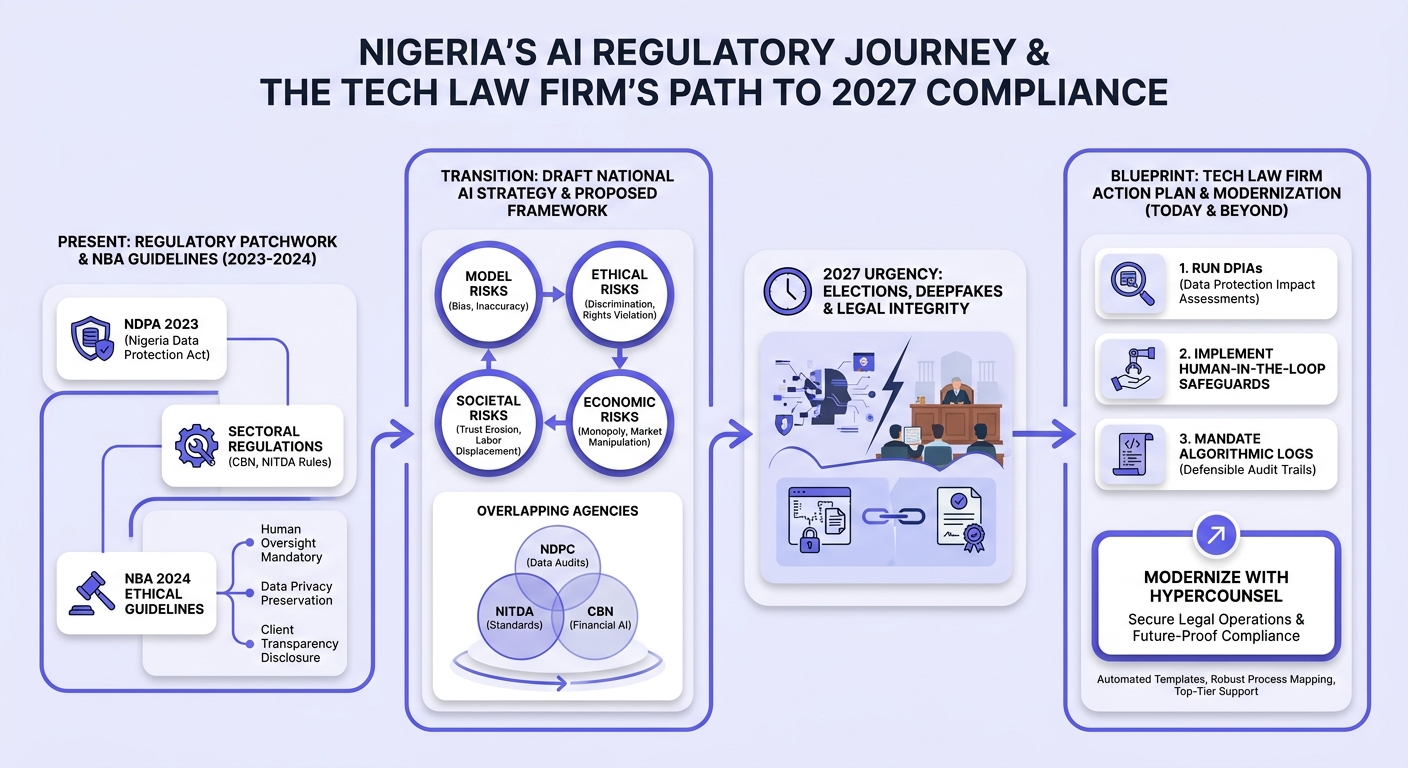
The State of AI Regulation in Nigeria Today
Currently, Nigeria lacks a dedicated, enacted "AI Act." Instead, regulatory oversight relies on a patchwork of existing consumer protection, intellectual property, cybercrime, and privacy laws. According to Nemko's AI regulatory guide, the country primarily uses the Nigeria Data Protection Act (NDPA) of 2023 to manage the automated processing of personal information.
This means that any automated algorithms deployed by legal practices must conform to strict limits on profiling, automated decision-making, and client data handling.
For tech law firms in nigeria, legal tech tools cannot operate as black boxes. If an algorithm processes client data to draft contracts or predict case outcomes, firms must ensure that the vendor complies with local privacy frameworks.
NBA 2024 Guidelines on Ethical Legal Tech
The Nigerian Bar Association (NBA) introduced clear guidelines in 2024 regarding the ethical adoption of legal technologies. As outlined by the White & Case AI regulatory tracker, the NBA requires absolute transparency and accountability.
There are three pillars to the NBA's stance on ethical legal tech:
- Human Oversight: Machine output must always undergo thorough review by a qualified Nigerian lawyer before being delivered to a client.
- Data Privacy Preservation: Legal tools must not expose confidential case files or client communications to open LLM training sets.
- Client Transparency: Under ethical standards, tech law firms in nigeria must disclose when artificial intelligence has substantially assisted in preparing legal products.
The Draft National AI Strategy and Risk Categories
Under the oversight of the Federal Ministry of Communications, Innovation and Digital Economy, Nigeria has actively developed its draft National AI Strategy (NAIS). This document outlines four specific risk categories designed to safe-keep national interests and model integrity:
- Model Risks: Technical failure, algorithmic inaccuracies, and biased training data.
- Ethical Risks: Discriminatory outputs that violate constitutional fundamental rights.
- Societal Risks: Widespread trust erosion, labor displacement, and digital inequality.
- Economic Risks: Market manipulation, digital monopolies, and unauthorized data exploitation.
Firms must understand these risks when integrating external digital platforms into corporate workflows.
Who Governs AI in Nigeria? The Overlapping Agencies
Without a single central oversight commission, regulatory compliance is managed by several overlapping governmental agencies. Security, compliance, and legal professionals must continuously monitor these organizations' rulings.
| Agency | Primary Mandate | AI Oversight Role |
|---|---|---|
| NDPC | Enforces the Nigeria Data Protection Act 2023. | Oversees data audits, user consent, and DPIAs for legal automation. |
| NITDA | Information technology development & baseline digital systems. | Drafts national frameworks, guidelines, and technical standards. |
| CBN | Financial sectors and fintech policy directives. | Controls automated algorithmic underwriting and financial risk modeling. |
Lessons from the EU AI Act
To build a reliable statutory legal structure by 2027, draft legislation like the National Artificial Intelligence Commission Bill is widely looking to the European Union (EU) AI Act.
As detailed by the IAPP's report on Nigeria's AI regulation, modeling regulatory frameworks on a risk-based approach allows local law to scale efficiently.
This model categorizes software into Unacceptable Risk (banned), High Risk (regulated strictly), Limited Risk (transparency mandatory), and Minimal Risk (unregulated). Tech law firms in nigeria can borrow these exact standards now to audit their internal tech stacks.
The 2027 Urgency: Deepfakes, Disinformation, and Legal Integrity
With political campaigns leading up to the 2027 national elections, the risk of sophisticated deepfakes and automated disinformation campaigns is unprecedented. Synthetic media can easily disrupt economic stability, deceive voters, and call the legitimacy of critical evidence into question.
For legal professionals, this timeline means that digital evidence verification protocols will undergo massive transformations. Courts and litigators must quickly establish baseline standards of cryptographic proof, chain-of-custody tracking, and forensic auditing to confirm client document authenticity.
Blueprint: How Tech Law Firms in Nigeria Can Prepare Today
Tech law firms in nigeria do not need to wait for national statutes to secure their practice. By preparing a solid, proactive internal framework, firms can adopt legal operations technology securely.

Use these three critical steps to protect your practice and demonstrate market leadership:
- Run Data Protection Impact Assessments (DPIAs): Conduct comprehensive reviews of every external legal tool to verify where server databases reside and how data is handled.
- Implement Human-in-the-Loop Safeguards: Establish a strict internal policy ensuring no AI-generated brief, memo, or contract leaves the office without human oversight.
- Mandate Algorithmic Logs: Keep verified operational records of systems utilized, queries submitted, and risk analyses performed, building a defensible paper trail.
By relying on professional services ecosystem partners like HyperCounsel, firms can streamline operations without sacrificing institutional security or ethical integrity.
Modernize Your Legal Practice with HyperCounsel
Building a secure, compliant, and forward-looking law firm requires cutting-edge tools and predictable technology. With HyperCounsel, you gain access to modern legal service templates, robust process mapping, and top-tier compliance support designed specifically for modern legal professionals. Protect your practice, build institutional trust, and future-proof your workflows before the 2027 regulatory landscape shifts.
Ready to position your practice at the forefront of legal technology?
- Book a Demo to see how clean legal technology transforms practice management.
- Explore Pricing to find transparent, fixed-pricing packages tailored to your scale.
Take the Next Step
Ready to protect your business with expert legal support? Explore how HyperCounsel can help:
Frequently Asked Questions
Why does Nigeria urgently need an AI regulatory framework by 2027?
Increasing capabilities in synthetic media, coupled with the upcoming 2027 national elections, leave the legal system vulnearble to AI-fueled disinformation and deepfakes. Nigeria needs a dedicated framework to secure institutional trust, regulate modern technologies, and standardize digital verification methods in court.
What are the NBA's 2024 guidelines for AI use in the legal profession?
The Nigerian Bar Association mandates strict human-in-the-loop oversight, data privacy preservation, and disclosure. Under these standards, no technology can replace professional attorney judgment, client confidentiality must be actively protected, and automated legal drafting remains subject to mandatory disclosure.
How does Nigeria's current AI regulation compare to the EU AI Act?
Nigeria currently relies on general privacy and cybercrime legislation like the NDPA 2023, whereas the EU utilizes a unified, risk-based statutory layout. However, Nigeria's upcoming draft proposals, including the National AI Strategy, heavily mirror the EU's hierarchical risk definitions.
What role does the Nigeria Data Protection Commission (NDPC) play in AI governance?
The NDPC enforces legal data compliance. Since modern algorithmic tools process vast datasets, the agency supervises mandatory audits, data processing conditions, and Data Protection Impact Assessments (DPIAs) to protect user rights against automated classification and bias.