

Homegrown AI for Tech Law Firms in Nigeria
Learn how Nigeria's 2026 tax reforms incentivize law firms to build local legal tech.
Nigeria's tech ecosystem is rapidly maturing, and law firms are no longer just advisors—they are builders. With the newly enacted tax reforms, forward-thinking tech law firms in nigeria are transitioning from traditional practice models to active legal software development.
A paradigm shift is underway that will redefine professional practice. Over 3,000 Nigerian startups qualify for small company exemptions under the 2025 Tax Reform Act, simplifying complex compliance barriers and clearing a fast path for legal tech innovation.
By building localized legal technology products, smart law firms are structuralizing new subsidiaries to bypass traditional professional service tax exclusions and claim lucrative corporate incentives. This guide explores how your firm can leverage these tax breaks, using solutions like HyperCounsel to transform how you deliver legal services.
Table of Contents
- Quick Summary
- The 2026 Tax Shift: Lower CIT and Professional Exclusions
- Unlocking Startup Act Benefits and the 5% Economic Development Tax Credit
- Navigating the Compliance Risks: CGT, Filings, and the Development Levy
- Step-by-Step Transition Guide for Law Firms
- Take the Next Step
- Frequently Asked Questions
- Recommended
Quick Summary
| Takeaway | Explanation |
|---|---|
| CIT Base Reduction | Corporate Income Tax (CIT) drops from 30% to 25% by 2026, dropping overall operational liabilities. |
| Professional Services Trap | Traditional law offices are explicitly excluded from the ₦100M small company exemptions unless they spin off a registered tech entity. |
| Startup Act Benefits | Qualifying tech-focused law entities gain 4-year tax holidays, CGT relief, and full research and development (&D) expense deductibility. |
| New Single Tax Portal | Mandatory online portals utilizing a single Tax Identification Number (TIN) streamline filing for VAT, WHT, and other levies. |
| The 5% Tax Credit | A 5% economic development tax credit actively offsets capital expenditures spent building priority-sector legal software. |
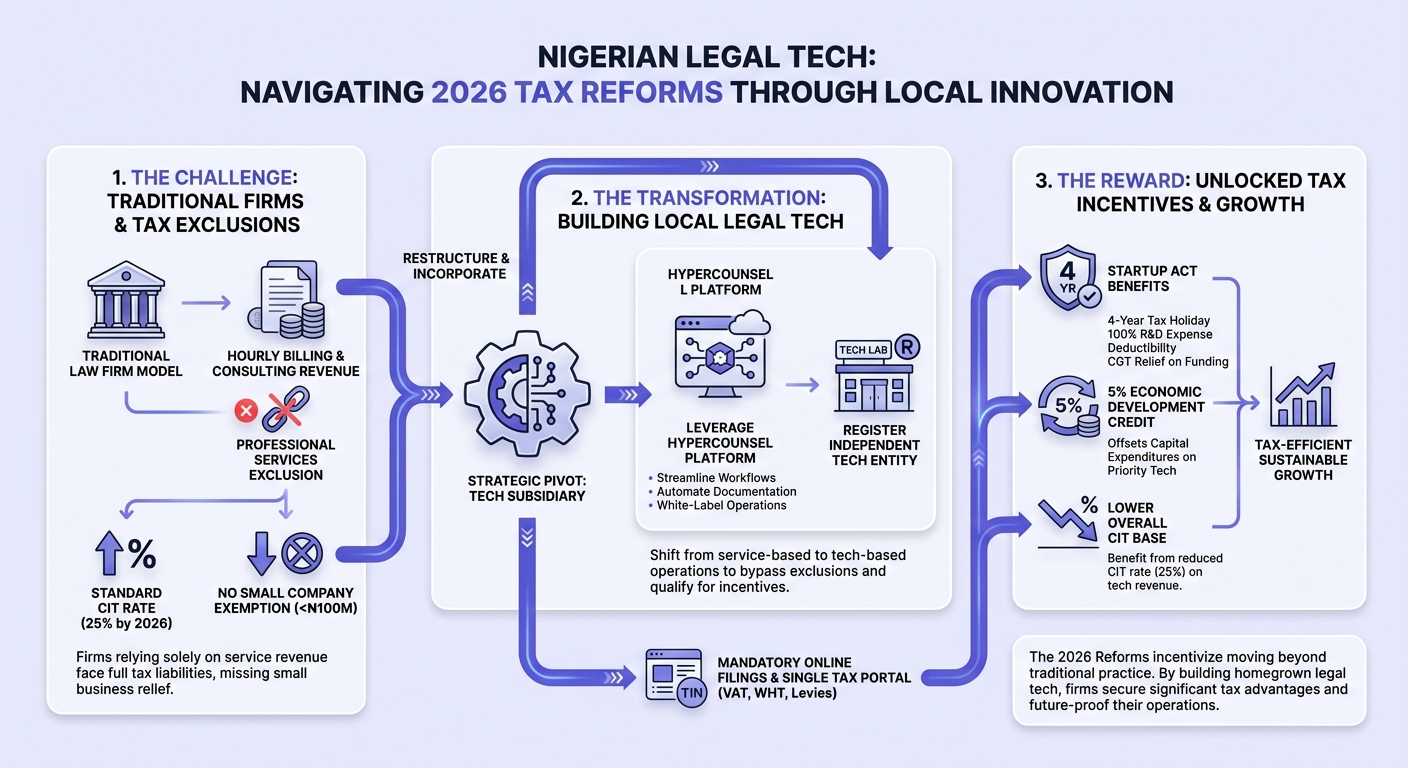
The 2026 Tax Shift: Lower CIT and Professional Exclusions
The landmark Tax Reform Act in Nigeria reduces the standard Corporate Income Tax (CIT) rate from 30% to 27.5% in 2025, landing at a historic low of 25% by 2026. While designed to spark national economic health, this tax relief specifically targets companies building technology and priority initiatives.
Why Standard Law Firms Miss the Small Company Exemption
To support micro-enterprises, the reform grants full corporate income tax exemptions to small companies earning under ₦100M in revenue. However, PwC research on Nigeria's individual and corporate developments highlights a critical catch: professional service firms, including traditional law practices, are explicitly excluded from these small business exemptions.
If your firm generates revenue exclusively through hourly consulting and direct billable hours, you will continue facing full corporate tax rates regardless of your annual revenue.
The Solution: Building Legal Tech Products
To bypass these strict professional exclusions, innovative tech law firms in nigeria are restructuring. By spinning off independent legal tech subsidiaries to design localized software, firms pivot from service-based exemptions to tech-based tax credits.
Partnering with workflow platforms like HyperCounsel allows firms to rapidly establish internal systems that build, host, and white-label operations, laying the groundwork to register as an independent tech business.
Unlocking Startup Act Benefits and the 5% Economic Development Tax Credit
Transitioning to a legal tech model allows your spun-off legal entity to tap into the powerful frameworks established by the Nigeria Startup Act.
By formalizing your technology wing as a labeled startup, you unlock massive competitive advantages:
- 4-Year Tax Holiday: Qualifying tech products secure complete relief from corporate income taxes for up to four years.
- R&D Expense Deductibility: 100% of the funds your firm invests in researching, prototyping, and deploying your localized AI or digital portals can be deducted from tax obligations.
- Economic Development Credit: Under latest amendments, a new 5% economic development tax credit applies immediately to capital expenditures in priority technology development.

Navigating the Compliance Risks: CGT, Filings, and the Development Levy
While these incentives offer immense room for growth, they come with aggressive compliance guidelines. Transitioning requires careful strategic planning to prevent penalties.
The Capital Gains Tax Tripling
Exit and liquidation strategies are significantly changed. Corporate Capital Gains Tax (CGT) has tripled from 10% to 30%, altering how tech platforms must calculate growth or acquisition gains. Law firms planning on packaging and selling customized tech must rely on Startup Act CGT waivers to shield investor payouts.
The Simplified 4% Development Levy
Broadening the tax base, the reform replaces highly fragmented local and state taxes with a single, unified 4% Development Levy. This change heavily reduces structural compliance costs, providing a predictable environment for growing software portals.
Mandatory Online Filings
Say goodbye to manual paperwork. All modern tax filings—ranging from Value Added Tax (VAT) and Withholding Tax (WHT) to local developmental levies—must now run through unified online systems using a singular TIN.
Step-by-Step Transition Guide for Law Firms
Developing homegrown tools does not require millions in custom software costs. Law firms can seamlessly execute this transition by taking a modular approach.
| Step | Action Item | Regulatory Alignment |
|---|---|---|
| 1 | Incorporate a Tech Subsidiary | Register a separate, technology-centric LLC focused purely on digital products. |
| 2 | Deploy Workflows | Leverage HyperCounsel to streamline firm billing, contract management, and localized document automation pipelines. |
| 3 | Secure a Startup Label | Submit the technology subsidiary's application to the Nigeria Startup Act digital portal for verification. |
| 4 | Link Singular TIN Accounts | Consolidate tax tracking on the mandatory online tax portal to claim R&D deductions and the 5% economic credit. |
Take the Next Step
Building homegrown legal tech tools holds the key to tax-efficient operational growth. Navigating this compliance shift while preparing specialized legal tech systems demands efficiency, precision, and reliable platforms designed for the legal market.
With HyperCounsel, your firm can deploy enterprise-grade automation systems designed for growing legal workflows. Protect your operating margins, automate complex documentation, and build the structural framework necessary to qualify for Nigeria's 2026 tech incentives with transparent, fixed pricing.
We help your practice leverage advanced technology without the burden of custom development delays. Ready to transform your law firm? Book a Demo today or explore our Pricing strategies to align your software architecture with incoming tax breaks.
This article provides general information and is not legal advice.
Frequently Asked Questions
Are Nigerian law firms eligible for small company tax exemptions under the 2025 Tax Reform Act?
No. Traditional professional services, including standard law firms, are explicitly excluded from the small company exemption (which applies to businesses generating under ₦100M revenue). To qualify, law firms must spin off separate, dedicated technology subsidiaries.
What Startup Act benefits apply to law firms building local legal tech in Nigeria?
By establishing a verified technology subsidiary, a firm can claim 4-year corporate tax holidays, full deduction of design and R&D costs, and significant Capital Gains Tax relief for funding partners.
How does the 5% economic development tax credit work for technology-based legal solutions?
This credit directly offsets a company's tax liabilities based on capital expenditures spent acquiring, building, or implementing priority technologies such as proprietary AI systems.
Is professional service still excluded from small company exemptions if the firm develops tech products?
Yes, the legal firm itself remains categorized under professional services and is excluded. However, the newly formed technology subsidiary operates independently and can claim standard startup tax incentives.