The Consent Wall: Why Copyright Law Rejections Limit AI Training in Legal Tech Australia
Australia's AI copyright stance forces legal tech firms to secure direct licenses.
Developing artificial intelligence is the modern frontier of information science, but building automation tools in the legal tech australia space faces a major statutory roadblock. The Australian government has closed the door on the regulatory shortcuts that international developers take for granted.
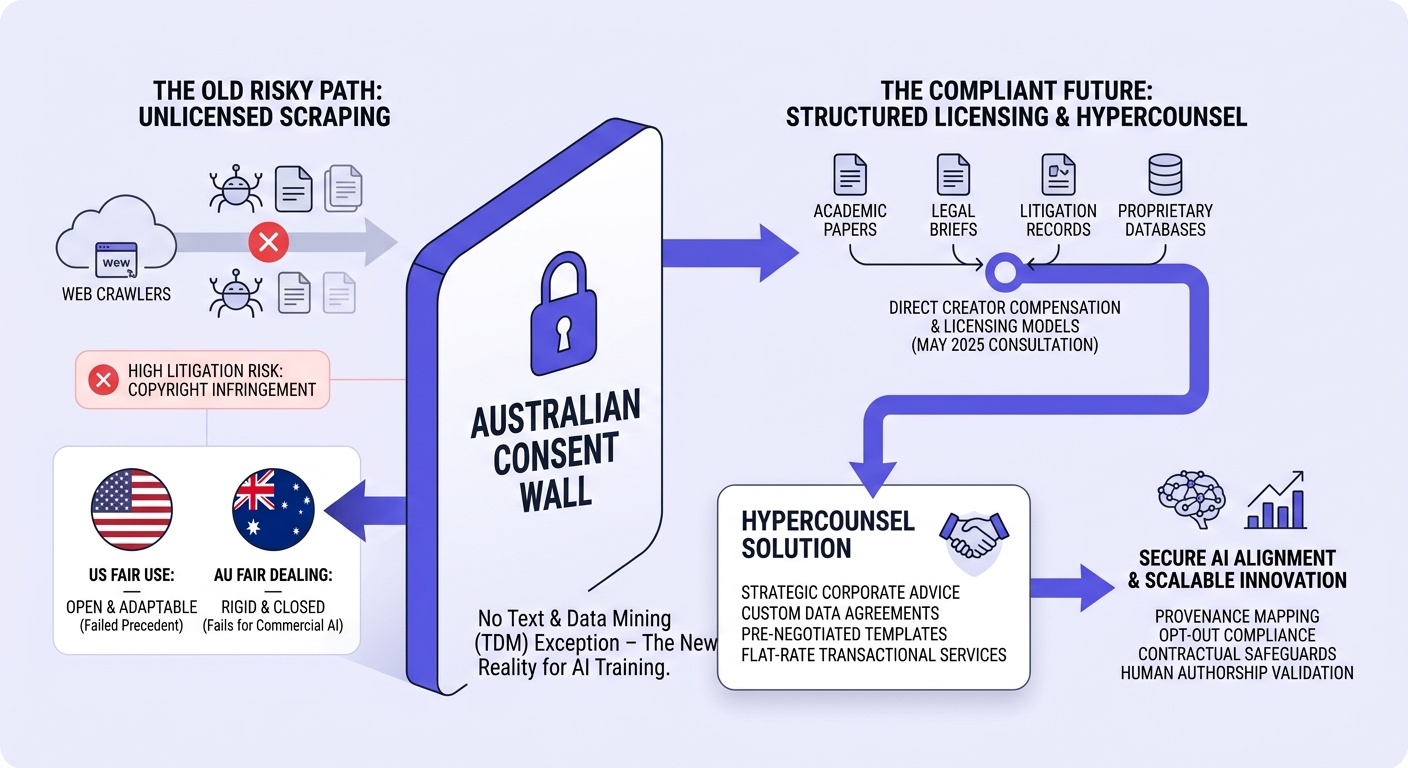
In a significant blow to commercial scraper models, the Australian Attorney-General's office confirmed that Australia will not introduce a text and data mining (TDM) exception to its copyright framework. Instead, the government is prioritizing fair terms of use and mandatory licensing models to protect content creators. This policy choice erects a sudden "consent wall" around data acquisition.
For legal tech founders, solo practitioners, and corporate legal departments, training AI models using unlicenced local litigation records, academic papers, or proprietary databases now exposes organizations to immense litigation risks. Understanding how to climb this consent wall safely is the only path forward for Australian legal innovation.
Table of Contents
- Quick Summary
- The TDM Rejection: Australia’s Concrete Stop Sign
- Fair Dealing vs Fair Use: Why the US Precedent Fails Here
- The May 2025 Consultation and Creator Compensation Models
- Risk Factors and Practical Compliance for Legal Tech Firms
- Solving the Data Licensing Bottleneck with HyperCounsel
- Secure Your AI Alignment
- Frequently Asked Questions
- Recommended
Quick Summary
| Takeaway | Explanation |
|---|---|
| No TDM Exception | High-level ruling out of a Text and Data Mining exception means scraping copyrighted data without permission remains illegal. |
| No Multi-Factor Fair Use | Unlike the US, Australia does not possess an open-ended fair use defense for commercial training. |
| High Litigation Risk | Unauthorized data copies used in model training can trigger copyright infringement lawsuits and regulatory fines. |
| Licensing Demands | Developers must build formal, compensated licensing pathways with data creators and rights holders. |
| Proactive Compliance | Transitioning to white-labeled databases and clear provenance mapping prevents operational downtime. |
The TDM Rejection: Australia’s Concrete Stop Sign
For years, technology developers lobbied the federal government for exceptions to the Copyright Act 1968 that would allow unauthorized scanning and automated analysis of digital works. However, the Attorney-General's firm stance, backed by statements on Australia's latest AI copyright announcements, has definitively ruled out any text and data mining exception.
This decision changes the dynamics of AI development in Australia. In countries with permissive TDM laws (such as Japan or parts of the EU under modified academic conditions), AI systems scrape web data freely to build semantic structures. In contrast, Australia's lack of a TDM exception creates a strict boundary:
- Reproduction equals infringement: Simply copying digital material to a local hard drive or cloud environment for training purposes constitutes reproducing the work, which requires explicit authorization.
- The "consent wall" is total: Without statutory carve-outs, developers must negotiate permissions directly with authors, licensing organizations, or publishers.
- Lack of safe harbors: Standard cloud providers and infrastructure systems do not shield commercial developers from direct or contributory copyright infringement claims.
Fair Dealing vs Fair Use: Why the US Precedent Fails Here
In the United States, case law like Bartz v. Anthropic has offered major tech companies a degree of protection under the broad "fair use" doctrine. US courts often conclude that copying millions of books or articles to build abstract mathematical weights represents a transformative, internal utility.
As analyzed in detail by Ashurst on AI training vs. copyright, this US framework does not exist under Australian law. Australia relies on a rigid "fair dealing" model defined by strict statutory purposes:
- Research or study
- Criticism or review
- Parody or satire
- Reporting news
- Providing professional advice by a legal practitioner or patent attorney
If your copying process does not fall precisely into one of these buckets, it is legally indefensible. Commercial developers training specialized AI tools cannot rely on the "legal advice" exception to scrape legal briefs, contract templates, or court materials. Doing so constitutes commercial usage outside of personal legal practice, completely bypassing the defensive scope of fair dealing.

The May 2025 Consultation and Creator Compensation Models
The federal government has established the Copyright and AI Reference Group, with key consultations running through May 2025. These dialogues aim to build frameworks for "fair terms of use" and realistic compensation packages for creators. Rather than opening the floodgates to free data collection, the consensus points to structured remuneration.
An elite precedent exists in the creative arts space context. Australian technology flagship Canva led the charge with its "Creator Compensation Program." This program distributes cash to designers who opt-in to let Canva’s internal generative systems learn from their designs.
For legal tech australia platforms, this signals a shift in operational mechanics. Startups and enterprise firms must move away from public-domain scraping and pivot to building structured, opt-in databases with structured commission payouts or subscription revenues for authors of legal briefs, articles, and legal documents.
Risk Factors and Practical Compliance for Legal Tech Firms
Operating an unvetted AI pipeline exposes developers, law firms, and tech platforms to systemic risk. Below is a comparison detailing how different data collection approaches stack up under current Australian regulations:
| Framework | Risk Level | Underpinning Requirement | Advice for Legal Tech |
|---|---|---|---|
| Web Scraping (Unlicensed) | High | Explicit copyright holder consent is missing. | Avoid immediately; cease training on local private data indices. |
| Open-Source Databases | Medium | Variable license terms (some forbid commercial AI use). | Audit metadata carefully; exclude non-commercial (NC) licenses. |
| Direct Syndication | Low | Commercially negotiated API and dataset licensing. | Secure clear indemnity from publisher partners. |
| Synthetic Data Generation | Low | Derived from certified public domain or proprietary inputs. | Maintain precise logs of the seed models to prove origin. |
To satisfy regulatory standards, Australian legal tech operations should implement the following engineering and policy checklist:
- Source Provenance Mapping: Document the original source of all data records used in neural networks.
- Opt-Out Compliance: Respect standard web exclusions like robots.txt and user-agent blocking strictly.
- Contractual Safeguards: When using third-party vendor APIs, demand explicit warranties that their models were trained on authorized data.
- Human Authorship Validation: Remember that purely AI-generated text has weak or non-existent copyright protections in Australia. Ensure human practitioners review and update localized templates to maintain clean IP ownership.
Solving the Data Licensing Bottleneck with HyperCounsel
Navigating Australia’s copyright laws while scaling a technology platform or upgrading automated processes requires deep compliance expertise. The conventional billable-hour model from legacy law firms often introduces unpredictable delays, creating friction precisely when developers need speed.
This is where HyperCounsel changes the game. By supplying strategic corporate advice and structured legal operations, HyperCounsel enables tech firms and enterprise law offices to design, execute, and scale custom data licensing agreements without friction.
Through pre-negotiated templates, clear intellectual property advice, and flat-rate transactional services, HyperCounsel clears the path for artificial intelligence in legal practice, providing certainty and transparent costs at every step.
Secure Your AI Alignment
Do not let licensing roadblocks or complex copyright structures stall your product development. Safeguard your intellectual property and construct compliant, scalable data pipelines with confidence.
With HyperCounsel, you get fixed-price legal support tailored for technology-driven firms. Simplify your commercial contracts, resolve your copyright questions, and scale in Australia safely.
Discover how we can secure your data assets. Book a Demo or explore our options on our Pricing Page to find the ideal compliance plan for your firm.
This article provides general information and is not legal advice.
Take the Next Step
Ready to protect your business with expert legal support? Explore how HyperCounsel can help:
Frequently Asked Questions
Does Australia have a Text and Data Mining (TDM) exception for AI training?
No. The Australian government and the Attorney-General have explicitly ruled out introducing a TDM exception to the Copyright Act. Any digital reproduction of copyrighted works for model training requires direct approval from the copyright holder.
Can legal tech firms in Australia use copyrighted material for AI training without permission under "fair use"?
No. Australia does not use the open-ended US "fair use" doctrine. It uses a narrow "fair dealing" exception limited to specific categories, none of which cover unauthorized, large-scale commercial database scraping.
What happens if an Australian legal tech firm scrapes documents from the web to train an AI model?
Scraping web data to build a local training database creates unauthorized digital reproductions. This exposes the firm to active copyright infringement claims, statutory damages, injunctions, and significant reputational damage.
How does Australia's "fair dealing" defence differ from the US "fair use" standard for AI training?
US "fair use" is an open, four-factor test that can adapt to digital tools. Australia's "fair dealing" standard is a rigid, closed-list system. Unless the act falls strictly under categories like criticism, news reporting, private study, or physical legal advice, it is considered infringement.